

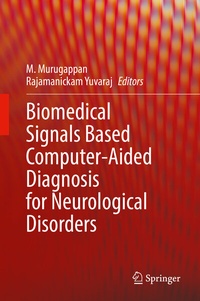
Biomedical Signals Based Computer-Aided Diagnosis for Neurological Disorders
Description

Biomedical signals provide unprecedented insight into abnormal or anomalous neurological conditions. The computer-aided diagnosis (CAD) system plays a key role in detecting neurological abnormalities and improving diagnosis and treatment consistency in medicine. This book covers different aspects of biomedical signals-based systems used in the automatic detection/identification of neurological disorders. Several biomedical signals are introduced and analyzed, including electroencephalogram (EEG), electrocardiogram (ECG), heart rate (HR), magnetoencephalogram (MEG), and electromyogram (EMG). It explains the role of the CAD system in processing biomedical signals and the application to neurological disorder diagnosis. The book provides the basics of biomedical signal processing, optimization methods, and machine learning/deep learning techniques used in designing CAD systems for neurological disorders.
More details
Other editions
Additional editions
Persons
Content
1. Abnormal EEG detection using time-frequency images and convolutional neural network..- 2. Physical action categorization pertaining to certain neurological disorders using machine learning based signal analysis.- 3. A comparative study on EEG features for neonatal seizure detection..- 4. Hilbert huang transform (HHT) analysis of heart rate variability (HRV) in recognition of emotion in children with autism spectrum disorder (ASD).- 5. Detection of tonic-clonic seizures using scalp EEG of spectral moments..- 6. Investigation of the brain activation pattern of stroke patients and healthy individuals during happiness and sadness.- 7. A novel parametric non-stationary signal model for EEG signals and its application in epileptic seizure detection.- 8. Biomedical signal analysis using entropy measures: A case study of motor imaginary BCI in end-users with disability.- 9. Automatic detection of epilepsy using CNN-GRU hybrid model.- 10. Catalogic systematic literature review of hardware-accelerated neurodiagnostic.- 11. Wearable Real-time Epileptic Seizure Detection and Warning System.- 12. Analysis of Intramuscular Coherence of Lower Limb Muscles Activities using Magnitude Squared Coherence.
