

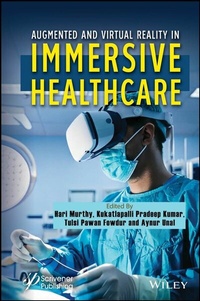
Augmented and Virtual Reality in Immersive Healthcare
Description

Future-proof your medical expertise with this indispensable guide that offers a comprehensive, expert-led exploration of how Augmented and Virtual Reality (AR/VR) are revolutionizing healthcare.
Augmented reality (AR) and virtual reality (VR) have profoundly impacted the healthcare sector, introducing ground-breaking applications ranging from surgical simulations and pain management to mental health therapies and patient education. This book delves into the various applications of AR and VR, including deep learning, surgical training, teleconsultation, and patient rehabilitation. By blending theoretical insights with practical case studies, it provides a deeper understanding of how these technologies are being integrated into medical practices to improve outcomes, enhance patient care, and train healthcare professionals. It also explores cutting-edge developments, such as AI-powered AR systems and VR-based mental health treatments, highlighting the future of healthcare innovation. With contributions from leading experts in healthcare, technology, and academia, this book offers a multidimensional perspective on the challenges and opportunities associated with AR and VR in the medical field. Through its accessible language and detailed illustrations, this book is an indispensable guide for anyone interested in the intersection of technology and medicine.
Readers will find the volume:
- Provides a comprehensive exploration of how immersive technology is unlocking new possibilities in healthcare, education, and rehabilitation;
- Offers insights from top researchers and practitioners in the field, providing authoritative perspectives on the latest technologies, applications, and trends shaping the future of XR;
- Offers practical guidance and actionable insights to help you harness the power of AR and VR, accelerating innovation and driving real-world impacts;
- Uncovers the diverse range of applications empowered by the convergence of healthcare and gamification, revolutionizing healthcare delivery and improving patient outcomes.
Audience
Healthcare professionals, medical educators and students, engineers, developers, researchers, and policymakers looking for cutting-edge technologies to enhance patient care and treatment outcomes.
More details
Other editions
Additional editions
Persons
Hari Murthy, PhD is an Assistant Professor in the Department of Electronics and Communication Engineering at Christ University, Bangalore, India. He has edited three books and published papers in international journals and conferences. His research interests include data engineering and material science.
Kukatlapalli Pradeep Kumar, PhD is an Associate Professor at Christ University, Bangalore, India. with more than 12 years of experience. He is a certified CISCO and Microsoft trainer in the Data Analytics domain. His areas of interest include data science, information security, computer forensics, data provenance, software engineering, and multiparty secret sharing.
Tulsi Pawan Fowdur, PhD is an Associate Professor in the Department of Electrical and Electronic Engineering of the University of Mauritius, Moka, Mauritius. He has published several papers on his research interests in mobile and wireless communications, multimedia communications, networking and security, telecommunications applications development, Internet of Things, and AI.
Aynur Unal, PhD is based in Stanford Medical School, Global Health Innovation Center, Palo Alto, CA, USA. She has a strong engineering design and manufacturing background and is credited with developing the Acoustics Institute in conjunction with the NASA-AMES research fellowships. Now, her work revolves around social entrepreneurial projects benefitting needy children and the elderly.
Content
Preface xxi
Part 1: Healthcare Practices with AR and VR 1
1 Revolutionizing Patient Care: Augmented and Virtual Reality Applications in Healthcare 3
M. Mary Adline Priya
1.1 Introduction: The Rise of XR in Healthcare 4
1.2 Transforming Medical Education and Training 8
1.3 Enhancing Surgical Planning and Precision 9
1.4 Redefining Patient Care and Management 10
1.5 Advancing Rehabilitation and Physical Therapy 12
1.6 Addressing Mental Health Needs 14
1.7 Ethical Considerations and Challenges 16
1.8 The Road Ahead: Future Directions of AR/VR in Healthcare 17
1.9 Economic Implications of AR/VR in Healthcare 19
1.10 Regulatory Landscape of AR/VR in Healthcare 20
1.11 Social and Cultural Considerations of AR/VR in Healthcare 22
1.12 Case Studies: AR/VR Transforming Healthcare Delivery 23
1.13 Conclusion: A New Era of Patient-Centered Care 27
2 Transformation of Augmented Reality and Virtual Reality in Healthcare for Breast Cancer: A Survey 31
Mahalakshmi V. and Sasikala G.
2.1 Introduction 32
2.2 Introduction to AR and VR Technologies 34
2.3 Significance of AR and VR in Revolutionizing Breast Cancer Imaging 39
2.4 Related Works 41
2.5 AI Integration with AR and VR in Breast Cancer Treatment 51
2.6 Challenges and Future Scope 52
2.7 Conclusion 53
3 Revolutionizing Mental Healthcare Through AR/VR Technologies 57
Jacob Tizhe Liberty and Shilni Jacob Liberty
3.1 Introduction 58
3.2 Applications of Augmented Reality in Mental Health 58
3.3 Virtual Reality for Psychological Treatment 61
3.4 AR/VR in Psychiatric Diagnostics and Assessment 63
3.5 Teletherapy and Remote Mental Healthcare 65
3.6 Addressing Stigma and Increasing Accessibility 67
3.7 Ethical and Privacy Considerations 69
3.8 Future Directions and Emerging Trends 71
3.9 Challenges and Opportunities 74
3.10 Conclusion 76
4 Augmented Reality and Virtual Reality in Urology: Innovations in Detection and Diagnosis 85
Naman Chauhan, Gesu Thakur, Ankush Joshi, Vikash Kumar and Yashvir Singh
4.1 Introduction to Augmented Reality and Virtual Reality in Urology 86
4.2 Applications of Augmented Reality in Urology 91
4.3 Utilizing Virtual Reality for Training and Simulation in Urology 97
4.4 Augmented Reality and Virtual Reality for Patient Care and Rehabilitation 105
4.5 Challenges and Future Directions 108
4.6 Case Studies and Clinical Applications 111
4.7 Conclusion 113
5 Revolutionizing Healthcare: The Impact of Augmented and Virtual Reality (AR/VR) Technologies 117
Arati Chabukswar, Swimpy Pahuja and Savitri Kulkarni
5.1 Introduction to AR and VR in Healthcare 118
5.2 Technological Foundations 121
5.3 Applications in Surgical Procedures 130
5.4 Transforming Patient Education 132
5.5 Chronic Disease Management 136
5.6 Telemedicine and Remote Healthcare 138
5.7 Virtual Clinical Trials and Research 142
5.8 Obstacles and Difficulties in Implementation 145
5.9 Conclusion 146
Part 2: AI and Computational Intelligence in AR/VR Healthcare 151
6 Leveraging Deep Learning for Early Detection of Autism Spectrum Disorder in Augmented and Virtual Reality Mental Healthcare Environments 153
Manjunath Ramanna Lamani, Asha V. and Padmaja K.
6.1 Introduction 154
6.2 Background and Related Work 156
6.3 Framework for ASD Detection in AR and VR 159
6.4 Implementation and Methodology 160
6.5 Results and Discussion 163
6.6 Personalized Intervention Strategies 167
6.7 Future Directions 169
6.8 Conclusion 172
7 Computational Intelligence and Augmented Reality in Stomatology 175
AleS Procházka, Saeid Sanei, Magdaléna Kloubcová, Tatjana Dostálová, Jindøich Charvát, Oldøich VySata, Danilo Mandic, Hana Charvátová and Vladimír Maøík
7.1 Introduction 176
7.2 Methods 183
7.3 Results 192
7.4 Discussion 196
7.5 Conclusion 196
7.6 Future Work 198
8 Reality's New Frontier: Exploring AI-Powered AR and VR Applications in Healthcare 207
Gesu Thankur, Bhupendra Singh Rawat, Hemendra Shankar Sharma and Ayush Vaishy
8.1 Introduction 208
8.2 Virtual Reality for Medical Procedure and Education 210
8.3 AR and VR for Public Health and Prevention 214
8.4 Virtual Reality for Mental Health Therapy 216
8.5 AR and VR for Patient Education and Engagement 219
8.6 Augmented Reality for Surgical Planning 221
8.7 AR Medical Simulations 224
8.8 AR Gamification for Patient Engagement 226
8.9 AR Healthcare Remote Diagnostics 228
8.10 AR and VR Drug Design and Discovery 231
8.11 Conclusion 233
9 Machine Learning-Based Disease Diagnosis and Treatment in Healthcare: A Review and Evaluation 239
Chandrashekhar Bechoo and Avinash Mungur
9.1 Introduction 240
9.2 Background Study 241
9.3 Research on Existing Systems with Critics 253
9.4 Quantitative and Qualitative Evaluation 262
9.5 Conclusion 270
10 Enhancing Healthcare Through AI, AR, and VR: Integrating Human-Computer Interaction for Improved Teleconsultations and Diagnostic Accuracy 275
Hans Johnson, Joshua Hayward, Joseph Vayalil Lawrence, Bayarbaatar Bold, Bijetri Biswas, Weiyi Li, Md Hassanuzzaman and Christopher Jacobs
10.1 Introduction to AI, AR, and VR in Healthcare 276
10.2 Technological Foundations and Innovations 278
10.3 Improving Teleconsultations with AR and VR 281
10.4 Enhancing Diagnostic Accuracy through AI 286
10.5 HCI Methods in Clinical AR/VR 289
10.6 Ethical Implications of AI in VR and AR 292
10.7 Future Directions and Concluding Thoughts 295
Part 3: AR/VR Applications in Medical Education and Public Health 315
11 Mixed Reality Applications in Public Healthcare Systems: A Scoping Study of Contemporary Approaches 317
Olunike R. Abodunrin, Mobolaji T. Olagunju, Folahanmi T. Akinsolu, Mobayode O. Akinsolu, Olusola A. Ladokun and Oliver C. Ezechi
11.1 Introduction 318
11.2 Current Applications of MR in Healthcare 321
11.3 Benefits and Drawbacks of MR in Healthcare and Challenges in LMICS 325
11.4 Proposed Model for MR Integration in LMICs' Public Healthcare and Tailored Approaches for LMICs 332
11.5 Conclusion 340
12 Virtual Reality for Procedural Skill Training in Medical Education: An Exploratory Study 353
Akash Gajanan Prabhune, Ragaviveka Gopalan, Chaithanya V.N. and Adith Chinnaswami
12.1 Introduction 354
12.2 Background 356
12.3 Methods 358
12.4 Results 364
12.5 Discussion 368
12.6 Conclusion 374
13 From Concept to Clinic: Augmented Reality and Virtual Reality in Emerging Health Diagnostics with a Focus on Autism 381
Smrity Prasad and Senthil Vadivu M.
13.1 Introduction 382
13.2 AR-Based Autism Diagnosis 383
13.3 Technological Frameworks for Augmented Reality in Autism Therapy 384
13.4 Case Study: Simulated Virtual Classroom 385
13.5 Approaches for AR-Based Autism Treatment 385
13.6 VR-Based Autism Diagnosis 387
13.7 Conclusions 389
14 Immersive Healthcare: Examining Virtual Reality's Revolutionary Potential Using Case Studies 393
Sheena Angra and Bhanu Sharma
14.1 Revolutionary Impact of Virtual Reality (VR) in Healthcare 394
14.2 Importance of Case Studies in Understanding VR's Role in Healthcare 398
14.3 Case Studies on Medical Training 399
14.4 Virtual Reality for Patient Therapy, Phobias Therapy, Persistent Pain, and Rehabilitation 402
14.5 The Application of Virtual Reality (VR) for the Purpose of Visualizing Medical Concepts and Educating Patients 404
14.6 Virtual Reality in Telemedicine and Telehealth 406
14.7 AR and VR in Rural Healthcare 406
14.8 Utilization of VR for Cutting-Edge Data Visualization and Medical Research 408
14.9 Challenges and Possible Approaches 409
14.10 Conclusion 411
Part 4: Next-Gen Digital and Immersive Healthcare Ecosystems 417
15 Integration of IoT, AI, and Metaverse Toward Healthcare 5.0: Navigating Future 419
Rajeev Ranjan
15.1 Introduction 420
15.2 Advantages of Collaborative Working 425
15.3 Literature Review of Collaborative Technologies in Healthcare Domain 428
15.4 Current Challenges and Future Direction 435
15.5 Conclusion 438
16 Driving Healthcare 4.0 with Intelligent Connectivity 449
Tulsi Pawan Fowdur, Aishani Radhakeesoon and Vladan Pantovic
16.1 Introduction 450
16.2 Healthcare 4.0-Evolution from 1.0 to 4.0 453
16.3 Intelligent Connectivity-Components and Architecture 457
16.4 Use Cases 461
16.5 Use-Case Summary 468
16.6 Conclusion 470
17 Meditating in VR: Immersion, Perceived Interactivity, Positive Thinking, and Psychological Well-Being of Young Adults 475
Biju Kunnumpurath, Vishnu Achutha Menon and Ajith Paul
17.1 Introduction 476
17.2 Review of Literature 483
17.3 Methodology 486
17.4 Results 487
17.5 Discussions 490
17.6 Conclusion 493
18 Healthcare Metaverse: A Comprehensive Review of Future Directives, Challenges, and Prospects 499
Sreeparnesh Sharma Sivadevuni and Naveen J.
18.1 Introduction 500
18.2 Exploring the Potential of Metaverse in Healthcare 502
18.3 Role of Blockchain in the Metaverse for Healthcare 504
18.4 Leveraging IoT in the Metaverse for Healthcare 506
18.5 Challenges and Considerations 507
18.6 Conclusion 509
19 Upholding Patient Trust in Healthcare's Digital Realities: Safeguarding Data in Augmented and Virtual Systems 513
Md. Afroz and Emmanuel Nyakwende
19.1 Introduction 514
19.2 Immersive Technologies in Healthcare: An Overview 516
19.3 Privacy and Security Challenges in Immersive Healthcare 519
19.4 Privacy-Enhancing Technologies for Immersive Healthcare 522
19.5 Multifaceted Defense Strategies 525
19.6 User-Centric Design for Privacy and Security 530
19.7 Regulatory Compliance and Ethical Considerations 533
19.8 Future Directions and Emerging Challenges 536
19.9 Conclusion 538
References 539
Index 543
1
Revolutionizing Patient Care: Augmented and Virtual Reality Applications in Healthcare
M. Mary Adline Priya
Saveetha Engineering College, Chennai, India
Abstract
This chapter investigates the significant role that augmented reality (AR) and virtual reality (VR) technologies are playing in transforming healthcare. These immersive technologies are reshaping traditional methods in areas like patient care, medical education, and therapeutic treatments, offering an enhanced and interactive approach. The chapter outlines how AR/VR is being leveraged in healthcare, including its use in advanced surgical simulations, real-time medical training, patient rehabilitation, and mental health therapies. By enabling lifelike simulations, these technologies provide healthcare professionals with unprecedented opportunities to hone their skills in a risk-free environment, while patients benefit from more personalized, engaging, and effective treatments.
The chapter also examines the current landscape of AR/VR adoption in healthcare, acknowledging that, although these technologies offer enormous promise, they come with certain challenges, such as cost, accessibility, and the need for technical expertise. It addresses both the potential advantages, including improved patient outcomes, and more efficient training processes, as well as the barriers to widespread implementation, such as regulatory issues and the integration with existing medical infrastructures.
Furthermore, the chapter highlights future trends and emerging developments in AR/VR applications that could further revolutionize healthcare. From improving diagnostic accuracy to creating more immersive therapeutic environments, the impact of AR/VR is poised to grow, making it a critical area for ongoing research and development. This chapter serves as a valuable resource for healthcare professionals, educators, and researchers who are interested in exploring how these technologies can be harnessed to create a more efficient and effective healthcare system. The insights provided offer a deeper understanding of how AR/VR can reshape the future of medicine and patient care, making it a crucial area of focus for anyone looking to stay at the forefront of technological innovation in healthcare.
Keywords: Patient care, augmented reality, virtual reality, XR, healthcare, chronic disease
1.1 Introduction: The Rise of XR in Healthcare
The healthcare industry is on the cusp of a revolution driven by the emergence of extended reality (XR) technologies. This chapter delves into the exciting world of AR (augmented reality) and VR (virtual reality) and their transformative impact on patient care.
1.1.1 Demystifying XR
Before we explore the applications, let us establish a common understanding of these terms:
- Augmented reality (AR): AR overlays digital information onto the real world, creating an interactive and enhanced experience. Imagine a surgeon seeing a patient's vital signs or a three-dimensional (3D) model of their anatomy superimposed on their actual body during surgery.
- Virtual reality (VR): VR immerses users in a completely computer-generated environment. VR simulations can transport medical students into a virtual operating room or patients with phobias into a safe virtual space for exposure therapy.
1.1.2 The Rise of a New Era
Traditionally associated with gaming and entertainment, XR technologies are rapidly making inroads into healthcare. This surge is fuelled by several factors:
- Technological advancements: Advancements in hardware and software have made AR and VR headsets lighter, more affordable, and offer higher-fidelity experiences.
- Improved user experience: AR and VR applications offer engaging and interactive experiences, promoting better learning and treatment outcomes.
- Increased accessibility: The availability of mobile-based AR solutions and lower-cost VR devices is expanding access to AR and VR technologies.
1.1.3 A Glimpse Into the Future
The integration of XR has the potential to revolutionize healthcare across various domains, from medical education to patient care. Imagine a future where:
- Doctors collaborate remotely using AR overlays for realtime surgical guidance.
- Patients experience personalized VR therapy programs for chronic pain management.
- Medical students practice complex procedures in immersive virtual environments.
This is just the beginning. As XR technologies continue to evolve, their impact on healthcare will be profound, fostering a future of personalized, efficient, and empowering patient care. Figure 1.1 illustrates the application of augmented reality in healthcare.
Figure 1.1 Augmented reality in healthcare.
This introduction sets the stage for the rest of the chapter, piquing the reader's interest and providing a foundational understanding of XR in healthcare. The following sections will delve deeper into specific applications and the transformative potential of this technology.
A doctor is using AR glasses to view information about a patient's medical history.
Virtual reality may have the potential to become a regular part of your treatment plan. The latest tool to help reduce chronic pain sounds like it belongs in your grandkids' video game collection. It is called VR-a computer-generated 3D environment you can see with special goggles-and it is gaining traction as a promising therapy.
In November of 2021, the FDA authorized the marketing of a prescription home-use VR device to help reduce chronic low back pain and Harvard-affiliated Spaulding Rehabilitation Hospital has been studying VR for a few years now to see if the approach has the potential to manage any type of chronic pain.
"In the past, a lot of providers were using opioids as a way to treat chronic pain. As has become clear in recent years, opioids have many downsides, and providers are thirsty for alternative treatments. That is why there is increasing interest in this technology, and that is why we are studying it," says Dr. David Binder, a physiatrist and director of innovation at Spaulding Rehabilitation Hospital. Figure 1.2 shows how virtual reality is being used for chronic pain relief.
Figure 1.2 Virtual reality in healthcare: Virtual reality for chronic pain relief.
AR vs. VR in Healthcare
Feature Augmented reality (AR) Virtual reality (VR) Technology Overlays digital information onto the real world Creates a completely immersive and virtual environment Equipment AR glasses, tablets, and smartphones VR headsets and controllers Applications in Healthcare- Medical diagnostics (visualizing anatomy)
- Treatment procedures (guiding surgery)
- Patient education and self-care
- Mental health therapy (exposure therapy)
- Pain management and distraction
- Rehabilitation exercises
- Improved diagnostic accuracy
- Enhanced surgical precision
- Empowers patients with real-time information
- Provides a safe space for exposure therapy
- Reduces pain perception
- Creates engaging and interactive rehabilitation programs
- Requires maintaining focus on the real world
- Limited field of view
- Accessibility (cost of equipment)
- Can cause nausea or dizziness
- May not be suitable for all patients (claustrophobia)
- Requires a powerful computer
1.1.4 VR for Chronic Pain
For chronic pain reduction, VR is not intended to excite you but to calm you. The virtual environments are serene nature settings, such as a grassy field with a brilliant blue sky and a rolling stream nearby. You might hear sounds such as birds chirping and water gently bubbling along rocks, and the environments are not always computer-generated. The system Spaulding Rehab experts are studying uses video of real places.
VR devices for chronic pain reduction incorporate other features as well, such as a narrator's voice guiding the wearer to take in the virtual surroundings, do breathing exercises, redirect negative thoughts about pain, or learn about pain responses.
The device Dr. Binder's team is developing is accompanied by additional education. "Patients view the content in four sessions and use a workbook. And if they hear things in the educational content about pain that they do not understand, they have a trusted clinician right there to talk about it and reinforce the concepts," says Lorna Brown, a physical therapist and lead clinical researcher for Spaulding's innovation team.
1.2 Transforming Medical Education and Training
The integration of AR and VR is transforming traditional medical education, moving beyond textbooks and cadaver-based learning. These technologies offer immersive, interactive experiences that enhance both theoretical understanding and...
