

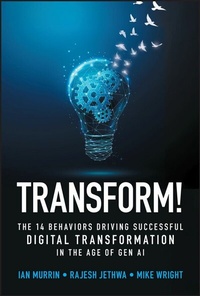
Transform!
Description

PRAISE FOR TRANSFORM!
"Transform! is an inspiring guide for leaders who want to drive meaningful transformation. Transform! gets to the heart of what truly matters when it comes to leading change: clarity of purpose, courageous leadership, and empowering people to deliver lasting change." -JIM SNABE, Chairman of Siemens, a board member of C3 AI and Temasek, a member of the World Economic Forum's Board of Trustees, former CEO of SAP and former Chairman of Moller - Maersk
"As big organizations scale, so do their technology and data challenges-making transformation increasingly difficult. Transform! shows how to achieve excellence by combining agility and high-performance behaviors with the power of GenAI. Insightful and accessible, it cuts through complexity and helps you pull ahead of the pack." -SIR RON DENNIS, Founder of McLaren Automotive and McLaren Applied and now leads Podium Analytics while advising governments on change and innovation
Learn what separates success from failure in technology-led transformation initiatives
Transform! The 14 behaviours driving successful digital transformation in the age of Gen AI explores the stark reality that only a small fraction of companies achieve their technology-led transformation objectives, with billions of dollars wasted each year. The book highlights the critical barriers to success, such as defining the right investment priorities and addressing workforce skills and attitudes. It also sheds light on the broader implications of this wastage, including the opportunity costs and the potential to fund global solutions like eradicating hunger.
Through compelling case studies and data-driven insights, Transform! The 14 behaviours driving successful digital transformation in the age of Gen AI delivers key insights on:
- Pitfalls of technology-led change programmes, from faulty air traffic control systems causing massive disruptions to tragic incidents like the UK's Post Office Horizon accounting system debacle
- 14 core behaviours which have been proven over more than two decades of application to reduce the chances of failure and to significantly increase the likelihood of creating more successful outcomes
- Steps to setting up and running technology programmes of any size, which are ultimately very human-intensive and creative
Tranform! is an essential read for all business leaders and professionals looking for a reliable and practical guide to navigate the complexities of digital transformation.
More details
Other editions
Additional editions
Persons
IAN MURRIN is a pioneering technology entrepreneur with over 30 years of success in building and scaling high-impact businesses. As the founder of Digiterre, he has led the company to become a multi-award-winning consultancy, trusted by many of the world's leading finance, energy, and commodities trading firms to deliver complex software and data engineering solutions at speed and scale.
RAJESH JETHWA is a multi-award-winning Chief Technology Officer with over 20 years of success leading high-performing technology organizations. Recognized five times as one of the UK's Top 100 CIOs, he is also an executive leadership coach and a dedicated mentor, known for developing talent and driving innovation at scale.
MIKE WRIGHT has served as CIO for some of the world's most respected organizations, including most recently, McKinsey & Company. Renowned for driving technology innovation and large-scale transformation, he has built a career on successfully delivering complex initiatives at global scale while fostering technology-led innovation and business growth.
Content
Section I What's the Problem Here? 1
Chapter 1 And Why Do I Care? 3
1.1 Time, Please 6
1.2 The Technical Debt Crises 10
1.3 How Big Is the Debt? 11
1.4 What Does This Mean for Me? 14
1.5 What's in It for Me? 16
1.6 Not so SWIFT 21
1.7 Where Did It All Go Wrong? 23
1.8 Change 101 24
Chapter 2 Who Needs a Survival Guide? 27
2.1 US Inc. and UK PLC 30
2.2 Legacy Code, Legacy Thinking 31
Section II How Do We Solve It? 35
Chapter 3 The Importance of a Software- Centric Mindset 37
3.1 The Decline of the Big Three 38
Chapter 4 When It All Goes Wrong 45
4.1 When the Virtual Wheels Fell Off at Volkswagen 45
4.2 Sonos's Sorry Tale 49
Chapter 5 The Common Pitfalls and How to Avoid Them 51
5.1 A Waterfall Approach to Improvement 51
5.2 Failing to Distinguish Between Hard Tasks and Complex Problems 54
5.3 Classifying the Problem Domain Correctly 55
5.4 Solving for the Wrong Problems 60
5.5 No Clarity Around the Definition of "Great" or How to Get There 61
5.6 The Vital Role of Testing 61
5.7 Lack of Psychological Safety 62
5.8 Pitfalls in Practice 63
Chapter 6 The 14 Behaviors Behind Successful TLT 75
Chapter 7 Real- World Effects: A Project Comparison 97
7.1 Paradise Lost: The Story of the Disastrous Post Office Horizon Project 98
7.2 "Big- Bang" ERP Transformation on a Global Scale 105
Section III What's the Plan, Stan? 115
Chapter 8 Before You Start Your Transformation 117
8.1 Bringing All Four Pillars of Technology- Led Transformation Together 118
8.2 Do You Have a Change Mindset? 118
8.3 Sears: A Story of Failed Success 119
8.4 Tesla: A Story of Successful Failure 122
8.5 Are You Grooving in the Right Behaviors from the Outset? 126
Chapter 9 Have You Assessed the Risks? 129
9.1 Data Migration as a Risk 133
9.2 Lloyds Banking Group's IT Failure 133
9.3 Some Practical Steps to Managing Project Risk More Effectively 134
9.4 Risk Management Tooling and Frameworks 134
Chapter 10 Cybersecurity and Data Integrity 139
10.1 Peak Loads and Capacity 140
Chapter 11 Setting Scope and Objectives 141
Chapter 12 Optimizing for Different Parameters to Address Changing Priorities 145
Chapter 13 Architecture in the Physical World 149
13.1 Leaning Tower of Pisa 149
13.2 St. Martin's- in- the- Field 150
13.3 Managing the Madness 151
13.4 What Defines Modern Software Architecture? 153
Chapter 14 Program Governance and Project Contingency 157
14.1 A Case Study- Willis and KKR 157
Chapter 15 Agile Explained 163
15.1 The Agile Manifesto 165
15.2 You Say "Tomato" and I Say "Tomato" 166
15.3 What Is Agile Really About? 167
15.4 What Agile Is Not 169
15.5 The Importance of Domain Knowledge 170
15.6 Patterns and Anti- Patterns of Effective Agile Teams 171
15.7 Agile Team Roles, Ceremonies, and Practices 173
15.8 Goal- Gradient Effect 178
Chapter 16 Organizational and Team Structures 181
16.1 Information Flows and Conway's Law 181
Chapter 17 Delivery Resourcing Strategy 185
17.1 Selecting the Team: The Insiders 185
17.2 Selecting the Team: The Third Parties 187
Chapter 18 Adopt a Proven Change Framework 189
18.1 From Nudge to Kotter 189
18.2 Maintaining Integrity of Leadership 191
Chapter 19 Getting Started and Keeping Going 193
19.1 Communicating Effectively About Progress 194
19.2 Maintaining Morale 194
19.3 Managing Risks 195
19.4 Responding to Problems 196
Chapter 20 Not- So- Minor Details 197
20.1 Early Adopters and Change Champions 197
20.2 Products, Not Projects 198
20.3 Non- Functional Requirements 199
20.4 Ensuring Third Parties Do Not Overstay Their Welcome 201
20.5 When Initiatives Do Happen, but They Don't Scale 202
Chapter 21 What to Measure and What Not to Measure 205
Chapter 22 After the First Delivery 209
22.1 Celebrating the First Deployment 209
22.2 Planning for Phase 2 and Beyond 210
22.3 Measuring Benefit Capture 210
Section IV GenAI- Enabled Change and the Rise of the Machines 211
Chapter 23 This Could Take Forever 213
23.1 The Elephant in the Room 215
23.2 Running to Stand Still 216
23.3 Out with the Old, In with the New 217
Chapter 24 Enter the Machines 221
24.1 The Tipping Point 222
24.2 Likely GenAI Use- Cases for Information Technology Organizations 229
24.3 Use the Force, Luke 232
24.4 GenAI- Assisted Engineering: All Change, Please 235
24.5 No Silver Bullets 239
Appendix 241
Notes 245
Acknowledgments 253
About the Authors 259
Index 263
1
And Why Do I Care?
Technology. It's everywhere. In our homes, in our hands, running our corporations, healthcare and banking systems, militaries, and the very apparatus of government itself. Simply put, "Our civilization runs on software."1 We are therefore very fortunate that there are a great many organizations and millions of individuals across the globe who work tirelessly to create products and services that do actually serve us well. Sometimes they do this against the odds, battling with aging or "legacy" systems to create the new features that consumers desire but which the original designers did not envisage. Yet, despite these great efforts on the part of so many, software-based technologies are increasingly failing us, with cybercrime, global system outages, and economic competitiveness becoming the norm rather than the exception. These issues stem from ever-greater consequences and implications for us all. However, you may well think, "Well . it's not my problem to solve, so why should I care about it?" After all, it's not an issue on the scale of, say, solving world hunger, right? Wrong. In financial terms, it's much, much bigger than the cost of solving world hunger, according to UN figures. Let's delve into this a bit.
As we shall learn, there is a lot of aging software that currently runs many of the systems that modern society relies upon. So much so that the aforementioned quote by Bjarne Stroustrup, creator of the widely used C++ language, which has an extensive and enduring presence across critical software systems worldwide, could reasonably be modified to state that "Our civilization runs on aging software." Not all aging software is "bad" per se, but running, updating, or improving older or "legacy" technologies can come at a significant cost, both financial and otherwise. Modernization of these technologies, sometimes expressed in terms of legacy modernization or digital transformation, is an imperative for most governments and corporations around the developed world, at least, since they have built up the largest estates of such legacy technologies and therefore face the biggest transformation challenges. We have chosen to use the term Technology-Led Transformation (TLT) throughout this book to describe change programs where digital technology plays a significant role-whether modernizing legacy systems or digitizing manual processes. This doesn't mean such initiatives must be led by the technology function; rather, TLT refers to any transformation where technology is central to the envisaged change. However, as multiple studies conducted across many countries and industries have shown, between 70% and 88% of all transformation efforts fail to deliver on their original goals. Digital transformation initiatives of any kind have the lowest success rates of all, as evidenced by the Bain survey involving 1,000 companies around the world to gauge their level of digital readiness. They found that only 5% of those undertaking some form of digital transformation initiative had achieved or exceeded the expectations they set for themselves, compared to a success rate of 12% for conventional transformations (Figure 1.1).2 A full 75% of these companies settled for dilution of value and mediocre performance, and 20% failed outright.
Figure 1.1 Conventional vs Digital Transformation.
Source: Bain risk history survey 2017 (n = 403); Digital 360 Barometer survey 2017 (n = 1012)
The range of outcomes recorded by other consultancies, including BCG and McKinsey, split broadly by total successes, partial results, and out-and-out failures, does vary somewhat, but the de facto success rates of between 5% and 30% are poor rates of return on stakeholder resources, regardless of how the overall program is viewed.
Table 1.1 summarizes the data published by three of the world's top management consulting firms. As you can see, the track record is not good. Furthermore, these figures relate to the types of companies and governments that provide us with the bulk of the products and services we rely on to live, thrive, or survive.
Table 1.1 Reported Success and Failure Rates: Sample Bain & Company, BCG, and McKinsey & Company.
Source What Is Measured Achieved or Succeeded Partial Results Failed Bain & Company (2017) Success of digital transformation initiatives 5% achieved or exceeded expectations 75% settled for dilution of value and mediocre performance 20% failed to deliver, producing less than 50% of the expected results BCG (2020) Success of digital transformation projects 30% met or exceeded their targets and resulted in sustainable change 44% created some value but did not meet their targets and resulted in only limited long-term change 26% created limited value (less than 50% of the target), producing no sustainable change McKinsey & Company (2018) Success of overall digital transformation 16% have successfully improved performance and also equipped them to sustain changes in the long term 7% performance improved but improvements were not sustained 77% performance did not improve** Implied, but not stated
1.1 Time, Please
IT systems are composed of multiple interconnected technological components that must function together as a whole. These components typically have interdependencies, whereby component A is reliant upon components B, C, and D to function well before it can function as designed. A failure in one component can lead to cascading issues across the whole system. This fact introduces complexity and increases the risk of delays and errors during the build, implementation, testing, and integration stages of a project. This problem is particularly acute when components are tightly coupled, as tends to be the case with legacy systems. In contrast, more modern, typically "decoupled" systems mitigate such risks by isolating failures. This interdependence plays a key role in explaining why many IT projects experience significant time and cost overruns. One study of 106 software projects conducted within a single organization found that, on average, projects took 200% longer than estimated, with the worst case running nearly 700% over time.3 The data indicated that large overruns are more frequent than the company anticipated. Other studies support this conclusion, with one analysis of 72 projects across 23 organizations identifying cost overruns of up to 525% that were much more heavily skewed toward significant overruns than had been expected. The U.S. Department of Defense reports that for the fiscal year ending in 2020, IT project spending was $37 billion, and only 35% of the projects were within budget.4 A study by McKinsey and the BT Centre for Major Programme Management at the University of Oxford reports that, on average, large IT projects run 45% over budget, with some projects overrunning cost-presumably time budgets-by as much as 400%.5
One of the most comprehensive studies in this space analyzed 5,392 IT projects worth a combined $56.5 billion, measured in terms of 2015 USD.6 It found that IT project cost overruns follow a power-law distribution, meaning that while most projects experience small overruns, a few projects incur extremely large overruns, disproportionately driving up average costs and making such extreme events more common than expected under normal distributions. The findings challenge the implicit managerial assumption that overruns follow a normal distribution. This, in turn, can dangerously underestimate the likelihood and cost of large-scale failures. The study conclusively demonstrates that interdependencies among technological components cause these extreme overruns. The key takeaway is that IT projects are far riskier than traditionally assumed, and accurate risk assessment must account for the possibility of rare but devastating overruns. So if leaders assume a normal distribution of IT project cost overruns, they may be unwittingly exposing their organizations to extreme risk by severely underestimating the probability of significant cost overruns.
According to Gartner, the global technology research and advisory firm, of the $5 trillion spent globally on IT in 2024, the largest proportion of that, at $1.55 trillion, was spent on technology services.7 This aligns closely with the data from Statista of $1.51 trillion (£1.18 trillion) for 2025.8 Taking a conservative position, we will work with these lower figures. As a point of reference, by far the largest component of Global IT expenditure is accounted for by the US with 36.4%. The UK accounts for 7.5% of the total and the expenditure per capita is similar in both countries at around $1,642 per person per year; this, however, is nearly nine times the global average. So, countries such as the UK, US, and other developed nations have the most to gain by getting this...
