

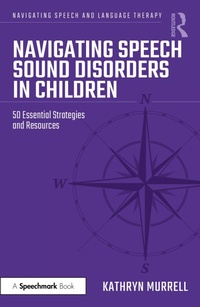
Navigating Speech Sound Disorders in Children
50 Essential Strategies and Resources
Published on 16. May 2025
264 pages
978-1-040-34363-0 (ISBN)
Description

Navigating Speech Sound Disorders in Children is an easy-to-read resource which gives an overview of the whole area of speech sound disorders (SSDs) in children, covering assessment, diagnosis, treatment, and management, underpinned by the latest research in the field.
The book focuses on key information, providing helpful therapy tips and evidence-based, practical advice drawing on clinical research and the author's extensive experience. Presented in 50 bite-sized chunks, therapists can find and refer to information quickly and easily. Additional guidance and links to further reading are signposted throughout so that the reader can explore topics in more detail, and a wealth of case examples is included to illustrate each point and demonstrate real-life application.
Written by a specialist in the field, this book provides strategies for students and qualified speech and language therapists (SALTs) working with children who present with many different types of SSD. It is valuable reading for both students and less experienced speech and language therapists, as well as seasoned clinicians.
The book focuses on key information, providing helpful therapy tips and evidence-based, practical advice drawing on clinical research and the author's extensive experience. Presented in 50 bite-sized chunks, therapists can find and refer to information quickly and easily. Additional guidance and links to further reading are signposted throughout so that the reader can explore topics in more detail, and a wealth of case examples is included to illustrate each point and demonstrate real-life application.
Written by a specialist in the field, this book provides strategies for students and qualified speech and language therapists (SALTs) working with children who present with many different types of SSD. It is valuable reading for both students and less experienced speech and language therapists, as well as seasoned clinicians.
Reviews / Votes
"This book is a vital source of information for all speech and language therapists. It is a critical resource for newly-qualified therapists, as having an easy-to-read book which clearly outlines the process of assessment, diagnosis, and therapeutic intervention is invaluable and efficient. This book makes excellent links between clinical work and theory, with case studies to provide evidence."Aimee Hilson, Speech and Language Therapist, Sarah Buckley Therapies Ltd
More details
Series
Language
English
Place of publication
London
United Kingdom
Publishing group
Taylor & Francis Ltd
Target group
College/higher education
Professional and scholarly
Illustrations
5 Tables, black and white
File size
10,34 MB
ISBN-13
978-1-040-34363-0 (9781040343630)
Copyright in bibliographic data and cover images is held by Nielsen Book Services Limited or by the publishers or by their respective licensors: all rights reserved.
Schweitzer Classification
Other editions
Additional editions

Book
06/2025
Routledge
Unfortunately, price unknown
Article exhausted; check different version
Book
05/2025
1st Edition
Routledge
€193.50
Shipment within 10-20 days
Book
05/2025
1st Edition
Routledge
€36.70
Shipment within 10-20 days
Person
Kathryn Murrell is the author of Working with Childhood Apraxia of Speech and is a specialist SALT in independent practice, as well as a clinical supervisor in SSDs.
Content
List of tables
Acknowledgements
Introduction
Part I: Classification and subtypes
1. What is a speech sound disorder?
2. How can we classify SSD?
3. Phonological delay
4. Consistent phonological disorder (CPD)
5. Inconsistent phonological disorder (IPD)
6. Articulation disorder
7. Childhood apraxia of speech (CAS)
8. When these subtypes overlap
Part II: Assessment and Diagnosis
9. Case history taking
10. The core speech sample
11. Detailed speech assessment
12. Transcription
13. Oral examination/oro-motor screen
14. Then pre-verbal child
15. Assessing the impact on the child's activity and participation
16. Assessing non-speech areas
17. The case profile and diagnostic statement
18. Communicating with others
Part III: Treatment
19. Goal-setting
20. Evidence-based practice (EBP)
21. Choosing an intervention
22. The central role of parents/carers
23. Pre-verbal interventions
24. Phonological approaches: interventions with a strong evidence base
25. Phonological approaches: syllable-level intervention
26. Intervention for inconsistent phonological disorder (IPD)
27. Therapy for articulation disorder: principles
28. Therapy for articulation disorder: common sound errors
29. Treatment approaches for childhood apraxia of speech (CAS)
30. Phonological awareness intervention
31. Working with older children with SSD
32. Considerations for children from culturally and linguistically diverse backgrounds
33. Multiple areas of need
34. Outcome measures
Part IV: Service-delivery and decision-making
35. Timing of therapy
36. Dosage
37. Discharge: when and how?
38. Effective time-management
39. Caseload prioritisation
40. Group therapy
41. Blocks and breaks approach
42. Telehealth
43. Consultative approach
Part V: The link with education
44.Working in the school setting
45. EHCPs and report-writing
46. SEND tribunals
47. The link with literacy
Part VI: Concluding thoughts
48. The concept of 'disorder'
49. Where we're heading with SSD
50. Moving forward with confidence
Index
Acknowledgements
Introduction
Part I: Classification and subtypes
1. What is a speech sound disorder?
2. How can we classify SSD?
3. Phonological delay
4. Consistent phonological disorder (CPD)
5. Inconsistent phonological disorder (IPD)
6. Articulation disorder
7. Childhood apraxia of speech (CAS)
8. When these subtypes overlap
Part II: Assessment and Diagnosis
9. Case history taking
10. The core speech sample
11. Detailed speech assessment
12. Transcription
13. Oral examination/oro-motor screen
14. Then pre-verbal child
15. Assessing the impact on the child's activity and participation
16. Assessing non-speech areas
17. The case profile and diagnostic statement
18. Communicating with others
Part III: Treatment
19. Goal-setting
20. Evidence-based practice (EBP)
21. Choosing an intervention
22. The central role of parents/carers
23. Pre-verbal interventions
24. Phonological approaches: interventions with a strong evidence base
25. Phonological approaches: syllable-level intervention
26. Intervention for inconsistent phonological disorder (IPD)
27. Therapy for articulation disorder: principles
28. Therapy for articulation disorder: common sound errors
29. Treatment approaches for childhood apraxia of speech (CAS)
30. Phonological awareness intervention
31. Working with older children with SSD
32. Considerations for children from culturally and linguistically diverse backgrounds
33. Multiple areas of need
34. Outcome measures
Part IV: Service-delivery and decision-making
35. Timing of therapy
36. Dosage
37. Discharge: when and how?
38. Effective time-management
39. Caseload prioritisation
40. Group therapy
41. Blocks and breaks approach
42. Telehealth
43. Consultative approach
Part V: The link with education
44.Working in the school setting
45. EHCPs and report-writing
46. SEND tribunals
47. The link with literacy
Part VI: Concluding thoughts
48. The concept of 'disorder'
49. Where we're heading with SSD
50. Moving forward with confidence
Index
