

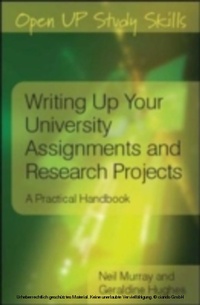
Writing Up Your University Assignments And Research Projects
1st Edition
Published on 1. April 2008
252 pages
978-0-335-23552-0 (ISBN)
Description

Based on their many years of experience, this book aims to build students' confidence in their own writing ability whilst at the same time respecting conventional ideas of what is, and what is not, acceptable in the academic domain.
More details
Other editions
Additional editions
Neil Murray | Geraldine Hughes
Writing up your University Assignments and Research Projects
A practical handbook
Book
04/2008
Open University Press
€43.55
Shipment within 15-20 days
Content
- Front Cover
- Half-title
- Title Page
- Copyright Page
- Contents
- Acknowledgements
- Foreword
- A guide to the book's icons: what do they mean?
- Part 1: THE FUNDAMENTALS OF ACADEMIC WRITING
- Chapter 1: What are the key functions in academic writing?
- 1.1 Introduction
- 1.2 Defining terms and ideas (see also Section 4.6)
- 1.3 Describing
- 1.4 Comparing and contrasting
- 1.5 Classifying
- 1.6 Explaining causes and effects
- 1.7 Developing an argument
- Chapter 2: How should I structure my writing?
- 2.1 Coherence: the flow of good writing
- 2.2 The three main parts of a writing project
- 2.3 Citation, referencing and paraphrasing
- 2.4 Using footnotes
- Chapter 3: What do I need to know about writing style?
- 3.1 Writing clearly and concisely
- 3.2 Level of formality (register)
- 3.3 Using Gender-neutral language
- 3.4 Reading other research projects
- Chapter 4: Approaching your writing project: tips and strategies
- 4.1 Planning carefully
- 4.2 Deciding on your writing approach
- 4.3 Sourcing and selecting information
- 4.4 Recording information/making notes
- 4.5 Drafting
- 4.6 Defining terms
- 4.7 Supporting your claims
- 4.8 Acknowledging alternative perspectives and counter-arguments
- Part 2: PUTTING TOGETHER YOUR RESEARCH PROJECT
- Chapter 5: Understanding the research and writing process
- 5.1 What is a research project?
- 5.2 What is the difference between a dissertation and a thesis?
- 5.3 The basic requirements of a research degree
- 5.4 Deciding on a research topic
- 5.5 Choosing and using your supervisor: what exactly is their role?
- 5.6 Writing a proposal
- 5.7 Adopting the correct mindset
- 5.8 Studying independently
- 5.9 Attending research seminars, conferences etc.
- 5.10 Understanding disciplinary differences
- 5.11 The upgrading process (PhDs only)
- 5.12 Familiarity with 'Codes of Practice'/Rules and Regulations
- 5.13 Ethical considerations
- 5.14 The importance of finding your own 'voice' . . . and why it can be challenging
- 5.15 Getting down to writing
- Chapter 6: What are the different components of a research project?
- 6.1 Title page
- 6.2 Abstract
- 6.3 Acknowledgements
- 6.4 List of contents
- 6.5 List of acronyms and abbreviations
- 6.6 Introduction
- 6.7 Literature review
- 6.8 Methodology
- 6.9 Results/data
- 6.10 Analysis and discussion
- 6.11 Conclusions
- 6.12 Bibliography
- 6.13 Appendices
- Chapter 7: . . . And when it's all over: publishing and presenting your research
- 7.1 Introduction
- 7.2 Journal articles
- 7.3 A book
- 7.4 Conference presentations
- 7.5 A final note
- Part 3: TOOLKIT
- Chapter 8: Punctuation basics: A brief guide to punctuation use
- 8.1 Introduction
- 8.2 Capital letters
- 8.3 The comma
- 8.4 The semicolon
- 8.5 The colon
- 8.6 Parentheses
- 8.7 Inverted commas (see also Section 2.3)
- 8.8 The hyphen
- 8.9 The apostrophe
- Chapter 9: Glossary of key terms
- Chapter 10: The academic word list
- Chapter 11: List of prefixes and suffixes
- Chapter 12: Appendix
- 12.1 Citation styles
- 12.2 Sample table of contents
- 12.3 Sample list of figures
- 12.4 Sample list of maps
- 12.5 Sample list of photos
- 12.6 Sample list of tables
- References
- Index
- Back Cover
