

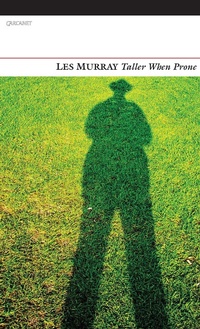
Taller When Prone
Published on 27. July 2012
72 pages
978-1-84777-967-0 (ISBN)
Description

Taller When Prone has at its heart Les Murray's celebrations of the rural world in Australia and elsewhere, evoked with a deep understanding of landscapes, and the seasons, working lives and languages that have shaped them. Stories and songs, fragments of conversations, memories and satire comprise this varied, habitable world. In Murray's vigorous and sinuous language, 'song and story are pixels / in a mirrorball', reflecting back to us endless possibilities.
Reviews / Votes
'Les Murray's Taller When Prone shows a poetic master nimbly and lyrically at work. Now seventy-two, Murray writes with the bigness of soul of a person twice his age. This collection adds another chuckie to the cairn of a remarkable personal achievement. A Nobel Prize for that man, please.'Robert Crawford, TLS Books Of The Year 2010 There's an art to the Australian poet's artlessness.
Les Murray has earned his reputation not only as one of Australia's finest writers but as one of the most engaging poets writing in English today. And if this means he is occasionally mistaken for a celebrity chef, it must be a price worth paying. 'Fame' (see below) is a delightful titbit - more a joke than an example of his greatest work - yet it reveals an essential quality in Murray's temperament: his resistance to anything puffed up (he once wrote a poem on this subject, 'The Holy Show' - a useful Australianism for making a fuss). His lack of self-aggrandisement extends to his take on poetry: he once likened his career to dairy farming, a comfortable analogy for a writer whose love of Australian landscape, and the New South Wales bush in particular, has been a defining feature.
Even the title of his thirtieth book - Taller When Prone - plays with the notion of cutting self down to size. He uses humour to restore perspective (although the punchline to the wonderful and ludicrous 'A Frequent Flyer Proposes a Name', in which he suggests a name for a new London airport, does not qualify as a deflationary joke). There are many more serious and ambitious pieces here, too. There are elegies in the tradition of Gerard Manley Hopkins's 'Felix Randal' - 'Rugby Wheels', about a disabled rugby player, and 'Double Diamond', about a gauche octogenarian soldier at his wife's funeral. It is a collection filled with celebrations of ordinary people, extraordinary Australian birds and open endings. Murray has a gentle way with his poems, letting them go, never forcing a conclusion.
One of his great gifts is that he is non-interventionist, never blocks a view - art in apparent artlessness. In his moving and precise 'High-Speed Bird', a kingfisher knocks itself out against a window and recovers in the palm of his hand: 'For maybe twenty minutes / we sat together, one on one, / as if staring back or / forward into prehistory.' Reading this poem, one reflects upon Murray's own brilliance as a viewfinder: knowing where and how to look (he has his readers, too, in the palm of his hand).
What is most striking is the number of 'found' poems, based on seeing or overhearing something he recognises to be a poem - and lifts. Murray is a poem-spotter. In 'Nursing Home', he describes an old woman who
sits holding hands
with an ancient woman
who calls her brother and George
as bees summarise the garden.
It is the overheard remark - its dotty camaraderie - that creates this sweet, muddled idyll. One of his poems alludes to 'sugarbag' (Australian honey made by stingless bees). His writing often has that sugarbag quality - with no sting. In 'Phone Canvass', he recounts being phoned by a blind person from a charity. He asks a 'shy' question about blindness and gets this answer which he recognises as a poem and preserves:
I love it on the street,
all the echo and air pressure,
people in my forehead and
metal stone brick, the buildings
passing in one side of my head...
I can hear you smiling.
And in the perfectly pitched 'Winding up at the Bootmaker's', he simply describes a widow handing out her husband's repair jobs, wrapped in newspaper, to customers after his death. Another 'found' poem, its ending depends on Murray's ability to witness and transform:
Kneeling up in Mediterranean black,
Reaching down the numbered parcels
As if returning all their wedding gifts. Taller When Prone (Carcanet) is the second collection of poems from Les Murray since the publication of his Collected Poems...As in the last book, The Biplane Houses both lines and poems themselves are frequently short, with a fragmentary flavour. Murray loves facts, detail, stuff about the world, and in that way he has always been a poet of witness. Throughout his oeuvre, particularly his essays, there are points on which I could launch a full and angry repudiation, and other places which reveal a compassionate profunity. If only he were a simple reactionary. It seems better for all cocnerned when he just describes things. Les Murray's poetry- rooted in rural Australia, yet intercontinental in scale and detail- at first apears in radical contrast to Jo Shapcott's very English quietness of survival. Yet both bring surreal gifts to work that award fresh imagination to metaphysical considerations.
Murray's poetry still seems best symbolised by the cover photograph to his Collected Poems (1998) showing a little girl snuggling up to an elephant. Like 'Takker When Prone', that huge volume was dedicated 'To the Glory of God'.
Murray still celebrates that glory with outback ambition, though his poems, unlike recent portraits of their happy portly writer, have become leaner. He relishes language like friar Tuck approaching dinner. There is, wrote Derek Walcott, 'no poetry in the English language so rooted in its sacredness'.
This revernce Murray often expresses in counterpoint. Land is honoured by reference to intrusion, peace through mention of soldiers, the scale of landscape through closely observed detail. The 'glory of God' emerges, sunlit, as transient images outline the eternal.
The 'pearl chimneys of the Taj Mahal' appear 'through haze' like 'perfection as a factory making depth' in the opening jottings of 'From a Tourist Journal'. The collection's title comes from 'The Conversations', a poem including meditations on moonlight, mortality, drugged monekys, and Donald Duck's wardrobe.
Murray writes with an exacting chuckle, watching 'muscles and torsos of cloud' rise over mountains, and finding a crocodile's jaw in police-car markings. Birds 'make outcry of the rotting Satsuma-plum moon'; an exposed tree root has 'fowed down, tight as mailing wax'. Always there is a generosity off shared delight. A new collection reminds Paul Batchelor why Les Murray is a necessary poet.
In one of his most celebrated poems, Les Murray tries repeatedly to define the quality of sprawl: 'Sprawl leans on things. It is loose-limbed in its mind' and 'Sprawl is more like the thirteenth banana in a dozen / or anyway the fourteenth'. Taller When Prone has plenty of sprawl: this is a decidedly relaxed collection of observations and anecdotes, songs and stories, jokes and diatribes. As always, Murray provides an abundance of lines that make you blink and see the familiar afresh: 'like all its kind / Python has a hare lip' and 'bees summarise the garden', and this of his cat: 'discreet with his few stained birds / he carries them off to read'.
Murray is a tireless collector of facts and curios, and two of the best poems here take the form of lists. 'Infinite Anthology' celebrates the work of the anonymous 'single-word poets' who enrich the language by coining new phrases and compounds. The poem is presented as a series of dictionary definitions, such as 'Baptist Boilermaker - coffee and soda (an imagined Puritan cocktail)' and 'tipping elbow - (Aboriginal) sneaking glances at one's watch'.
Beginning in a similar vein, 'The Conversations' presents itself as a list of seemingly unrelated trivia:
A full moon always rises at sunset
and a person is taller at night.
Many fear their phobias more than death.
The glass King of France feared he'd shatter.
Chinese eunuchs kept their testes in spirit.
The list grows increasingly surreal ('Donald Duck was once banned in Finland / because he didn't wear trousers'), until it quietly shifts into a more serious mode: 'A fact is a small compact faith, / a sense-datum to beasts, a power to man / even if true, even while true...' The tone-change is telling. It indicates that Murray's enthusiasm for trivia - and, by extension, the curiosity that drives his capacious poetic enterprise - is backlit by a powerful sense of isolation. He has an autodidact's lonely fascination with knowledge for its own sake; and his rural, Catholic background in a predominantly urban, secular country has made him a lifelong outsider. The esteem in which he is held has only enhanced the privacy of his endeavour.
Not that Taller When Prone is an anxious affair. Poems step in and out of rhyme and metre with unselfconscious ease, and several are closer to sketches than finished pieces - though Murray can usually rely on his gift for the weirdly apposite image to redeem unpromising subject matter: 'Wrecked Birds' is a squib on the subject of road-kill, until it yields this definition of the open road: 'that naked ground young birds / don't sense as haunted'. And I wouldn't want to be without a poem such as 'Cherries from Young'. It, too, is a sketch; but an attractive, graceful one:
Cherries from Young
that pretty town,
white cherries and black,
sun-windows on them.
Cherries from Young
the tastiest ever
grow in drought time
on farms above there...
Less happily, the sense of an artist underwhelmed by his material can declare itself in the form of one-liners, or cheap shots. 'Reading by Starlight' describes the Milky Way as 'the illuminant immense / irrefutable by science'. This seems intended to clinch an argument, but it raises more questions than it answers. A further irritation is Murray's increasing tendency to be cryptic. Given the man's gift for making the world available through language, it is infuriating to be confronted by a poem as impenetrable as 'The Springfields', which reads in full: 'Lead drips out of / a burning farm rail. / Their Civil War.' Such moments act like bursts of white noise interrupting a symphony. They serve as a reminder that the urge to baffle, like the urge to shock, is usually best resisted: familiarity will diminish both effects, leaving only the artist's intention exposed.
There are also poems here that remind you why Murray is such a necessary poet. A late salvo in Australia's history wars, 'Port Jackson Greaseproof Rose' changes the terms of that debate by demanding 'Who made poverty legal? / Who made poverty at all?'
We see Murray:
Eating a pork sandwich
out of greaseproof paper
as I cross to Circular Quay
where the world ships landed poverty
on the last human continent
where it had not been known.
His sympathy is always with the underdog; in this case, the convicts. Depicting them as victims of illegal poverty rather than imperialist settlers, he ends the poem by giving an ambiguous salute to an incoming jumbo jet: 'I hold aloft my greaseproof rose'.
Murray's last collection, The Biplane Houses, included the following pithy observation, 'The Test':
How good is their best?
And how good is their rest?
The first is a question to be asked of an artist.
Both are the questions to be asked of a culture.
On this basis, how much should we ask of Taller When Prone? 'Port Jackson Greaseproof Rose' and 'The Conversations' will take their place in future editions of Murray's selected poems; but nothing here has the plainspoken, visionary quality of 'An Absolutely Ordinary Rainbow', the unsparing self-scrutiny of 'Burning Want' or the technical dazzle of 'Translations From the Natural World'. Murray's best is intimidatingly good; but sprawl is as sprawl does, and this remains a generous, celebratory volume. Taller When Prone (Carcanet) is the second collection of poems from Les Murray since the publication of his Collected Poems...As in the last book, The Biplane Houses both lines and poems themselves are frequently short, with a fragmentary flavour. Murray loves facts, detail, stuff about the world, and in that way he has always been a poet of witness. Throughout his oeuvre, particularly his essays, there are points on which I could launch a full and angry repudiation, and other places which reveal a compassionate profunity. If only he were a simple reactionary. It seems better for all cocnerned when he just describes things. Les Murray's poetry- rooted in rural Australia, yet intercontinental in scale and detail- at first apears in radical contrast to Jo Shapcott's very English quietness of survival. Yet both bring surreal gifts to work that award fresh imagination to metaphysical considerations.
Murray's poetry still seems best symbolised by the cover photograph to his Collected Poems (1998) showing a little girl snuggling up to an elephant. Like 'Taller When Prone', that huge volume was dedicated 'To the Glory of God'.
Murray still celebrates that glory with outback ambition, though his poems, unlike recent portraits of their happy portly writer, have become leaner. He relishes language like friar Tuck approaching dinner. There is, wrote Derek Walcott, 'no poetry in the English language so rooted in its sacredness'.
This revernce Murray often expresses in counterpoint. Land is honoured by reference to intrusion, peace through mention of soldiers, the scale of landscape through closely observed detail. The 'glory of God' emerges, sunlit, as transient images outline the eternal.
The 'pearl chimneys of the Taj Mahal' appear 'through haze' like 'perfection as a factory making depth' in the opening jottings of 'From a Tourist Journal'. The collection's title comes from 'The Conversations', a poem including meditations on moonlight, mortality, drugged monekys, and Donald Duck's wardrobe.
Murray writes with an exacting chuckle, watching 'muscles and torsos of cloud' rise over mountains, and finding a crocodile's jaw in police-car markings. Birds 'make outcry of the rotting Satsuma-plum moon'; an exposed tree root has 'fowed down, tight as mailing wax'. Always there is a generosity off shared delight. It would be perverse to ignore a new book of poems by Les Murray, Australia's finest. Taller When Prone finds him ploughing home turf with his usual mixture of breeziness and verbal intricacy. Murray's is work which starts in reportage - things glimpsed or heard on the wing. Then begins the artful and often humerous work of gentle exploration. Some of the fine moments in this book begin in local pleasures - his lovely poem about observing a mute cat, for example. Murray has a wonderful way of bringing over - call it verbal mimicry if you like - the particular ways of being of this earth's oddly various assortment of creatures. Les Murray's Taller When Prone shows a poetic master nimbly and lyrically at work. Now seventy-two, Murray writers with the bigness of soul of a person twice his age. This collection adds another chuckie to the cairn of a remarkable poetic acheievement. A Nobel Prize for that man, please.
More details
Language
English
Place of publication
London
United Kingdom
Publishing group
Carcanet Press Ltd
File size
0,58 MB
ISBN-13
978-1-84777-967-0 (9781847779670)
Copyright in bibliographic data and cover images is held by Nielsen Book Services Limited or by the publishers or by their respective licensors: all rights reserved.
Schweitzer Classification
Other editions
Additional editions
Les Murray
Taller When Prone
Book
11/2010
Carcanet Press Ltd
€32.34
Article exhausted; check different version
Person
Les Murray (1938-2019) grew up on a dairy farm at Bunyah on the north coast of New South Wales.He studied at Sydney University and later worked as a translator at the Australian National University and as an officer in the Prime Minister's Department.His real vocation was poetry, however, and from 1971 he has made literature his full-time career. He was the first Australian poet to achieve international acclaim without expatriation. Murray first visited Europe in the sixties, and returned frequently to give poetry readings.
Carcanet publish his Collected Poems and his New Selected Poems (2012), as well as his individual collections, including Subhuman Redneck Poems (1996, awarded the T.S.Eliot Prize) and The Biplane Houses (2006), and his essays and prose writings in The Paperbark Tree (1992). His verse novel Fredy Neptune appeared in 1998 and in 2004 won the Mondello Prize in Italy and a major German award at the Leipzig Book Fair. He also edited The Quadrant Book of Poetry 2001-2010.
Murray had special links with Scotland, and his Scots ancestors, whilst remaining an important and distinctive Australian writer. Blake Morrison, writing in the Independent on Sunday, called Murray: 'one of the finest poets writing in English today, one of the super league which includes Seamus Heaney, Derek Walcott and Joseph Brodsky', and C. K. Stead said of his poetry in the London Review of Books: 'It is wonderfully disciplined writing, offering what poetry and nothing else can offer, an art that arrests one's otherwise ever frustrated sense of the richness of the life that lives only for the moment'.
In 1994 Murray was nominated for the Oxford Chair of Poetry and in June 1999 he was awarded The Queen's Gold Medal for Poetry at Buckingham Palace, an honour was recommended by the late Poet Laureate Ted Hughes.
Les Murray has a page on the Poetry Archive website, where you can listen to audio recordings of his poetry and access other useful resources. Click here.
Carcanet publish his Collected Poems and his New Selected Poems (2012), as well as his individual collections, including Subhuman Redneck Poems (1996, awarded the T.S.Eliot Prize) and The Biplane Houses (2006), and his essays and prose writings in The Paperbark Tree (1992). His verse novel Fredy Neptune appeared in 1998 and in 2004 won the Mondello Prize in Italy and a major German award at the Leipzig Book Fair. He also edited The Quadrant Book of Poetry 2001-2010.
Murray had special links with Scotland, and his Scots ancestors, whilst remaining an important and distinctive Australian writer. Blake Morrison, writing in the Independent on Sunday, called Murray: 'one of the finest poets writing in English today, one of the super league which includes Seamus Heaney, Derek Walcott and Joseph Brodsky', and C. K. Stead said of his poetry in the London Review of Books: 'It is wonderfully disciplined writing, offering what poetry and nothing else can offer, an art that arrests one's otherwise ever frustrated sense of the richness of the life that lives only for the moment'.
In 1994 Murray was nominated for the Oxford Chair of Poetry and in June 1999 he was awarded The Queen's Gold Medal for Poetry at Buckingham Palace, an honour was recommended by the late Poet Laureate Ted Hughes.
Les Murray has a page on the Poetry Archive website, where you can listen to audio recordings of his poetry and access other useful resources. Click here.
Content
Contents
From a Tourist Journal
Bluelookout Mountain
The Sharman Drum
The Toppled Head
Defi nitions
The Conversations
The Double Diamond
As Country Was Slow
The Death of Isaac Nathan, 1864
The Filo Soles
Midi
Observing the Mute Cat
Buttress on a High Cutting
Ovoids
Nursing Home
Fame
Cattle-Hoof Hardpan
Phone Canvass
King Lear Had Alzheimer's
Science Fiction
Atlantic Pavements
Refusing Saul's Armour
Our Dip in the Rift Valley
Brown Suits
Southern Hemisphere Garden
Two Scapes
The Suspect Corpse
Eucalypts in Exile
The Monroe Survey
Reading by Starlight
Cherries from Young
Lunar Eclipse
Croc
High-speed Bird
The Cowladder Stanzas
The Farm Terraces
The Drizzle of Chefs' Knives
The Sphere
The Submerged Chute of Bass Strait
Visiting Geneva
The Bronze Bull
Port Jackson Greaseproof Rose
The Springfi elds
Rugby Wheels
A Frequent Flyer Proposes a Name
Hesiod on Bushfire
The Blame
Singing Tour in Vietnam
Midwinter Kangaroo Nests
The 41st Year of 1968
Daylight Cloth
The Mirrorball
Infi nite Anthology
Wrecked Birds
At the Opera
The Relative Gold
The Cartoonist
Manuscript Roundel
Natal Grass
The Fallen Golfer
The Man in the White Bay Hotel
Winding Up at the Bootmaker's
Acknowledgements
From a Tourist Journal
Bluelookout Mountain
The Sharman Drum
The Toppled Head
Defi nitions
The Conversations
The Double Diamond
As Country Was Slow
The Death of Isaac Nathan, 1864
The Filo Soles
Midi
Observing the Mute Cat
Buttress on a High Cutting
Ovoids
Nursing Home
Fame
Cattle-Hoof Hardpan
Phone Canvass
King Lear Had Alzheimer's
Science Fiction
Atlantic Pavements
Refusing Saul's Armour
Our Dip in the Rift Valley
Brown Suits
Southern Hemisphere Garden
Two Scapes
The Suspect Corpse
Eucalypts in Exile
The Monroe Survey
Reading by Starlight
Cherries from Young
Lunar Eclipse
Croc
High-speed Bird
The Cowladder Stanzas
The Farm Terraces
The Drizzle of Chefs' Knives
The Sphere
The Submerged Chute of Bass Strait
Visiting Geneva
The Bronze Bull
Port Jackson Greaseproof Rose
The Springfi elds
Rugby Wheels
A Frequent Flyer Proposes a Name
Hesiod on Bushfire
The Blame
Singing Tour in Vietnam
Midwinter Kangaroo Nests
The 41st Year of 1968
Daylight Cloth
The Mirrorball
Infi nite Anthology
Wrecked Birds
At the Opera
The Relative Gold
The Cartoonist
Manuscript Roundel
Natal Grass
The Fallen Golfer
The Man in the White Bay Hotel
Winding Up at the Bootmaker's
Acknowledgements
