

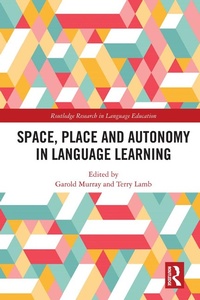
Space, Place and Autonomy in Language Learning
Published on 3. November 2017
282 pages
978-1-317-22089-3 (ISBN)
Description

This book explores theories of space and place in relation to autonomy in language learning. Encompassing a wide range of linguistically and culturally diverse learning contexts, this edited collection brings together research papers from academics working in fourteen countries. In their studies, these researchers examine physical, virtual and metaphorical learning spaces from a wide range of theoretical and interdisciplinary perspectives (semiotic, ecological, complexity, human geography, linguistic landscapes, mediated discourse analysis, sociocultural, constructivist and social constructivist) and methodological approaches. The book traces its origins to the first-ever symposium on space, place and autonomy, which was held at the International Association of Applied Linguistics (AILA) 2014 World Congress in Brisbane. The final chapter, which presents a thematic analysis of the papers in this volume, discusses the implications for theory development, further enquiry, and pedagogical practice.
Reviews / Votes
'Our concepts and practices of time and space are socially constructed and understood by us, not as they were a decade ago, and not as they will a decade from now. Notions of classrooms, learning programs and centers, and educational institutions themselves are increasingly becoming challenged and re-imagined, and the theories and research from this volume can help guide our re-imaginings . . . readers will think differently of space and place.' - Joseph Falout, Nihon University, Japan 'Our concepts and practices of time and space are socially constructed and understood by us, not as they were a decade ago, and not as they will a decade from now. Notions of classrooms, learning programs and centers, and educational institutions themselves are increasingly becoming challenged and re-imagined, and the theories and research from this volume can help guide our re-imaginings . . . readers will think differently of space and place.' - Joseph Falout, Nihon University, JapanMore details
Series
Language
English
Place of publication
London
United Kingdom
Publishing group
Taylor & Francis Ltd
Target group
College/higher education
Professional and scholarly
Product notice
Reflowable
Illustrations
13 Tables, black and white
File size
2,18 MB
ISBN-13
978-1-317-22089-3 (9781317220893)
Copyright in bibliographic data and cover images is held by Nielsen Book Services Limited or by the publishers or by their respective licensors: all rights reserved.
Schweitzer Classification
Other editions
Additional editions
Garold Murray | Terry Lamb
Space, Place and Autonomy in Language Learning
Book
03/2019
1st Edition
Routledge
€70.00
Shipment within 15-20 days
Garold Murray | Terry Lamb
Space, Place and Autonomy in Language Learning
Book
11/2017
1st Edition
Routledge
€232.00
Shipment within 10-20 days
Persons
Garold Murray is an associate professor in the Center for Liberal Arts and Language Education at Okayama University, Japan.
Terry Lamb is a professor of languages and interdisciplinary pedagogy and head of the Westminster Centre for Teaching Innovation at the University of Westminster, London, UK.
Terry Lamb is a professor of languages and interdisciplinary pedagogy and head of the Westminster Centre for Teaching Innovation at the University of Westminster, London, UK.
Content
List of contributors
1. Space, place and autonomy in language learning: an introduction (Terry Lamb and Garold Murray)
Part 1: Urban spaces
2. Collective autonomy and multilingual spaces in super-diverse urban contexts: interdisciplinary perspectives (Terry Lamb and Goran Vodicka)
3. Emotion in the construction of space, place and autonomous learning opportunities (Cynthia White and Jennifer Bown)
4. Learning a language for free: space and autonomy in adult foreign language learning (Alice Chik)
5. The 'English Cafe' as a social learning place (Cem Balcikanli)
6 Multilingual linguistic landscapes as a site for developing learner autonomy (Antje Wilton And Christian Ludwig)
Part 2: Teacher education spaces
7. Teacher education for autonomy: case pedagogy as an empowering interspace between reality and ideals (Manuel Jimenez Raya and Flavia Vieira)
8 Language students designing a learning project for children: a matter of managing multiple attention spaces (Leena Kuure)
9 Naoko's story: one autonomous learner's journey through time and space (Beverly-Anne Carter)
Part 3: Classroom spaces and beyond
10 Ownership of learning spaces through humour (Mehtap Kocatepe)
11 Creating spaces for learning: structure and agency in EST course design (Christoph A. Hafner and Lindsay Miller)
12 Time, space and memory in the teaching and learning of English within a Brazilian juvenile detention centre: the effect of suspension in a confused space (Valdeni Da Silva Reis)
Part 4: Institutional spaces
13. Spaced out or zoned in? An exploratory study of spaces enabling autonomous learning in two New Zealand tertiary learning institutions (Moira Hobbs and Kerstin Dofs)
14. Autonomous learning support base: enhancing autonomy in a TEFL undergraduate program (Walkyria Magno E Silva)
15. Social learning spaces and the invisible fence (Garold Murray, Naomi Fujishima and Mariko Uzuka)
Conclusion
16. Space, place, autonomy and the road not yet taken (Garold Murray and Terry Lamb)
Index
1. Space, place and autonomy in language learning: an introduction (Terry Lamb and Garold Murray)
Part 1: Urban spaces
2. Collective autonomy and multilingual spaces in super-diverse urban contexts: interdisciplinary perspectives (Terry Lamb and Goran Vodicka)
3. Emotion in the construction of space, place and autonomous learning opportunities (Cynthia White and Jennifer Bown)
4. Learning a language for free: space and autonomy in adult foreign language learning (Alice Chik)
5. The 'English Cafe' as a social learning place (Cem Balcikanli)
6 Multilingual linguistic landscapes as a site for developing learner autonomy (Antje Wilton And Christian Ludwig)
Part 2: Teacher education spaces
7. Teacher education for autonomy: case pedagogy as an empowering interspace between reality and ideals (Manuel Jimenez Raya and Flavia Vieira)
8 Language students designing a learning project for children: a matter of managing multiple attention spaces (Leena Kuure)
9 Naoko's story: one autonomous learner's journey through time and space (Beverly-Anne Carter)
Part 3: Classroom spaces and beyond
10 Ownership of learning spaces through humour (Mehtap Kocatepe)
11 Creating spaces for learning: structure and agency in EST course design (Christoph A. Hafner and Lindsay Miller)
12 Time, space and memory in the teaching and learning of English within a Brazilian juvenile detention centre: the effect of suspension in a confused space (Valdeni Da Silva Reis)
Part 4: Institutional spaces
13. Spaced out or zoned in? An exploratory study of spaces enabling autonomous learning in two New Zealand tertiary learning institutions (Moira Hobbs and Kerstin Dofs)
14. Autonomous learning support base: enhancing autonomy in a TEFL undergraduate program (Walkyria Magno E Silva)
15. Social learning spaces and the invisible fence (Garold Murray, Naomi Fujishima and Mariko Uzuka)
Conclusion
16. Space, place, autonomy and the road not yet taken (Garold Murray and Terry Lamb)
Index
