

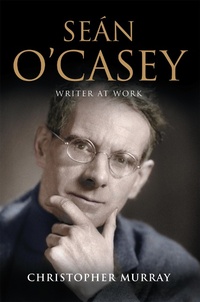
Sean O'Casey, Writer at Work
Description

Christopher Murray's definitive study of Seán O'Casey, the last great writer of the Irish literary revival, provides a strong interpretative context for his life. Murray looks afresh at the Dublin of the 1880s and 1890s in order to provide an authoritative background to O'Casey's childhood. He pays particular attention to the political situation from 1880 to 1922, setting it against O'Casey's own treatment in his autobiographies in an attempt to establish 'O'Casey's Ireland'. But O'Casey was an international as well as a national figure: half his life was spent away from Ireland and his annual income came mainly from the USA. Murray considers O'Casey's career up to the controversial premiere of The Plough and the Stars in 1926 in the light of W.B. Yeats and Lady Gregory and their dream of a national theatre. Thereafter he interprets it in a much wider, equally contentious, international context, chronicling his subsequent projects, which included The Silver Tassie and his Marxist play The Star Turns Red. Murray establishes O'Casey as a self-made man of letters, an irrepressible fighter, a man who combined political courage and innocence, an individual torn between a humanist vision of life rooted in his Dublin childhood and a utopian but blinkered loyalty to the Soviet Union. Murray contends that while much of O'Casey's work was uneven, flawed and overambitious, at its best it was infused with a passion and generosity that place it among the best bodies of drama in the twentieth century. Rich in original material, Murray's biography reconstructs a life committed to the act of writing as a moral endeavour. There was something profoundly religious in O'Casey's psyche, which was at war with the communism he embraced, just as there was something profoundly romantic in a sensibility that retained the image of his first love throughout his years in exile. He was a man of many contradictions, a complex, combative public figure and yet a warm and intimate family man. If Seán O'Casey's life was in the end a failure, it was a noble one which reveals that, to quote a Jacobean playwright he admired, 'Integrity of life is fame's best friend'. That integrity shines through in this biography more brightly and engagingly than ever before.
- Beginnings
- Seeing Things
- 'Give Me That Old Style Religion!'
- 'To Make Eternal Silence Speak'
- Under Which Flag?
- Love Among the Ruins
- Going Through the Mill
- Telling It Like It Is
- 'I Banish You!'
- London Lights and The Silver Tassie
- Trapped Inside the Gates?
- 'Beside the Golden Door'
- O'Casey's Good War
- Oak Leaves and Lavender
- Cock-a-Doodle Dandy
- The Road to Torquay
- The Writer's Not for Burning
- A Death in the Family
- The Drums of Archbishop McQuaid
- Something of a Renaissance
- Talking to God
More details
Other editions
Additional editions
Person
Content
- Cover
- Title page
- Dedication
- Contents
- Preconception(s)
- Part 1: First Things
- Chapter 1: Beginnings
- Chapter 2: Seeing Things
- Chapter 3: 'Give Me That Old Style Religion!'
- Chapter 4: 'To Make Eternal Silence Speak'
- Chapter 5: Under Which Flag?
- Part 2: The Dublin Plays
- Chapter 6: Love Among the Ruins
- Chapter 7: Going Through the Mill
- Chapter 8: Telling It Like It Is
- Chapter 9: 'I Banish You!'
- Part 3: London - New York - London
- Chapter 10: London Lights and The Silver Tassie
- Chapter 11: Trapped Inside the Gates?
- Chapter 12: 'Beside the Golden Door'
- Part 4: Toughing It Out In Devon
- Chapter 13: O'Casey's Good War
- Chapter 14: Oak Leaves and Lavender
- Chapter 15: Cock-a-Doodle Dandy
- Chapter 16: The Road to Torquay
- Part 5: Last Things
- Chapter 17: The Writer's Not for Burning
- Chapter 18: A Death in the Family
- Chapter 19: The Drums of Archbishop McQuaid
- Chapter 20: Something of a Renaissance
- Chapter 21: Talking to God
- Afterlife
- List of Abbreviations
- Notes
- Selected Bibliography
- Acknowledgements
- Copyright
- About the Author
- About Gill & Macmillan
