

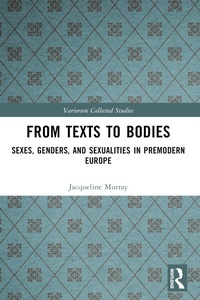
From Texts to Bodies
Sexes, Genders, and Sexualities in Premodern Europe
1st Edition
Published on 24. April 2025
406 pages
978-1-040-33519-2 (ISBN)
Description

From Texts to Bodies: Sexes, Genders, and Sexualities in Premodern Europe reflects the historiographical changes to the study of women, gender, and sexuality in premodern Europe across the 1990s into the 2010s. Developing from post-Baby Boom interest in marriage and the family, subsequently inspired by feminist theory and cultural studies, scholars turned their gaze to the wider field of sex and gender. Using an interdisciplinary methodology and a broad cross-section of medieval primary sources, these articles trace the evolution of medieval studies from the family, through women and gender, to focus on sex and sexuality, concluding with critical analyses of men, masculinity, and male embodiment.
Part I focuses on medieval women within the context of marriage, family, and the church and reveals new approaches to recovering women's experiences. The articles sit at the transition point between recuperative women's history and critical gender history. Part II uses an interdisciplinary lens to examine the body, sex, and sexuality and the intersections of sex/sexualities and genders. The innovative articles in Part III comprise the foundations for the critical analysis of premodern men, masculinity, embodiment, and male sexuality. Together, these studies demonstrate the expansion of research from the examination of theoretical texts to the analysis of bodies as lived experience.
This volume will be of interest to scholars and students of premodern marriage, genders, sexualities, and embodiment, as well as those interested in the social and religious contexts of premodern society. Clear and accessible, this volume also provides an introduction and overview for readers with a broad interest in the Middle Ages.
Part I focuses on medieval women within the context of marriage, family, and the church and reveals new approaches to recovering women's experiences. The articles sit at the transition point between recuperative women's history and critical gender history. Part II uses an interdisciplinary lens to examine the body, sex, and sexuality and the intersections of sex/sexualities and genders. The innovative articles in Part III comprise the foundations for the critical analysis of premodern men, masculinity, embodiment, and male sexuality. Together, these studies demonstrate the expansion of research from the examination of theoretical texts to the analysis of bodies as lived experience.
This volume will be of interest to scholars and students of premodern marriage, genders, sexualities, and embodiment, as well as those interested in the social and religious contexts of premodern society. Clear and accessible, this volume also provides an introduction and overview for readers with a broad interest in the Middle Ages.
More details
Series
Edition
1. Auflage
Language
English
Place of publication
London
United Kingdom
Publishing group
Taylor & Francis Ltd
Target group
Professional and scholarly
College/higher education
Illustrations
2 Halftones, black and white; 2 Illustrations, black and white
File size
1,47 MB
ISBN-13
978-1-040-33519-2 (9781040335192)
Copyright in bibliographic data and cover images is held by Nielsen Book Services Limited or by the publishers or by their respective licensors: all rights reserved.
Schweitzer Classification
Other editions
Additional editions
Book
approx. 07/2026
1st Edition
Routledge
€57.50
Not yet published

Book
05/2025
Routledge
Unfortunately, price unknown
Available (delivery time upon request)
Book
04/2025
1st Edition
Routledge
€232.90
Shipment within 10-20 days
Person
Jacqueline Murray is University Professor Emeritus of History at the University of Guelph. She is an internationally recognized pioneer in medieval social history and a leader in medieval gender and sexuality studies. She earned her BA from the University of British Columbia and MA and PhD from the University of Toronto. Her thirty scholarly articles and seventeen collections of essays about sexuality, gender, and particularly medieval masculinity have transformed our understanding of the past and opened new research areas. She is a frequent contributor to the popular media, demonstrating the relevance of medieval roots to contemporary questions about sex and gender.
Content
Introduction
PART I: WOMEN, MARRIAGE, AND GENDER
1. Kinship and Friendship: The Perception of Family by Clergy and Laity in Late Medieval London. In Albion 20, no. 3 (1988): 369-385.
2. Individualism and Consensual Marriage: Some Evidence from Medieval England. In Women, Marriage, and the Family in Medieval Christendom. Essays in Memory of Michael M. Sheehan, edited by Joel T. Rosenthal and Constance M. Rousseau, 121-151. Kalamazoo, MI: Medieval Institute Publications, Western Michigan University, 1998.
3. The Absent Penitent: The Cure of Women's Souls and Confessors' Manuals in Thirteenth-Century England. In Women, the Book, and the Godly, edited by Lesley Smith and Jane H. M. Taylor, 13-25. London: Boydell and Brewer, 1995.
4. On the Origins and Role of 'Wise Women' in Causes for Annulment on the Grounds of Male Impotence. In Journal of Medieval History 16, no. 3 (1990): 235-249.
5. Twice Marginal and Twice Invisible: Lesbians in the Middle Ages. In Handbook of Medieval Sexuality, edited by Vern L. Bullough and James A. Brundage, 191-211. New York: Garland, 1996.
6. Thinking about Gender: The Diversity of Medieval Perspectives. In Power of the Weak: Women in the Middle Ages, edited by J. Carpenter and S. B. Maclean, 1-26. Chicago: University of Illinois Press, 1995.
PART II: SEXUALITIES AND GENDERS
7. Gendered Souls in Sexed Bodies: The Male Construction of Sexuality in Some Medieval Confessor's Manuals. In Handling Sin: Confession in the Middle Ages, edited by Peter Biller and A. J. Minnis, York Studies in Medieval Theology, vol. 2, 79-93. York, Eng.: Boydell and Brewer, 1998.
8. Historicizing Sex, Sexualizing History. In Writing Medieval History, edited by Nancy Partner, 133-52. London: Hodder, 2005. Reprint, London: Bloomsbury Academic, 2010.
9. The Sexual Body. In A Cultural History of the Body in the Medieval Age, vol. 2, A Cultural History of the Human Body, edited by Linda Kalof, 59-75. Oxford: Berg, 2010.
10. Sexuality and Spirituality: The Intersection of Medieval Theology and Medicine. In Fides et Historia 23, no. 1 (1991): 20-36.
11. Agnolo Firenzuola on Female Sexuality and Women's Equality. In Sixteenth Century Journal 22, no. 1 (1991): 199-213.
12. One Flesh, Two Sexes, Three Genders? In Gender and Christianity in Medieval Europe: New Perspectives, edited by Lisa Bitel and Felice Lifshitz, 52-75. Philadelphia: University of Pennsylvania Press, 2008.
PART III: MEN AND MASCULINITIES
13. Hiding Behind the Universal Man: Male Sexuality in the Middle Ages. In Handbook of Medieval Sexuality, edited by Vern L. Bullough and James A. Brundage, 123-52. New York: Garland, 1996.
14. 'The law of sin that is in my members': The Problem of Male Embodiment. In Gender and Holiness: Men, Women, and Saints in Late Medieval Europe, edited by Samantha J. E. Riches and Sarah Salih, 9-22. London: Routledge, 2002.
15. Masculinizing Religious Life: Sexual Prowess, the Battle for Chastity, and Monastic Identity. In Holiness and Masculinity, edited by Katherine J. Lewis and Patricia Callum, 24-42. Cardiff: University of Wales Press; Toronto: University of Toronto Press, 2004.
16. Men's Bodies, Men's Minds: Seminal Emissions and Sexual Anxiety in the Middle Ages. In Annual Review of Sex Research 8, no. 1 (1997): 1-26.
17. Mystical Castration: Some Reflections on Peter Abelard, Hugh of Lincoln, and Sexual Control. In Conflicted Identities and Multiple Masculinities: Men in the Medieval West, edited by Jacqueline Murray, 73-91. New York: Garland Press, 1999.
18. Sexual Mutilation and Castration Anxiety: A Medieval Perspective. In The Boswell Thesis: Essays on Christianity, Social Tolerance, and Homosexuality, edited by Matthew Kuefler, 254-272. Chicago: University of Chicago Press, 2006.
19. The Battle for Chastity: Miraculous Castration and the Quelling of Desire in the Middle Ages. In Journal of the History of Sexuality 28, no. 1 (2019): 96-116.
Bibliography
Publishers Permissions
PART I: WOMEN, MARRIAGE, AND GENDER
1. Kinship and Friendship: The Perception of Family by Clergy and Laity in Late Medieval London. In Albion 20, no. 3 (1988): 369-385.
2. Individualism and Consensual Marriage: Some Evidence from Medieval England. In Women, Marriage, and the Family in Medieval Christendom. Essays in Memory of Michael M. Sheehan, edited by Joel T. Rosenthal and Constance M. Rousseau, 121-151. Kalamazoo, MI: Medieval Institute Publications, Western Michigan University, 1998.
3. The Absent Penitent: The Cure of Women's Souls and Confessors' Manuals in Thirteenth-Century England. In Women, the Book, and the Godly, edited by Lesley Smith and Jane H. M. Taylor, 13-25. London: Boydell and Brewer, 1995.
4. On the Origins and Role of 'Wise Women' in Causes for Annulment on the Grounds of Male Impotence. In Journal of Medieval History 16, no. 3 (1990): 235-249.
5. Twice Marginal and Twice Invisible: Lesbians in the Middle Ages. In Handbook of Medieval Sexuality, edited by Vern L. Bullough and James A. Brundage, 191-211. New York: Garland, 1996.
6. Thinking about Gender: The Diversity of Medieval Perspectives. In Power of the Weak: Women in the Middle Ages, edited by J. Carpenter and S. B. Maclean, 1-26. Chicago: University of Illinois Press, 1995.
PART II: SEXUALITIES AND GENDERS
7. Gendered Souls in Sexed Bodies: The Male Construction of Sexuality in Some Medieval Confessor's Manuals. In Handling Sin: Confession in the Middle Ages, edited by Peter Biller and A. J. Minnis, York Studies in Medieval Theology, vol. 2, 79-93. York, Eng.: Boydell and Brewer, 1998.
8. Historicizing Sex, Sexualizing History. In Writing Medieval History, edited by Nancy Partner, 133-52. London: Hodder, 2005. Reprint, London: Bloomsbury Academic, 2010.
9. The Sexual Body. In A Cultural History of the Body in the Medieval Age, vol. 2, A Cultural History of the Human Body, edited by Linda Kalof, 59-75. Oxford: Berg, 2010.
10. Sexuality and Spirituality: The Intersection of Medieval Theology and Medicine. In Fides et Historia 23, no. 1 (1991): 20-36.
11. Agnolo Firenzuola on Female Sexuality and Women's Equality. In Sixteenth Century Journal 22, no. 1 (1991): 199-213.
12. One Flesh, Two Sexes, Three Genders? In Gender and Christianity in Medieval Europe: New Perspectives, edited by Lisa Bitel and Felice Lifshitz, 52-75. Philadelphia: University of Pennsylvania Press, 2008.
PART III: MEN AND MASCULINITIES
13. Hiding Behind the Universal Man: Male Sexuality in the Middle Ages. In Handbook of Medieval Sexuality, edited by Vern L. Bullough and James A. Brundage, 123-52. New York: Garland, 1996.
14. 'The law of sin that is in my members': The Problem of Male Embodiment. In Gender and Holiness: Men, Women, and Saints in Late Medieval Europe, edited by Samantha J. E. Riches and Sarah Salih, 9-22. London: Routledge, 2002.
15. Masculinizing Religious Life: Sexual Prowess, the Battle for Chastity, and Monastic Identity. In Holiness and Masculinity, edited by Katherine J. Lewis and Patricia Callum, 24-42. Cardiff: University of Wales Press; Toronto: University of Toronto Press, 2004.
16. Men's Bodies, Men's Minds: Seminal Emissions and Sexual Anxiety in the Middle Ages. In Annual Review of Sex Research 8, no. 1 (1997): 1-26.
17. Mystical Castration: Some Reflections on Peter Abelard, Hugh of Lincoln, and Sexual Control. In Conflicted Identities and Multiple Masculinities: Men in the Medieval West, edited by Jacqueline Murray, 73-91. New York: Garland Press, 1999.
18. Sexual Mutilation and Castration Anxiety: A Medieval Perspective. In The Boswell Thesis: Essays on Christianity, Social Tolerance, and Homosexuality, edited by Matthew Kuefler, 254-272. Chicago: University of Chicago Press, 2006.
19. The Battle for Chastity: Miraculous Castration and the Quelling of Desire in the Middle Ages. In Journal of the History of Sexuality 28, no. 1 (2019): 96-116.
Bibliography
Publishers Permissions
