

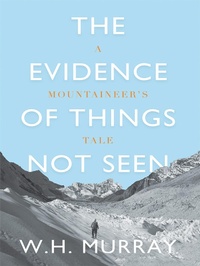
The Evidence of Things Not Seen
Description

The Evidence of Things Not Seen is the autobiography of remarkable mountaineer, writer and environmentalist W.H. Murray. After being introduced to climbing in his early twenties, Murray's relationship with the outdoors was shaped as much by his time on the mountains as away from them. His early Scottish climbs were brought to a halt by the Second World War, which saw him spend three years as a Nazi prisoner of war. These years were devoted to not only to philosophical study, but also to writing his classic Mountaineering in Scotland not once, but twice, on toilet paper.
The time to write about mountains only fuelled Murray's enthusiasm to climb them. The regeneration in mountaineering that followed the war saw Murray complete three Himalayan expeditions, alongside other iconic figures such as Doug Scott, Tom MacKinnon and Tom Weir, and Eric Shipton. He not only explored Himalayan peaks never before attempted by westerners, but also established the crucial Khumbu Icefall route up Everest, which paved the way for the mountain's first ascent in 1953.
Later life saw Murray return to Scotland and begin the fight to conserve the wild places that motivated him. From pioneering the John Muir Trust to fighting threats to forestry, Murray's writing is laced with a philosophical edge and a contagious appreciation for Scotland's wild places, capturing the essence of why Murray's work has been inspiring readers for decades.
Written just before his death in 1996, and with a foreword by renowned Scottish mountaineer Hamish MacInnes, The Evidence of Things Not Seen is a must-read for anyone for which the mountains are still a source of wonder.
More details
Other editions
Additional editions
Person
W.H. Murray is one of Britain's most significant mountain writers. Born in Liverpool in 1913, he soon moved to Glasgow, where he was later introduced Scotland's mountains. His pioneering early climbs in the 1930s came to a halt at the outbreak of World War Two, in which he saw combat in Africa before being captured as a Nazi prisoner of war. He spent three years as a captive, but was not idle, devoting much of his time to philosophical study and meditation. It is during this time he wrote his classic Mountaineering in Scotland not once, but twice on toilet paper. After his release he went on to complete three expeditions to the Himalaya in the 1950s. One of these, his 1951 Everest Reconnaissance Expedition, established a route up Everest via the Khumbu Icefall, paving the way for the first ascent in 1953. The remainder of Murray's life was devoted to writing about and conserving the wild places he loved. A founding member of both the Scottish Countryside Activities Council and the John Muir Trust, he also acted as advisor on mountain properties for the National Trust for Scotland, and was President for both the Mountaineering Council for Scotland and the Scottish Mountaineering Club. He was a prolific writer, publishing twenty books and countless articles. These include the classics Mountaineering in Scotland and Undiscovered Scotland, as well as his autobiography, The Evidence of Things Not Seen, for which he posthumously won the Grand Prize at the Banff Mountain Book Festival 2002. These remarkable achievements ensured that he continues to inspire readers old and new to this day.
Content
- Intro
- Contents
- Foreword by Hamish MacInnes
- Early Years
- Chapter 1: Twists of the Thread
- Chapter 2: Siren Song
- Pre-War Climbing in Scotland
- Chapter 3: Rocks and Climbers
- Chapter 4: Renaissance: 1930s
- Chapter 5: The Winter Ascent of Garrick's Shelf
- Fortunes of War
- Chapter 6: The Home Front
- Chapter 7: North Africa
- Chapter 8: To Iraq and Cyprus
- Chapter 9: The Battle of the Cauldron
- Incarceration
- Chapter 10: Stone Walls: Chieti
- Chapter 11: To Bavaria and Bohemia
- Chapter 12: Brunswick
- The Post-War World
- Chapter 13: Home
- Chapter 14: The Right Holds
- Chapter 15: Freedom - Decisions to Make
- Chapter 16: First Steps
- Chapter 17: The Alps: Highs and Lows
- First Expeditions to the Himalaya
- Chapter 18: Introduction to the Garhwal
- Chapter 19: To the Rishi Gorge
- Chapter 20: Attempts on Bethartoli Himal and Hanuman
- Chapter 21: Mountaineering and Medicine in Dunagiri
- Chapter 22: The Ascent of Uja Tirche and an attempt on Lampak South
- Chapter 23: Through the Girthi Gorge to Milam
- Chapter 24: The Ralam Pass and Panch Chuli
- Chapter 25: The Untrodden Ranges: Around Menlungste and Gaurisankar
- Exploring the Api Massif
- Chapter 26: Approach to Api: The Kali Gorge
- Chapter 27: Api and Nampa
- Chapter 28: Yokapahar Himal - Warnings
- Chapter 29: Tibet - Into Chinese Held Territory
- Chapter 30: The Seti Gorge
- Chapter 31: A Meeting with the Rajah of Bajhang
- Everest and the Muztagh Tower
- Chapter 32: Everest and the Muztagh Tower: The seemingly impossible overcome
- Concerns Closer to Home
- Chapter 33: Return to Scotland
- Chapter 34: The Cragsmen of Lewis: How they climbed the Great Stac of Handa
- Chapter 35: The Life of Ben Humble: Tribute to a Fighter
- Chapter 36: A Writer's World
- Chapter 37: Conservation
- Chapter 38: Tomorrow
- Epilogue
- Appendices
- Appendix I: Murray's Books, Plays and Articles plus a selection of relevant articles and books by others
- Appendix II: Sundry Correspondence
- Appendix III: Writing about Climbing and Mountain Landscape
- Appendix IV: The Rob Roy Affair
- Appendix V: Publishing and the Practicalities of the Writing Business
- Photographs, Maps and Illustrations
