

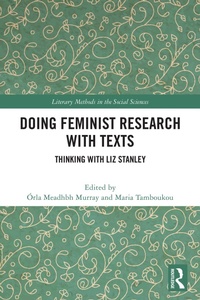
Doing Feminist Research with Texts
Thinking with Liz Stanley
Published on 2. June 2026
236 pages
978-1-040-66678-4 (ISBN)
Description

This festschrift honours the work of Liz Stanley, whose scholarship has been highly influential in opening new paths in feminist research across the human sciences. Bringing together contributions from scholars shaped by her thinking, the volume reflects both on the intellectual reach of her work and on its continuing capacity to inspire feminist inquiry.
The chapters engage with key strands of Stanley's intellectual legacy, including feminist epistemologies, the auto/ biographical I, letters and correspondences, the epistolarium, and her concept of archigraphics as a way of opening the 'black box' of the archive. Through a wide range of studies, contributors explore her challenge to mainstream sociology, her distinctive approach to feminist research with texts, her foundational role in auto/ biography studies, her systematic analysis of letters and correspondences, and her pioneering work on archives, temporality, and the writing of history. Collectively, the contributions trace an intellectual lineage and demonstrate the enduring relevance and generative power of Stanley's scholarship across disciplines.
This volume is intended for scholars and postgraduate students in the social sciences and humanities, particularly those working in feminist theory, qualitative methods, archival studies, auto/ biography, and the sociology of knowledge.
The chapters engage with key strands of Stanley's intellectual legacy, including feminist epistemologies, the auto/ biographical I, letters and correspondences, the epistolarium, and her concept of archigraphics as a way of opening the 'black box' of the archive. Through a wide range of studies, contributors explore her challenge to mainstream sociology, her distinctive approach to feminist research with texts, her foundational role in auto/ biography studies, her systematic analysis of letters and correspondences, and her pioneering work on archives, temporality, and the writing of history. Collectively, the contributions trace an intellectual lineage and demonstrate the enduring relevance and generative power of Stanley's scholarship across disciplines.
This volume is intended for scholars and postgraduate students in the social sciences and humanities, particularly those working in feminist theory, qualitative methods, archival studies, auto/ biography, and the sociology of knowledge.
More details
Series
Language
English
Place of publication
London
United Kingdom
Publishing group
Taylor & Francis Ltd
Target group
College/higher education
Product notice
Reflowable
Illustrations
3 Halftones, black and white; 3 Illustrations, black and white
File size
3,16 MB
ISBN-13
978-1-040-66678-4 (9781040666784)
Copyright in bibliographic data and cover images is held by Nielsen Book Services Limited or by the publishers or by their respective licensors: all rights reserved.
Schweitzer Classification
Other editions
Additional editions
Book
06/2026
1st Edition
Routledge
€201.50
Shipment within 10-20 days
Persons
Orla Meadhbh Murray (she/ they) is Assistant Professor of Criminology and Sociology at Northumbria University, Fellow at Durham University's Institute for Medical Humanities, and co- founder of the Institutional Ethnography Network. Their research addresses inequalities in higher education, sociology of the gut, and feminist knowledge production, primarily through institutional ethnography.
Maria Tamboukou is a scholar in Gender and Feminist Studies and has held professorial roles in the UK, Sweden, and Australia. Her work spans feminist epistemologies, narrative inquiry, and archival research. She has published widely, including her latest book, Numbers and Narratives: A Feminist Genealogy of Automathographies (2025).
Maria Tamboukou is a scholar in Gender and Feminist Studies and has held professorial roles in the UK, Sweden, and Australia. Her work spans feminist epistemologies, narrative inquiry, and archival research. She has published widely, including her latest book, Numbers and Narratives: A Feminist Genealogy of Automathographies (2025).
Content
Foreword Introduction: Liz Stanley and the Power of Texts: A Feminist Sociological Tribute Part I: Challenging Sociology 1. On Provocation 2. How we feel: the Mass Observation Archive, Elias and doing sociology Part II: Doing Feminist Research with Texts 3. Beyond the cookbook: Feminist research, personal narratives, and scholarly insights 4. A Stanleyian Toolkit Approach: Learning to Read and Write with Feminist Fractured Foundationalism Part III: Thinking Auto/Biographically 5. Wave~Diffractions. Revisiting the Untimely Academic Novellas in the Anthropocene 6. (Un)alienated Groundings: Feminist and Queer Revisions of Indian Personal Narratives 7. Relating with past lives: cultural historian as a biographer Part IV: Reading and Rewriting Letters 8. The stroke of my pen: On transferring the past into the present 9. Learning and Teaching about the Epistolarium in a Foreign Language Degree in Brazil: A Correspondence Between a Teacher, Her Two Students, and the Author They Read 10. Emergent properties in the letters of Nancy Nolan and Leonard Woolf: "...produce something good for yourself and possibly at some time good for other people..." Part V: Problematising the Archive 11. Fan letter from a sociologist of secrets in the archive 12. Women mathematicians' 'epistolaria': between the personal and the scientific Afterword: Toward Feminist Textualities Yet to Come
