

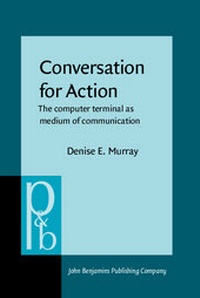
Conversation for Action
The computer terminal as medium of communication
1st Edition
Published on 13. December 1991
XII, 176 pages
978-90-272-8330-6 (ISBN)
Description

Today, computer-mediated communication spans a range of activities from interactive messages to word processing. Researchers interested in this new technology have concentrated on its effects in the workplace for knowledge production and dissemination or on its word processing function. The study reported here examines communication events in which the computer is the medium and views such computer-mediated communication from the perspective of language use. Its goal is to understand, through data collected from an anthropological perspective, the ways of communicating used by members of an established community of computer users. In particular, it answers the questions: (i) How do computer communicators choose among the available media and modes of communication? (ii) What are the basic and recurring discourse patterns across media and modes through which this community achieves its institutional goals of innovation and product development? (iii) How do the answers to the previous two questions inform our understanding of language use in general?
More details
Other editions
Additional editions
Book
12/1991
John Benjamins Publishing Co
€104.94
Shipment within 10-15 days
Person
Content
- CONVERSATION FOR ACTION
- Editorial page
- Title page
- Copyright page
- Acknowledgements
- Table of contents
- Settings and Actors
- IBM sites (with n etwork node), employees and roles
- Transcription Conventions
- Conventions used by computer-mediated communicators
- Researcher's transcription conventions
- Chapter 1. INTRODUCTION
- PART I: THE WEB OF COMMUNICATION
- Chapter 2. WORKING AT PARK LAB
- Tuesday, October 1984
- Meeting room 999
- Wednesday
- Friday, May 1985
- Chapter 3. WHO SPEAKS WHAT LANGUAGE
- 1. Face-to-face communication
- 2. Telephone
- 3. Computer-mediated communication
- 3.1 Computer Messages
- 3.2 Computer Mail
- 3.3 Computer Conferencing
- 3.4 Forums
- 3.5 Bulletin Boards
- 3.6 Documents
- 3.7 Bill Boards (e.g. HELP files)
- 4. Hard copy
- 4.1 Paper/print
- 4.2 Overhead transparencies
- 4.3 Whiteboard
- Chapter 4. WHO SPEAKS TO WHOM
- 1. Networks of dialogues via E-messages
- 2. Networks of dialogues via E-mail
- 3. Carbon Copying (CC)
- 4. Networks of dialogues via telephone
- 5. Networks of dialogues via face-to-face interaction
- Chapter 5. WHO SPEAKS WHAT LANGUAGE TO WHOM AND WHEN?12
- PART II: TERMINAL LITERACY
- Chapter 6. APPROACHES TO VARIATION IN LANGUAGE
- 1. Literacy traditions
- 2. Ways of speaking
- 2.1 Speech style
- 2.2 Register
- 2.3 Genre
- 3. Context of situation
- Chapter 7. TAXONOMY OF MODE/MEDIA CHOICES
- PART III: CONVERSATION FOR ACTION
- Chapter 8. THE OBJECT OF DISCOURSE STUDY
- Chapter 9. STRUCTURE OF COMPUTER-MEDIATED CONVERSATION
- 1. Various approaches
- 1.1 Conversation analysis approach
- 1.2 Winograd and Flores approach
- 1.3 Folk notions
- 2. Applying models of discourse structure
- 2.1Firstsampleconversation
- 2.2 Second sample conversation
- 2.3 Third sample conversation
- 2.4 Fourth sample conversation
- 3. Alternative approach
- Chapter 10. THE SCHEMA FOR A CONVERSATION FOR ACTION
- 1. A Model for conversation for action
- 1.1 Negotiate action
- 1.2. Negotiate Open
- 1.3 Negotiate close
- 2. Interpretive principles
- 3. External contingencies
- Chapter 11. NEGOTIATING THE CONDITIONS FOR CONVERSATION19
- 1. Bid refuse: Negotiating conditions of agreement
- 1.1. Requestee refusal
- 1.2 Requestor response
- 1.3 Justification: Pre-establishing the conditions
- 1.4 Multiple validity claims
- 1.5 Ju- stificationas pre-sequence
- 1.6 The effects of medium
- Chapter 12. COLLABORATIVE INFORMATION DEVELOPMENT
- 1. Structure of collaborative information development
- 1.1 Action structure
- 1.2 Participant structure
- 1.3 Con versa tion for information developm ent
- PART IV: CONCLUSIONS
- 1. Literacy
- 1.1 Literacy and education
- 2. Conversation for action
- 2.2 Other contexts
- 2.3 Computer tools
- Appendix A. DATA COLLECTION
- Appendix B. FLOOR PLAN OF PARK LAB
- Appendix C. FLOOR PLAN OF LES'S OFFICE
- NOTES
- REFERENCES
- AUTHOR INDEX
- SUBJECT INDEX
