

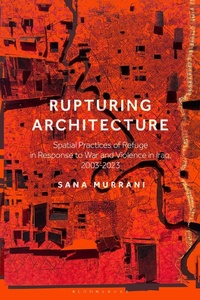
Rupturing Architecture
Spatial Practices of Refuge in Response to War and Violence in Iraq, 2003-2023
1st Edition
Published on 5. September 2024
248 pages
978-1-350-32536-4 (ISBN)
Description

This is the first book to critically and visually explore the spatial practices of refuge in response to conditions of war, violence, and displacement experienced in Iraq from 2003 to 2023.
Written by an Iraqi architect who has lived through the trauma of several wars, 10 years of UN-imposed sanctions, an invasion, and the subsequent violence, this book captures a broad spectrum of spatial responses to trauma and presents a fresh perspective on how ordinary Iraqis create refuge across the spaces of the home, the urban environment, and border geographies.
In the face of spatial wounding and the many injustices suffered by the Iraqi people, there has also been a wealth of refuge-making practices that showcase their creative and imaginative design and adaptability to change and trauma over time. Rupturing Architecture employs methods such as creative deep mapping, memory work, storytelling, interviews, and case studies of architectural responses to the geographies of war and violence. At the core of the book are the lived and felt experiences of fifteen Iraqis from across Iraq, whose resilience underscores a broader narrative of spatial justice and feminist spatial practices. The book articulates the dual nature of rupturing as both a sign of trauma and a powerful act of resistance, examining how these forces shape domesticity, urbanity, and border spaces. The concluding manifesto for spatial justice calls for a deep, integrated understanding of place, memory, and trauma, advocating for comprehensive strategies in the making of refuge spaces that also resonate in a wider, global context.
Written by an Iraqi architect who has lived through the trauma of several wars, 10 years of UN-imposed sanctions, an invasion, and the subsequent violence, this book captures a broad spectrum of spatial responses to trauma and presents a fresh perspective on how ordinary Iraqis create refuge across the spaces of the home, the urban environment, and border geographies.
In the face of spatial wounding and the many injustices suffered by the Iraqi people, there has also been a wealth of refuge-making practices that showcase their creative and imaginative design and adaptability to change and trauma over time. Rupturing Architecture employs methods such as creative deep mapping, memory work, storytelling, interviews, and case studies of architectural responses to the geographies of war and violence. At the core of the book are the lived and felt experiences of fifteen Iraqis from across Iraq, whose resilience underscores a broader narrative of spatial justice and feminist spatial practices. The book articulates the dual nature of rupturing as both a sign of trauma and a powerful act of resistance, examining how these forces shape domesticity, urbanity, and border spaces. The concluding manifesto for spatial justice calls for a deep, integrated understanding of place, memory, and trauma, advocating for comprehensive strategies in the making of refuge spaces that also resonate in a wider, global context.
More details
Edition
1. Auflage
Language
English
Place of publication
London
United Kingdom
Publishing group
Bloomsbury Publishing PLC
Target group
Professional and scholarly
Illustrations
39 bw illus
ISBN-13
978-1-350-32536-4 (9781350325364)
Copyright in bibliographic data and cover images is held by Nielsen Book Services Limited or by the publishers or by their respective licensors: all rights reserved.
Schweitzer Classification
Other editions
Additional editions
Sana Murrani
Rupturing Architecture
Spatial Practices of Refuge in Response to War and Violence in Iraq, 2003-2023
Book
approx. 01/2026
Bloomsbury Visual Arts
€31.50
Not yet published
Sana Murrani
Rupturing Architecture
Spatial Practices of Refuge in Response to War and Violence in Iraq, 2003-2023
Book
10/2024
Bloomsbury Visual Arts
€121.50
Shipment within 15-20 days
Person
Dr Sana Murrani is Associate Professor in Spatial Practice at the University of Plymouth, UK.
Content
List of illustrations
Preface
Foreword, Elena Fiddian-Qasmiyeh (University College London, UK)
Acknowledgements
Introduction: The spatial structure of Rupturing Architecture
1. The positionality of protracted rupture
Spatial practice in Rupturing Architecture
Deep mapping and the ethics within
Conceptual underpinnings
Siting rupture across and between vernacular informality and humanitarian living
Struggle over refuge
2. Siting trauma spatially: Negotiated and centralized spatial responses from the Global North and South
Locating trauma
Dwelling, shelter and refuge
Divisions and overlaps on a fluid map: From north to south, east to west and back
Spatial responses: Views from the North
Expanded model of spatiality: Views from the South (with a focus on the Middle East)
3. Creative negotiations in spaces of refuge and memory: Material objects, home and domesticity, urban, borders
Intimacies and scales of refuge
Ruptured domesticity
The urban in a spherical space between vertical and horizontal violence
Displacement and mobility inside centres, and into borders
Creative negotiations of spatiality between trauma and violence
4. Architectural structures and disrupted memory of refuge in relation to time
Sudden ruptures
Ruptures of mobility and displacement
Temporal ruptures
Conclusion: A manifesto for structures of refuge in spatial justice
Conceptual findings
Methodological findings
Spatial justice manifesto
References
Index
Preface
Foreword, Elena Fiddian-Qasmiyeh (University College London, UK)
Acknowledgements
Introduction: The spatial structure of Rupturing Architecture
1. The positionality of protracted rupture
Spatial practice in Rupturing Architecture
Deep mapping and the ethics within
Conceptual underpinnings
Siting rupture across and between vernacular informality and humanitarian living
Struggle over refuge
2. Siting trauma spatially: Negotiated and centralized spatial responses from the Global North and South
Locating trauma
Dwelling, shelter and refuge
Divisions and overlaps on a fluid map: From north to south, east to west and back
Spatial responses: Views from the North
Expanded model of spatiality: Views from the South (with a focus on the Middle East)
3. Creative negotiations in spaces of refuge and memory: Material objects, home and domesticity, urban, borders
Intimacies and scales of refuge
Ruptured domesticity
The urban in a spherical space between vertical and horizontal violence
Displacement and mobility inside centres, and into borders
Creative negotiations of spatiality between trauma and violence
4. Architectural structures and disrupted memory of refuge in relation to time
Sudden ruptures
Ruptures of mobility and displacement
Temporal ruptures
Conclusion: A manifesto for structures of refuge in spatial justice
Conceptual findings
Methodological findings
Spatial justice manifesto
References
Index
