

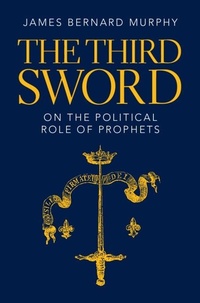
The Third Sword
On The Political Role of Prophets
Published on 29. November 2023
978-1-009-37223-7 (ISBN)
Description

Prophets are wild cards in the game of politics, James Bernard Murphy writes in this startling new book. They risk their lives by calling out the abuses of political and religious leaders, forcing us to confront evils we would prefer to ignore. By setting moral limits on political leaders, prophets chasten our political pretensions and remind us there are values that transcend politics. They wield a third sword-distinct from the familiar swords of state and church power-their sword is the word of God. The Third Sword offers a new take on political history, illustrating a theory of prophetic politics through tales of political crises, interspersed with direct dialogue between the prophets and their persecutors. With chapters on Socrates, Jesus, Joan of Arc, Thomas More, and Martin Luther King, Murphy brings these prophets to life with storytelling that blends biography, history, and political theory.
Reviews / Votes
'The themes of prophets and prophecy have been too long ignored by political theorists. In this brilliant new study, James Murphy makes the case for the prophetic voice as the 'third sword' in politics. Surveying cases from Nathan, Socrates, and Jesus to Joan of Arc, Thomas More, and Martin Luther King, Murphy defines the prophet by the capacity to say 'No.' It is this willingness to heed the voice of conscience and resist the allure of power that makes the prophet such an enduring and often maddening archetype. This book is a must read for every serious political theorist.' Steven B. Smith, Yale University 'Using examples from classical Greece, early Christianity, Medieval Europe and modern America, James Bernard Murphy shows why we need prophets today. Through an historical and bibliographic interpretation of the lives of important figures like Socrates, Jesus, Joan of Arc and Martin Luther King, James Bernard Murphy's engaging writing constitutes a provocative recalling of the social role of prophets that will help us all grow in wisdom.' Margarita Mooney Clayton, Associate Professor of Practical Theology at Princeton Theological Seminary and Executive Director of Scala Foundation 'Most of us, when we think of prophets, don't think of them as playing a political role in their societies. James Murphy's The Third Sword forces us to think again: we have either too narrow a view of prophets or too narrow a view of politics. Taking Socrates, Jesus, Joan of Arc, Thomas More, and Martin Luther King as his examples, Murphy compellingly identifies the distinct political role of prophets: 'The goal of prophetic politics is not to solve problems but to confront evils, not to espouse policies but to raise awareness.' While highlighting the commonality among the prophets he discusses, Murphy, with great acuity and deep scholarship, also articulates what is distinctive of each. A fascinating read, especially the dialogues that Murphy imagines the prophets to have held with their opponents.' Nicholas Wolterstorff, Noah Porter Professor Emeritus of Philosophical Theology, Yale University 'An erudite and engaging account of the essential and enduring role of prophets in Western politics from biblical times until today. Political theorists have long described the 'two swords' of political and religious authority, each with its own power, province, and prerogatives. Professor Murphy shows brilliantly that ever major civilization has also had a 'third sword' wielded by prophets who serve to check and balance the political and religious authorities and to summon citizens to think above, beyond, and against current fashions. An extraordinary and innovative essay in political theology.' John Witte, Jr, Center for the Study of Law and Religion, Emory University 'Standing on its own, the book walks a fine line between philosophy, theology, history, and political science. Chapters provide useful sources for further reading that might pair well with the text in the classroom. The book could also be a nice complement to works by the six prophets or for a fresh take on adversarial political thought. Recommended.' A. P. Audette, CHOICE 'A compelling study of some key ingredients of prophetic identity.' Samuel Hildebrandt, Journal for the Study of the Old TestamentMore details
Language
English
Place of publication
Cambridge
United Kingdom
Illustrations
Worked examples or Exercises
File size
1,54 MB
ISBN-13
978-1-009-37223-7 (9781009372237)
Copyright in bibliographic data and cover images is held by Nielsen Book Services Limited or by the publishers or by their respective licensors: all rights reserved.
Schweitzer Classification
Other editions
Additional editions
Book
12/2023
Cambridge University Press
€29.50
Shipment within 15-20 days
Book
12/2023
Cambridge University Press
€88.00
Shipment within 15-20 days
Person
Content
Introduction: what is prophetic politics?; 1. The Hebrew prophets; 2. Socrates; 3. Jesus of Nazareth; 4. Joan of arc; 5. Thomas more; 6. Martin Luther King Jr; Conclusion: the power of no.
