

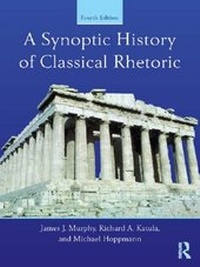
A Synoptic History of Classical Rhetoric
4th Edition
Published on 24. July 2013
304 pages
978-1-136-29291-0 (ISBN)
Description

Continuing its tradition of providing students with a thorough review of ancient Greek and Roman rhetorical theory and practices, A Synoptic History of Classical Rhetoric is the premier text for undergraduate courses and graduate seminars in the history of rhetoric. Offering vivid examples of each classical rhetor, rhetorical period, and source text, students are led to understand rhetoric's role in the exchange of knowledge and ideas. Completely updated throughout, Part I of this new edition integrates new research and expanded footnotes and bibliographies for students to develop their own scholarship. Part II offers eight classical texts for reading, study, and criticism, and includes discussion questions and keys to the text in Part I.
More details
Edition
4th edition
Language
English
Place of publication
London
United Kingdom
Publishing group
Taylor & Francis Ltd
Target group
Professional and scholarly
Edition type
Revised edition
Illustrations
11 s/w Abbildungen, 1 s/w Tabelle, 1 s/w Zeichnung
1 Tables, black and white; 1 Line drawings, black and white; 11 Illustrations, black and white
File size
4,61 MB
ISBN-13
978-1-136-29291-0 (9781136292910)
Copyright in bibliographic data and cover images is held by Nielsen Book Services Limited or by the publishers or by their respective licensors: all rights reserved.
Schweitzer Classification
Other editions
Additional editions
James J. Murphy | Richard A. Katula | Michael Hoppmann
A Synoptic History of Classical Rhetoric
Book
07/2013
4th Edition
Routledge
€110.10
Shipment within 15-20 days
James J. Murphy | Richard A. Katula | Michael Hoppmann
A Synoptic History of Classical Rhetoric
Book
07/2013
4th Edition
Routledge
€230.40
Shipment within 15-20 days
Persons
James J. "Jerry" Murphy (Ph.D., Stanford University, 1957) is Emeritus Professor at the University of California, Davis. He is the author or editor of 21 books and more than 70 scholarly articles. His book Rhetoric in the Middle Ages was acknowledged with the 1975 Speech Communication Association Book Award. He is a Fellow of the Medieval Academy of America, and a Fellow of the Rhetoric Society of America. He was the founding Editor (1983-88) of Rhetorica, journal of the International Society for the History of Rhetoric. He was until 1995 the publisher of Hermagoras Press, devoted to publishing books related to language use. Hermagoras Press is now an imprint of Routledge Publishers. His most recent edited book is A Short History of Writing Instruction from Ancient Greece to Contemporary America (Routledge, 2012). His professional motto is a line from Thomas Aquinas: "Teachers don't teach, learners learn."
Richard A. Katula (Ph.D., University of Illinois, C-U, 1974) is a Professor in the Department of Communication Studies at Northeastern University. Professor Katula has authored Principles and Patterns of Public Speaking (1987) and The Eloquence of Edward Everett (2010). He has also co-authored two books, Communication: Writing and Speaking and A Synoptic History of Classical Rhetoric, 3rd Ed. (2003). Professor Katula's documentary video on The Gettysburg Address: A Speech for the Ages (2000) was awarded the Eastern Communication Association's Everett Lee Hunt prize for scholarship. Professor Katula is the Director of "The Lyceum and Public Culture: the Rhetoric of Idealism, Opportunity, and Abolition," sponsored by the National Endowment for the Humanities. He directs a "Dialogue of Civilizations" program to Greece every summer, and is fond of the expression, "Respect speaks when spoken to."
Michael J. Hoppmann (Ph.D., University of Tuebingen,) is a lecturer in the Department of Communication Studies at Northeastern University. He has authored Argumentative Verteidigung [Argumentive Defense] and co-authored four books on applied argumentation, debate, and rhetoric in German. In addition, he has contributed numerous articles on classical rhetoric and modern argumentation theory to German and English publications, including a number of entries to two of the largest rhetorical lexica, the Historisches Woerterbuch der Rhetorik [Historical Lexicon of Rhetoric] and the Handbuch der Sprach- und Kommunikationswissenschaft[Handbook of Linguistics and Communication Science]. Before coming to the U.S., Dr. Hoppmann worked at the University of Tuebingen (Germany) where he wrote his dissertation on stasis theory under the supervision of Joachim Knape and Frans van Eemeren. He teaches courses in argument, debate, and public speaking.
Richard A. Katula (Ph.D., University of Illinois, C-U, 1974) is a Professor in the Department of Communication Studies at Northeastern University. Professor Katula has authored Principles and Patterns of Public Speaking (1987) and The Eloquence of Edward Everett (2010). He has also co-authored two books, Communication: Writing and Speaking and A Synoptic History of Classical Rhetoric, 3rd Ed. (2003). Professor Katula's documentary video on The Gettysburg Address: A Speech for the Ages (2000) was awarded the Eastern Communication Association's Everett Lee Hunt prize for scholarship. Professor Katula is the Director of "The Lyceum and Public Culture: the Rhetoric of Idealism, Opportunity, and Abolition," sponsored by the National Endowment for the Humanities. He directs a "Dialogue of Civilizations" program to Greece every summer, and is fond of the expression, "Respect speaks when spoken to."
Michael J. Hoppmann (Ph.D., University of Tuebingen,) is a lecturer in the Department of Communication Studies at Northeastern University. He has authored Argumentative Verteidigung [Argumentive Defense] and co-authored four books on applied argumentation, debate, and rhetoric in German. In addition, he has contributed numerous articles on classical rhetoric and modern argumentation theory to German and English publications, including a number of entries to two of the largest rhetorical lexica, the Historisches Woerterbuch der Rhetorik [Historical Lexicon of Rhetoric] and the Handbuch der Sprach- und Kommunikationswissenschaft[Handbook of Linguistics and Communication Science]. Before coming to the U.S., Dr. Hoppmann worked at the University of Tuebingen (Germany) where he wrote his dissertation on stasis theory under the supervision of Joachim Knape and Frans van Eemeren. He teaches courses in argument, debate, and public speaking.
Content
Introduction: "Voices"
About the Authors
Part One: Theories of Rhetoric
1 The Origins of Rhetoric in the Democracy of Ancient Greece
2 Rhetorical Consciousness and the Rise of the Sophists
3 Aristotle's Rhetorical Theory, with a Synopsis of His Rhetoric
4 From Greek to Roman Rhetoric, with Synopses of Three pragmatic Handbooks
5 The Rhetorical Theory of the Mature Cicero, with Synopses of His Major Rhetorical Works
6 Quintilian's Place in Roman Rhetorical and Educational Theory, with a Synopsis of His Institutio oratoria
7 Epilogue: What Happened Next?
Part Two: Orations for Pleasure and Practice
Seven Classical Texts for Reading, Study, and Discussion
Pericles, The Funeral Oration
Lysias, On the Refusal of a Pension to the Invalid
Socrates, The Apology of Socrates
Gorgias, Encomium to Helen
Isocrates, Helen
Demosthenes, First Philippic Oration
Cicero, The First Speech Against Lucius Sergius Cataline
About the Authors
Part One: Theories of Rhetoric
1 The Origins of Rhetoric in the Democracy of Ancient Greece
2 Rhetorical Consciousness and the Rise of the Sophists
3 Aristotle's Rhetorical Theory, with a Synopsis of His Rhetoric
4 From Greek to Roman Rhetoric, with Synopses of Three pragmatic Handbooks
5 The Rhetorical Theory of the Mature Cicero, with Synopses of His Major Rhetorical Works
6 Quintilian's Place in Roman Rhetorical and Educational Theory, with a Synopsis of His Institutio oratoria
7 Epilogue: What Happened Next?
Part Two: Orations for Pleasure and Practice
Seven Classical Texts for Reading, Study, and Discussion
Pericles, The Funeral Oration
Lysias, On the Refusal of a Pension to the Invalid
Socrates, The Apology of Socrates
Gorgias, Encomium to Helen
Isocrates, Helen
Demosthenes, First Philippic Oration
Cicero, The First Speech Against Lucius Sergius Cataline
