

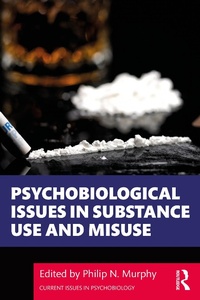
Psychobiological Issues in Substance Use and Misuse
1st Edition
Published on 29. December 2020
316 pages
978-1-000-33625-2 (ISBN)
Description

In this book, Murphy brings together a team of international experts to review cutting-edge scientific literature from the field of psychobiology and related disciplines which addresses important questions and broadens our understanding of substance use behaviours.
The reader is introduced to the multi-faceted nature of substance use and misuse, and its growing need to be discussed across diverse disciplines and perspectives. The book also addresses important questions regarding public policy and professional practice in the context of different social and cultural environments, and comments on the methodological and ethical issues in substance use and misuse. Chapters explore a spectrum of substances, which include: cocaine, alcohol, ecstasy (MDMA), methamphetamine, synthetic cannabinoids, tobacco, ketamine, novel psychoactive substances, and vaping products. The use of these substances poses important questions for science and for society. This book is written to help academics, practitioners, and students in a variety of academic and professional disciplines answer those questions while staying up to date with the psychobiological literature.
This is a vital resource for professionals and upper-level undergraduate and postgraduate students undertaking research in areas related to biological psychology, biology, health studies, and medicine.
The reader is introduced to the multi-faceted nature of substance use and misuse, and its growing need to be discussed across diverse disciplines and perspectives. The book also addresses important questions regarding public policy and professional practice in the context of different social and cultural environments, and comments on the methodological and ethical issues in substance use and misuse. Chapters explore a spectrum of substances, which include: cocaine, alcohol, ecstasy (MDMA), methamphetamine, synthetic cannabinoids, tobacco, ketamine, novel psychoactive substances, and vaping products. The use of these substances poses important questions for science and for society. This book is written to help academics, practitioners, and students in a variety of academic and professional disciplines answer those questions while staying up to date with the psychobiological literature.
This is a vital resource for professionals and upper-level undergraduate and postgraduate students undertaking research in areas related to biological psychology, biology, health studies, and medicine.
More details
Series
Edition
1. Auflage
Language
English
Place of publication
London
United Kingdom
Publishing group
Taylor & Francis Ltd
Target group
College/higher education
Professional and scholarly
Illustrations
3 Tables, black and white; 2 Line drawings, black and white; 1 Halftones, black and white; 3 Illustrations, black and white
ISBN-13
978-1-000-33625-2 (9781000336252)
Copyright in bibliographic data and cover images is held by Nielsen Book Services Limited or by the publishers or by their respective licensors: all rights reserved.
Schweitzer Classification
Other editions
Additional editions
Book
01/2021
Taylor & Francis
Unfortunately, price unknown
Available (delivery time upon request)
Philip Murphy
Psychobiological Issues in Substance Use and Misuse
Book
12/2020
1st Edition
Routledge
€206.90
Shipment within 15-20 days
Philip Murphy
Psychobiological Issues in Substance Use and Misuse
Book
12/2020
1st Edition
Routledge
€63.80
Shipment within 15-20 days
Person
Philip N. Murphy, PhD is Professor of Psychology at Edge Hill University in Lancashire, UK. He has worked professionally in addiction and substance use since 1984 and has done extensive research in the areas of opiate dependence, and the impairment of cognitive functioning related to the use of ecstasy (MDMA) and cannabis. He is also the editor of the Routledge International Handbook of Psychobiology, published in 2018.
Content
Foreward
List of contributors
The Psychobiology of Substance Use Behaviours and its Relationship to Personal and Social Psychological Interpretations of these Behaviours
Philip N. Murphy, Serge Combaluzier, Derek Heim and Rebecca Monk
Psychobiological Aspects of Cocaine Dependence: Implications for Prevention, Treatment, and the Consequences of Use
Mieke H. J. Schulte, Wim, van den Brink, and Reinout W. Wiers
The Neurobiological Implications of Early Onset Excessive Alcohol Use: Potential Consequences for Psychological Functioning
Sarah Benson
Zebrafish Models of Drug Addiction
Susan Schenk, Gabriel D. Bosse and Randall T. Peterson
The Neurobiological Mechanisms Underpinning MDMA and Impaired Psychological Functioning: A Review of Studies with Human Participants
Catharine Montgomery and Carl Alexander Roberts
Methamphetamine Use Disorder: Structural and Functional Implications as Shown by Brain Imaging Studies
Samantha Brooks, Kate Cockcroft and Helgi B. Schioeth
Synthetic Cannabinoids (SCs): Current Knowledge, Psychobiology and Clinical Applications
Koby Cohen and Aviv M. Weinstein
Feelings of Well-being: The Contributions of Alcohol and Tobacco in Employed Workers and Students
Andrew P. Smith
The Psychobiological Implications of Ketamine Misuse
Amie Hayley
Is there Evidence of a Genetic Basis for Substance Use Disorders?
Susan Schenk
Psychobiological; Medical; and Psychiatric Implications of New/Novel Psychoactive Substance (NPS) Use
Fabrizio Schifano, Stefania Chiappini, Valeria Catalani, Flavia Napoletano, Davide Arillotta, Caroline Zangani, Amira Guirguis, Alessandro Emiliano Vento, Stefania Bonaccorso and John Martin Corkery
'Ecstasy' (MDMA) and Visusospatial Processing: A follow-up Systematic Review
Philip N. Murphy, Ida Ryland, Felicity Wolohan & Janice Bartholomew
The Psychobiology of Nicotine Vaping: Impact on Addiction, Cognition, Mood, Anxiety and Appetite
Harry Tattan-Birch and Lion Shahab
Index
List of contributors
The Psychobiology of Substance Use Behaviours and its Relationship to Personal and Social Psychological Interpretations of these Behaviours
Philip N. Murphy, Serge Combaluzier, Derek Heim and Rebecca Monk
Psychobiological Aspects of Cocaine Dependence: Implications for Prevention, Treatment, and the Consequences of Use
Mieke H. J. Schulte, Wim, van den Brink, and Reinout W. Wiers
The Neurobiological Implications of Early Onset Excessive Alcohol Use: Potential Consequences for Psychological Functioning
Sarah Benson
Zebrafish Models of Drug Addiction
Susan Schenk, Gabriel D. Bosse and Randall T. Peterson
The Neurobiological Mechanisms Underpinning MDMA and Impaired Psychological Functioning: A Review of Studies with Human Participants
Catharine Montgomery and Carl Alexander Roberts
Methamphetamine Use Disorder: Structural and Functional Implications as Shown by Brain Imaging Studies
Samantha Brooks, Kate Cockcroft and Helgi B. Schioeth
Synthetic Cannabinoids (SCs): Current Knowledge, Psychobiology and Clinical Applications
Koby Cohen and Aviv M. Weinstein
Feelings of Well-being: The Contributions of Alcohol and Tobacco in Employed Workers and Students
Andrew P. Smith
The Psychobiological Implications of Ketamine Misuse
Amie Hayley
Is there Evidence of a Genetic Basis for Substance Use Disorders?
Susan Schenk
Psychobiological; Medical; and Psychiatric Implications of New/Novel Psychoactive Substance (NPS) Use
Fabrizio Schifano, Stefania Chiappini, Valeria Catalani, Flavia Napoletano, Davide Arillotta, Caroline Zangani, Amira Guirguis, Alessandro Emiliano Vento, Stefania Bonaccorso and John Martin Corkery
'Ecstasy' (MDMA) and Visusospatial Processing: A follow-up Systematic Review
Philip N. Murphy, Ida Ryland, Felicity Wolohan & Janice Bartholomew
The Psychobiology of Nicotine Vaping: Impact on Addiction, Cognition, Mood, Anxiety and Appetite
Harry Tattan-Birch and Lion Shahab
Index
