

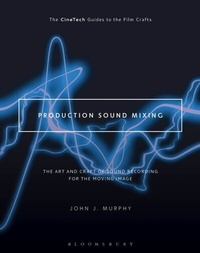
Production Sound Mixing
The Art and Craft of Sound Recording for the Moving Image
1st Edition
Published on 17. December 2015
256 pages
978-1-5013-0710-2 (ISBN)
Description

The latest hot camera is pretty irrelevant if one can't understand what's happening on screen. The key to any narrative is in the dialogue and voice over, but if this is unintelligible or difficult to hear, viewers will soon lose interest. With real world applications and a narrative to keep the reader's interest, Production Sound Mixing is the indispensable guide for film and video audio recording. Written by veteran sound mixer John J. Murphy, the book offers a step by step collaborative journey through the basic physics of sound, concluding with a practical guide of the latest techniques and equipment available to all who are interested in the best audio for their projects.
Structured to mimic a 14-week semester, each chapter begins with an audio problem to be solved and ends with a solution drawn from information gleaned from past chapters. Suggested movie scenes that demonstrate the relevant audio techniques will also be included. Equally applicable to studio and location recording, the book is oriented toward commonly accessible environments such as conference rooms, hallways, beaches, car interiors, bathrooms, and so on. The intent is to allow the student to make the best of a location no matter how challenging it might be. Most importantly, this book will make one aware of the potential of sound on screen, for it is truly 50% of the viewing experience.
Structured to mimic a 14-week semester, each chapter begins with an audio problem to be solved and ends with a solution drawn from information gleaned from past chapters. Suggested movie scenes that demonstrate the relevant audio techniques will also be included. Equally applicable to studio and location recording, the book is oriented toward commonly accessible environments such as conference rooms, hallways, beaches, car interiors, bathrooms, and so on. The intent is to allow the student to make the best of a location no matter how challenging it might be. Most importantly, this book will make one aware of the potential of sound on screen, for it is truly 50% of the viewing experience.
Reviews / Votes
An excellent, comprehensive, and contemporary primer for those interested in becoming sound recordists or mixers. John J. Murphy's Production Sound Mixing guides you through all you need to know to understand sound recording and technique. * Bill Linsman, Associate Professor of Film and Television, Boston University, USA, and Former Professional Sound Recordist and Mixer * Full of detailed, specific, practical knowledge as well as tips that only pros can teach, Production Sound Mixing is a valuable resource with a relaxed, readable style. With professional-but not overly technical-insights, John M. Murphy covers the physics of sound, equipment, work practice, and troubleshooting for faculty, students, and amateurs in sound production. * Peter Kiwitt, Assistant Professor, School of Film and Animation, Rochester Institute of Technology, USA, and Direcor Member of the Directors Guild of America * I've waited years for this book: it is far and away the most useful book on production audio for first-time students that I've encountered. * Piers Storey, University of Suffolk, UK * Comprehensive guide to the theory, technology and working practices involved in capturing location sound. With plenty of diagrams and an accessible style, this will be of huge value to Film sound students and aspiring professionals. * Simon Waite, Staffordshire University *More details
Series
Edition
1. Auflage
Language
English
Place of publication
New York
United States
Publishing group
Bloomsbury Publishing PLC (Digital)
Illustrations
280 bw illus
ISBN-13
978-1-5013-0710-2 (9781501307102)
Copyright in bibliographic data and cover images is held by Nielsen Book Services Limited or by the publishers or by their respective licensors: all rights reserved.
Schweitzer Classification
Other editions
Additional editions
Book
03/2016
Bloomsbury Academic USA
€37.50
Shipment within 15-20 days
Person
John J. Murphy, a member of IATSE Local 52 Sound Department, has worked as a sound recordist, boom operator, A2, camera operator, and director of cinematography. He has shot and sound mixed feature films, commercials, documentaries, industrial films, corporate videos, music videos, direct-to-consumer DVDs, and reality television, including 10 of the 12 seasons of Project Runway as an audio mixer and A2. He has taught filmmaking since 1980 at various schools including Pratt Institute of Design, NY, USA, for the last 13 years.
Content
Preface
Acknowledgements
Introduction
Chapter 1: What is Sound?
Chapter 2: Microphones: The Basic Types and How They Work
Chapter 3: The DSLR Shoot: Making the Most of What's at Hand
Chapter 4: The Audio Mixer
Chapter 5: Choosing a Location
Chapter 6: Booming: The View from Above
Chapter 7: Wireless Microphones: What They Are, How They Work, and How and Why We Use Them
Chapter 8: Interviews!
Chapter 9: On the Set
Chapter 10: Prep Is Everything: Your Basic Kit
Chapter 11: Synchronization
Chapter 12: Post-Production: Where Does It GO From Here?
Chapter 13: Opportunities for Sound Work in Film/Video
Chapter 14: Stereo: When Two Become One
Appendix
Glossary
Index
Acknowledgements
Introduction
Chapter 1: What is Sound?
Chapter 2: Microphones: The Basic Types and How They Work
Chapter 3: The DSLR Shoot: Making the Most of What's at Hand
Chapter 4: The Audio Mixer
Chapter 5: Choosing a Location
Chapter 6: Booming: The View from Above
Chapter 7: Wireless Microphones: What They Are, How They Work, and How and Why We Use Them
Chapter 8: Interviews!
Chapter 9: On the Set
Chapter 10: Prep Is Everything: Your Basic Kit
Chapter 11: Synchronization
Chapter 12: Post-Production: Where Does It GO From Here?
Chapter 13: Opportunities for Sound Work in Film/Video
Chapter 14: Stereo: When Two Become One
Appendix
Glossary
Index
