

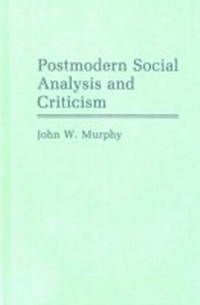
Postmodern Social Analysis and Criticism
1st Edition
Published on 15. June 1989
185 pages
978-0-313-38920-7 (ISBN)
Description

Although postmodernism has had clear impact on literary criticism, the social and political implications of this philosophy have not been systematically investigated. Murphy's study is the first to bring a broad interdisciplinary perspective to the subject and to present postmodernism as a coherent social theory. Responding with compelling arguments to critics of postmodernism, Murphy develops a model that offers a viable alternative to traditional approaches to conceptualizing and studying social life.
In an introductory chapter, Murphy looks at the differences between modernism and postmodernism and discusses the metanarratives that characterize the former. He goes on to clarify key assumptions and concepts, especially the postmodern opposition to the traditional Western separation of subject and object. In subsequent chapters, he describes the research methodology used by postmodernists, their views of social ontology and the relationship between order and structure, and the creation of socially responsible institutions. The postmodernists' reconceptualization of key aspects of cultural reality, including time, space, reason, and social relations, is examined in detail. Murphy concludes by exploring the political ramifications of the postmodernist model and its potential as a vehicle for building a genuinely democractic society. This study will be of particular interest to philosophers, economists, and sociologists concerned with contemporary developments in European social philosophy. It is relevant to courses or study in social theory and philosophy, communication theory, cultural criticism, and related fields.
In an introductory chapter, Murphy looks at the differences between modernism and postmodernism and discusses the metanarratives that characterize the former. He goes on to clarify key assumptions and concepts, especially the postmodern opposition to the traditional Western separation of subject and object. In subsequent chapters, he describes the research methodology used by postmodernists, their views of social ontology and the relationship between order and structure, and the creation of socially responsible institutions. The postmodernists' reconceptualization of key aspects of cultural reality, including time, space, reason, and social relations, is examined in detail. Murphy concludes by exploring the political ramifications of the postmodernist model and its potential as a vehicle for building a genuinely democractic society. This study will be of particular interest to philosophers, economists, and sociologists concerned with contemporary developments in European social philosophy. It is relevant to courses or study in social theory and philosophy, communication theory, cultural criticism, and related fields.
More details
Series
Edition
1. Auflage
Language
English
Place of publication
New York
United States
Publishing group
Bloomsbury Publishing Plc
Target group
College/higher education
Interest Age: From 7 to 17 years
ISBN-13
978-0-313-38920-7 (9780313389207)
Copyright in bibliographic data and cover images is held by Nielsen Book Services Limited or by the publishers or by their respective licensors: all rights reserved.
Schweitzer Classification
Other editions
Additional editions
John W. Murphy
Postmodern Social Analysis and Criticism
Book
06/1989
Praeger Publishers Inc
€91.80
Article exhausted; check different version
Person
JOHN W. MURPHY is Associate Professor of Sociology at the University of Miami, Coral Gables, Florida. He received his Ph.D. from Ohio State University. His present interests include social philosophy and sociological theory.
Content
The Historical Development of Modernism
The Making of the Postmodern World
Postmodern Social Science
Order and Discourse
Socially Responsible Institutions
Dimensions of Postmodern Culture
The Politics of Postmoderism
Conclusion--Social Rehabilitation
Selected Bibliography
Index
The Making of the Postmodern World
Postmodern Social Science
Order and Discourse
Socially Responsible Institutions
Dimensions of Postmodern Culture
The Politics of Postmoderism
Conclusion--Social Rehabilitation
Selected Bibliography
Index
