

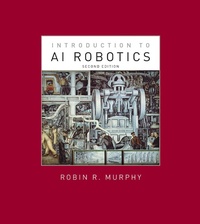
Introduction to AI Robotics, second edition
Published on 1. October 2019
648 pages
978-0-262-34815-7 (ISBN)
Description

A comprehensive survey of artificial intelligence algorithms and programming organization for robot systems, combining theoretical rigor and practical applications. This textbook offers a comprehensive survey of artificial intelligence (AI) algorithms and programming organization for robot systems. Readers who master the topics covered will be able to design and evaluate an artificially intelligent robot for applications involving sensing, acting, planning, and learning. A background in AI is not required; the book introduces key AI topics from all AI subdisciplines throughout the book and explains how they contribute to autonomous capabilities. This second edition is a major expansion and reorganization of the first edition, reflecting the dramatic advances made in AI over the past fifteen years. An introductory overview provides a framework for thinking about AI for robotics, distinguishing between the fundamentally different design paradigms of automation and autonomy. The book then discusses the reactive functionality of sensing and acting in AI robotics; introduces the deliberative functions most often associated with intelligence and the capability of autonomous initiative; surveys multi-robot systems and (in a new chapter) human-robot interaction; and offers a "metaview" of how to design and evaluate autonomous systems and the ethical considerations in doing so. New material covers locomotion, simultaneous localization and mapping, human-robot interaction, machine learning, and ethics. Each chapter includes exercises, and many chapters provide case studies. Endnotes point to additional reading, highlight advanced topics, and offer robot trivia.
More details
Other editions
Additional editions
Robin R. Murphy
Introduction to AI Robotics
Book
10/2019
2nd Edition
MIT Press
€105.23
Shipment within 10-20 days
Person
Robin R. Murphy is Raytheon Professor of Computer Science and Engineering at Texas A&M University, where she is also Director of the Center for Robot-Assisted Search and Rescue. She is the author of Introduction to AI Robotics and Disaster Robotics and the editor of Robotics Through Science Fiction (all published by the MIT Press).
Content
- Intro
- Series Page
- Title Page
- Copyright
- Dedication
- Brief Contents
- Table of Contents
- Preface
- Acknowledgments
- I: Framework for Thinking About AI and Robotics
- 1. What Are Intelligent Robots?
- 1.1. Overview
- 1.2. Definition: What Is an Intelligent Robot?
- 1.3. What Are the Components of a Robot?
- 1.4. Three Modalities: What Are the Kinds of Robots?
- 1.5. Motivation: Why Robots?
- 1.6. Seven Areas of AI: Why Intelligence?
- 1.7. Summary
- 1.8. Exercises
- 1.9. End Notes
- 2. A Brief History of AI Robotics
- 2.1. Overview
- 2.2. Robots as Tools, Agents, or Joint Cognitive Systems
- 2.3. World War II and the Nuclear Industry
- 2.4. Industrial Manipulators
- 2.5. Mobile Robots
- 2.6. Drones
- 2.7. The Move to Joint Cognitive Systems
- 2.8. Summary
- 2.9. Exercises
- 2.10. End Notes
- 3. Automation and Autonomy
- 3.1. Overview
- 3.2. The Four Sliders of Autonomous Capabilities
- 3.2.1. Plans: Generation versus Execution
- 3.2.2. Actions: Deterministic versus Non-deterministic
- 3.2.3. Models: Open- versus Closed-World
- 3.2.4. Knowledge Representation: Symbols versus Signals
- 3.3. Bounded Rationality
- 3.4. Impact of Automation and Autonomy
- 3.5. Impact on Programming Style
- 3.6. Impact on Hardware Design
- 3.7. Impact on Types of Functional Failures
- 3.7.1. Functional Failures
- 3.7.2. Impact on Types of Human Error
- 3.8. Trade-Spaces in Adding Autonomous Capabilities
- 3.9. Summary
- 3.10. Exercises
- 3.11. End Notes
- 4. Software Organization of Autonomy
- 4.1. Overview
- 4.2. The Three Types of Software Architectures
- 4.2.1. Types of Architectures
- 4.2.2. Architectures Reinforce Good Software Engineering Principles
- 4.3. Canonical AI Robotics Operational Architecture
- 4.3.1. Attributes for Describing Layers
- 4.3.2. The Reactive Layer
- 4.3.3. The Deliberative Layer
- 4.3.4. The Interactive Layer
- 4.3.5. Canonical Operational Architecture Diagram
- 4.4. Other Operational Architectures
- 4.4.1. Levels of Automation
- 4.4.2. Autonomous Control Levels (ACL)
- 4.4.3. Levels of Initiative
- 4.5. Five Subsystems in Systems Architectures
- 4.6. Three Systems Architecture Paradigms
- 4.6.1. Trait 1: Interaction Between Primitives
- 4.6.2. Trait 2: Sensing Route
- 4.6.3. Hierarchical Systems Architecture Paradigm
- 4.6.4. Reactive Systems Paradigm
- 4.6.5. Hybrid Deliberative/Reactive Systems Paradigm
- 4.7. Execution Approval and Task Execution
- 4.8. Summary
- 4.9. Exercises
- 4.10. End Notes
- 5. Telesystems
- 5.1. Overview
- 5.2. Taskable Agency versus Remote Presence
- 5.3. The Seven Components of a Telesystem
- 5.4. Human Supervisory Control
- 5.4.1. Types of Supervisory Control
- 5.4.2. Human Supervisory Control for Telesystems
- 5.4.3. Manual Control
- 5.4.4. Traded Control
- 5.4.5. Shared Control
- 5.4.6. Guarded Motion
- 5.5. Human Factors
- 5.5.1. Cognitive Fatigue
- 5.5.2. Latency
- 5.5.3. Human: Robot Ratio
- 5.5.4. Human Out-of-the-Loop Control Problem
- 5.6. Guidelines for Determining if a Telesystem Is Suitable for an Application
- 5.6.1. Examples of Telesystems
- 5.7. Summary
- 5.8. Exercises
- 5.9. End Notes
- II: Reactive Functionality
- 6. Behaviors
- 6.1. Overview
- 6.2. Motivation for Exploring Animal Behaviors
- 6.3. Agency and Marr's Computational Theory
- 6.4. Example of Computational Theory: Rana Computatrix
- 6.5. Animal Behaviors
- 6.5.1. Reflexive Behaviors
- 6.6. Schema Theory
- 6.6.1. Schemas as Objects
- 6.6.2. Behaviors and Schema Theory
- 6.6.3. S-R: Schema Notation
- 6.7. Summary
- 6.8. Exercises
- 6.9. End Notes
- 7. Perception and Behaviors
- 7.1. Overview
- 7.2. Action-Perception Cycle
- 7.3. Gibson: Ecological Approach
- 7.3.1. Optic Flow
- 7.3.2. Nonvisual Affordances
- 7.4. Two Perceptual Systems
- 7.5. Innate Releasing Mechanisms
- 7.5.1. Definition of Innate Releasing Mechanisms
- 7.5.2. Concurrent Behaviors
- 7.6. Two Functions of Perception
- 7.7. Example: Cockroach Hiding
- 7.7.1. Decomposition
- 7.7.2. Identifying Releasers
- 7.7.3. Implicit versus Explicit Sequencing
- 7.7.4. Perception
- 7.7.5. Architectural Considerations
- 7.8. Summary
- 7.9. Exercises
- 7.10. End Notes
- 8. Behavioral Coordination
- 8.1. Overview
- 8.2. Coordination Function
- 8.3. Cooperating Methods: Potential Fields
- 8.3.1. Visualizing Potential Fields
- 8.3.2. Magnitude Profiles
- 8.3.3. Potential Fields and Perception
- 8.3.4. Programming a Single Potential Field
- 8.3.5. Combination of Fields and Behaviors
- 8.3.6. Example Using One Behavior per Sensor
- 8.3.7. Advantages and Disadvantages
- 8.4. Competing Methods: Subsumption
- 8.4.1. Example
- 8.5. Sequences: Finite State Automata
- 8.5.1. A Follow the Road FSA
- 8.5.2. A Pick Up the Trash FSA
- 8.6. Sequences: Scripts
- 8.7. AI and Behavior Coordination
- 8.8. Summary
- 8.9. Exercises
- 8.10. End Notes
- 9. Locomotion
- 9.1. Overview
- 9.2. Mechanical Locomotion
- 9.2.1. Holonomic versus Nonholonomic
- 9.2.2. Steering
- 9.3. Biomimetic Locomotion
- 9.4. Legged Locomotion
- 9.4.1. Number of Leg Events
- 9.4.2. Balance
- 9.4.3. Gaits
- 9.4.4. Legs with Joints
- 9.5. Action Selection
- 9.6. Summary
- 9.7. Exercises
- 9.8. End Notes
- 10. Sensors and Sensing
- 10.1. Overview
- 10.2. Sensor and Sensing Model
- 10.2.1. Sensors: Active or Passive
- 10.2.2. Sensors: Types of Output and Usage
- 10.3. Odometry, Inertial Navigation System (INS) and Global Positioning System (GPS)
- 10.4. Proximity Sensors
- 10.5. Computer Vision
- 10.5.1. Computer Vision Definition
- 10.5.2. Grayscale and Color Representation
- 10.5.3. Region Segmentation
- 10.5.4. Color Histogramming
- 10.6. Choosing Sensors and Sensing
- 10.6.1. Logical Sensors
- 10.6.2. Behavioral Sensor Fusion
- 10.6.3. Designing a Sensor Suite
- 10.7. Summary
- 10.8. Exercises
- 10.9. End Notes
- 11. Range Sensing
- 11.1. Overview
- 11.2. Stereo
- 11.3. Depth from X
- 11.4. Sonar or Ultrasonics
- 11.4.1. Light Stripers
- 11.4.2. Lidar
- 11.4.3. RGB-D Cameras
- 11.4.4. Point Clouds
- 11.5. Case Study: Hors d'Oeuvres, Anyone?
- 11.6. Summary
- 11.7. Exercises
- 11.8. End Notes
- III: Deliberative Functionality
- 12. Deliberation
- 12.1. Overview
- 12.2. Strips
- 12.2.1. More Realistic Strips Example
- 12.2.2. Strips Summary
- 12.2.3. Revisiting the Closed-World Assumption and the Frame Problem
- 12.3. Symbol Grounding Problem
- 12.4. Global World Models
- 12.4.1. Local Perceptual Spaces
- 12.4.2. Multi-level or Hierarchical World Models
- 12.4.3. Virtual Sensors
- 12.4.4. Global World Model and Deliberation
- 12.5. Nested Hierarchical Controller
- 12.6. RAPS and 3T
- 12.7. Fault Detection Identification and Recovery
- 12.8. Programming Considerations
- 12.9. Summary
- 12.10. Exercises
- 12.11. End Notes
- 13. Navigation
- 13.1. Overview
- 13.2. The Four Questions of Navigation
- 13.3. Spatial Memory
- 13.4. Types of Path Planning
- 13.5. Landmarks and Gateways
- 13.6. Relational Methods
- 13.6.1. Distinctive Places
- 13.6.2. Advantages and Disadvantages
- 13.7. Associative Methods
- 13.8. Case Study of Topological Navigation with a Hybrid Architecture
- 13.8.1. Topological Path Planning
- 13.8.2. Navigation Scripts
- 13.8.3. Lessons Learned
- 13.9. Discussion of Opportunities for AI
- 13.10. Summary
- 13.11. Exercises
- 13.12. End Notes
- 14. Metric Path Planning and Motion Planning
- 14.1. Overview
- 14.2. Four Situations Where Topological Navigation Is Not Sufficient
- 14.3. Configuration Space
- 14.3.1. Meadow Maps
- 14.3.2. Generalized Voronoi Graphs
- 14.3.3. Regular Grids
- 14.3.4. Quadtrees
- 14.4. Metric Path Planning
- 14.4.1 A* and Graph-Based Planners
- 14.4.2. Wavefront-Based Planners
- 14.5. Executing a Planned Path
- 14.5.1. Subgoal Obsession
- 14.5.2. Replanning
- 14.6. Motion Planning
- 14.7. Criteria for Evaluating Path and Motion Planners
- 14.8. Summary
- 14.9. Exercises
- 14.10. End Notes
- 15. Localization, Mapping, and Exploration
- 15.1. Overview
- 15.2. Localization
- 15.3. Feature-Based Localization
- 15.4. Iconic Localization
- 15.5. Static versus Dynamic Environments
- 15.6. Simultaneous Localization and Mapping
- 15.7. Terrain Identification and Mapping
- 15.7.1. Digital Terrain Elevation Maps
- 15.7.2. Terrain Identification
- 15.7.3. Stereophotogrammetry
- 15.8. Scale and Traversability
- 15.8.1. Scale
- 15.8.2. Traversability Attributes
- 15.9. Exploration
- 15.9.1. Reactive Exploration
- 15.9.2. Frontier-Based Exploration
- 15.9.3. Generalized Voronoi Graph Methods
- 15.10. Localization, Mapping, Exploration, and AI
- 15.11. Summary
- 15.12. Exercises
- 15.13. End Notes
- 16. Learning
- 16.1. Overview
- 16.2. Learning
- 16.3. Types of Learning by Example
- 16.4. Common Supervised Learning Algorithms
- 16.4.1. Induction
- 16.4.2. Support Vector Machines
- 16.4.3. Decision Trees
- 16.5. Common Unsupervised Learning Algorithms
- 16.5.1. Clustering
- 16.5.2. Artificial Neural Networks
- 16.6. Reinforcement Learning
- 16.6.1. Utility Functions
- 16.6.2. Q-learning
- 16.6.3. Q-learning Example
- 16.6.4. Q-learning Discussion
- 16.7. Evolutionary Robotics and Genetic Algorithms
- 16.8. Learning and Architecture
- 16.9. Gaps and Opportunities
- 16.10. Summary
- 16.11. Exercises
- 16.12. End Notes
- IV: Interactive Functionality
- 17. MultiRobot Systems (MRS)
- 17.1. Overview
- 17.2. Four Opportunities and Seven Challenges
- 17.2.1. Four Advantages of MRS
- 17.2.2. Seven Challenges in MRS
- 17.3. Multirobot Systems and AI
- 17.4. Designing MRS for Tasks
- 17.4.1. Time Expectations for a Task
- 17.4.2. Subject of Action
- 17.4.3. Movement
- 17.4.4. Dependency
- 17.5. Coordination Dimension of MRS Design
- 17.6. Systems Dimensions in Design
- 17.6.1. Communication
- 17.6.2. MRS Composition
- 17.6.3. Team Size
- 17.7. Five Most Common Occurrences of MRS
- 17.8. Operational Architectures for MRS
- 17.9. Task Allocation
- 17.10. Summary
- 17.11. Exercises
- 17.12. End Notes
- 18. Human-Robot Interaction
- 18.1. Overview
- 18.2. Taxonomy of Interaction
- 18.3. Contributions from HCI, Psychology, Communications
- 18.3.1. Human-Computer Interaction
- 18.3.2. Psychology
- 18.3.3. Communications
- 18.4. User Interfaces
- 18.4.1. Eight Golden Rules for User Interface Design
- 18.4.2. Situation Awareness
- 18.4.3. Multiple Users
- 18.5. Modeling Domains, Users, and Interactions
- 18.5.1. Motivating Example of Users and Interactions
- 18.5.2. Cognitive Task Analysis
- 18.5.3. Cognitive Work Analysis
- 18.6. Natural Language and Naturalistic User Interfaces
- 18.6.1. Natural Language Understanding
- 18.6.2. Semantics and Communication
- 18.6.3. Models of the Inner State of the Agent
- 18.6.4. Multi-modal Communication
- 18.7. Human-Robot Ratio
- 18.8. Trust
- 18.9. Testing and Metrics
- 18.9.1. Data Collection Methods
- 18.9.2. Metrics
- 18.10. Human-Robot Interaction and the Seven Areas of Artificial Intelligence
- 18.11. Summary
- 18.12. Exercises
- 18.13. End Notes
- V: Design and the Ethics of Building Intelligent Robots
- 19. Designing and Evaluating Autonomous Systems
- 19.1. Overview
- 19.2. Designing a Specific Autonomous Capability
- 19.2.1. Design Philosophy
- 19.2.2. Five Questions for Designing an Autonomous Robot
- 19.3. Case Study: Unmanned Ground Robotics Competition
- 19.4. Taxonomies and Metrics versus System Design
- 19.5. Holistic Evaluation of an Intelligent Robot
- 19.5.1. Failure Taxonomy
- 19.5.2. Four Types of Experiments
- 19.5.3. Data to Collect
- 19.6. Case Study: Concept Experimentation
- 19.7. Summary
- 19.8. Exercises
- 20. Ethics
- 20.1. Overview
- 20.2. Types of Ethics
- 20.3. Categorizations of Ethical Agents
- 20.3.1. Moor's Four Categories
- 20.3.2. Categories of Morality
- 20.4. Programming Ethics
- 20.4.1. Approaches from Philosophy
- 20.4.2. Approaches from Robotics
- 20.5. Asimov's Three Laws of Robotics
- 20.5.1. Problems with the Three Laws
- 20.5.2. The Three Laws of Responsible Robotics
- 20.6. Artificial Intelligence and Implementing Ethics
- 20.7. Summary
- 20.8. Exercises
- 20.9. End Notes
- Bibliography
- Index
- Series List
