

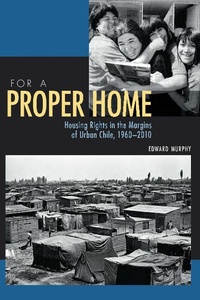
For a Proper Home
Housing Rights in the Margins of Urban Chile, 1960-2010
Published on 15. January 2015
356 pages
978-0-8229-8021-6 (ISBN)
Description

From 1967 to 1973, a period that culminated in the socialist project of Salvador Allende, nearly 400,000 low-income Chileans illegally seized parcels of land on the outskirts of Santiago. Remarkably, today almost all of these individuals live in homes with property titles. As Edward Murphy shows, this transformation came at a steep price, through an often-violent political and social struggle that continues to this day.
In analyzing the causes and consequences of this struggle, Murphy reveals a crucial connection between homeownership and understandings of proper behavior and governance. This link between property and propriety has been at the root of a powerful, contested urban politics central to both social activism and urban development projects. Through projects of reform, revolution, and reaction, a right to housing and homeownership has been a significant symbol of governmental benevolence and poverty reduction. Under Pinochet's neoliberalism, subsidized housing and slum eradication programs displaced many squatters, while awarding them homes of their own. This process, in addition to ongoing forms of activism, has permitted the vast majority of squatters to live in homes with property titles, a momentous change of the past half-century.
This triumph is tempered by the fact that today the urban poor struggle with high levels of unemployment and underemployment, significant debt, and a profoundly segregated and hostile urban landscape. They also find it more difficult to mobilize than in the past, and as homeowners they can no longer rally around the cause of housing rights.
Citing cultural theorists from Marx to Foucault, Murphy directly links the importance of home ownership and property rights among Santiago's urban poor to definitions of Chilean citizenship and propriety. He explores how the deeply embedded liberal belief system of individual property ownership has shaped political, social, and physical landscapes in the city. His approach sheds light on the role that social movements and the gendered contours of home life have played in the making of citizenship. It also illuminates processes through which squatters have received legally sanctioned homes of their own, a phenomenon of critical importance in cities throughout much of Latin America and the Global South.
In analyzing the causes and consequences of this struggle, Murphy reveals a crucial connection between homeownership and understandings of proper behavior and governance. This link between property and propriety has been at the root of a powerful, contested urban politics central to both social activism and urban development projects. Through projects of reform, revolution, and reaction, a right to housing and homeownership has been a significant symbol of governmental benevolence and poverty reduction. Under Pinochet's neoliberalism, subsidized housing and slum eradication programs displaced many squatters, while awarding them homes of their own. This process, in addition to ongoing forms of activism, has permitted the vast majority of squatters to live in homes with property titles, a momentous change of the past half-century.
This triumph is tempered by the fact that today the urban poor struggle with high levels of unemployment and underemployment, significant debt, and a profoundly segregated and hostile urban landscape. They also find it more difficult to mobilize than in the past, and as homeowners they can no longer rally around the cause of housing rights.
Citing cultural theorists from Marx to Foucault, Murphy directly links the importance of home ownership and property rights among Santiago's urban poor to definitions of Chilean citizenship and propriety. He explores how the deeply embedded liberal belief system of individual property ownership has shaped political, social, and physical landscapes in the city. His approach sheds light on the role that social movements and the gendered contours of home life have played in the making of citizenship. It also illuminates processes through which squatters have received legally sanctioned homes of their own, a phenomenon of critical importance in cities throughout much of Latin America and the Global South.
More details
Other editions
Additional editions
Book
01/2015
University of Pittsburgh Press
€58.00
Shipment within 10-20 days
Person
Edward Murphy is assistant professor of history and global urban studies at Michigan State University. He is the coeditor of The Housing Question: Tensions, Continuities, and Contingencies in the Modern City and Anthrohistory: Unsettling Knowledge, Questioning Discipline.
Content
- Intro
- Contents
- Acknowledgments
- Introduction
- Part One. Unsettled Foundations
- Chapter 1. The Urban Politics of Propriety through Revolution and Reaction
- Chapter 2. Property, Governance, and the City: A Longue Durée Perspective
- Part Two. Insurgent Ownership
- Chapter 3. A Place in the State: Housing Activism and the Seizure of Land, May Day, 1969
- Chapter 4. Specters in the Revolution: Dilemmas of Home during the Chilean Path to Socialism
- Part Three. Reactionary Turns
- Chapter 5. Locating States of Emergency: The Politics of "Normalization" after the Military Coup
- Chapter 6. Aesthetics of Order: Forging Spaces of Distinction amid Neoliberal Expansion
- Part Four. Domesticated Peripheries
- Chapter 7. Containing Protest in the Transition to Democracy
- Chapter 8. Fractures of Home and Nation: Property Titling after the Dictatorship
- Chapter 9. The Indignities of Home in the Margins of Modern Urban Life
- Conclusion
- Notes
- Glossary and Acronyms
- References
- Index
