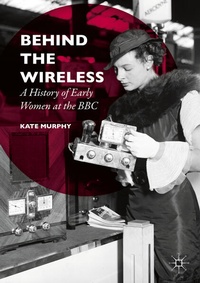
Behind the Wireless
Description

Behind the Wireless tells the story of women at the BBC in the 1920s and 30s. Broadcasting was brand new in Britain and the BBC developed without many of the overt discriminatory practices commonplace at the time. Women were employed at all levels, except the very top, for instance as secretaries, documentary makers, advertising representatives, and librarians. Three women held Director level posts, Hilda Matheson (Director of Talks), Mary Somerville (Director of School Broadcasting), and Isa Benzie (Foreign Director). Women also produced the programmes aimed at female listeners and brought women broadcasters to the microphone. There was an ethos of equality and the chance to rise through the ranks from accounts clerk to accompanist. But lurking behind the façade of modernity were hidden inequalities in recruitment, pay, and promotion and in 1932 a marriage bar was introduced. Kate Murphy examines how and why the interwar BBC created new opportunities for women.
Reviews / Votes
"The book will complement the scholarship about the BBC but also add to the current exploration of the participation of women in the workforce in the interwar period. I expect that the book will be of great interest for scholars of media, gender, modern Britain and labor relations. It is a wonderful example of how to bring all these concerns into conversation." (Tal Zalmanovich, New Books network, newbooksnetwork.com, March, 2017)
"I would recommend the bibliography to students as an up-to-date survey of the history of women's work in the early twentieth century. . the book is an informative and entertaining read and will doubtless become the go-to resource on women at the interwar BBC." (Laura Beers, Oxford University Press Journals, December, 2016)
"I was riveted by Kate Murphy's Behind the Wireless . a brilliantly researched study of the young women who worked at the fledgling BBC in the Twenties and Thirties." (Juliet Nicolson, Evening Standard, standard.co.uk, November, 2016)
"A meticulously researched exploration of the numerous women who worked at the BBC in its early years, the 1920s and 1930s. . Behind the Wireless portrays well how in recruitment, mobility and pay, unspoken gender inequalities were clearly identifiable in the early BBC, even if some individual women were successful. . This book is, therefore, to be recommended not merely for the history it explores but also for the questions and issues it raises which remain very pertinent today." (Maggie Andrews, Women's History Review, Vol. 26 (3), November, 2016)
"This book fully explores the role of women at all levels in the BBC from its formation in 1922 up to 1939. . This book is an important work in the history of broadcasting, women's history and the sociology of work." (David Harris, radiouser, September, 2016)
More details
Other editions
Additional editions