

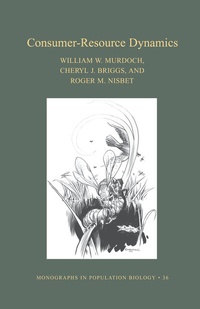
Consumer-Resource Dynamics
1st Edition
Published on 15. February 2013
464 pages
978-1-4008-4725-9 (ISBN)
Description

No detailed description available for "Consumer-Resource Dynamics".
More details
Series
Edition
Course Book
Language
English
Place of publication
Princeton, NJ
United States
Publishing group
De Gruyter
Target group
Professional and scholarly
Edition type
Digital original
Illustrations
17 tables. 98 line illus.
17 tables. 98 line illus.
File size
2,11 MB
ISBN-13
978-1-4008-4725-9 (9781400847259)
Schweitzer Classification
Other editions
Additional editions
William W. Murdoch | Cheryl J. Briggs | Roger M. Nisbet
Consumer-Resource Dynamics
Book
06/2003
Princeton University Press
€99.04
Article exhausted; check different version
William W. Murdoch | Cheryl J. Briggs | Roger M. Nisbet
Consumer-Resource Dynamics
Book
05/2003
Princeton University Press
€74.50
Shipment within 10-20 days
Persons
William W. Murdoch is Charles A. Storke II Professor of Ecology at the University of California, Santa Barbara. He has published widely on population dynamics and other ecological subjects. Cheryl J. Briggs is Associate Professor of Integrative Biology at the University of California, Berkeley. She has published extensively on the population and community consequences of insect-parasitoid and host-disease interactions. Roger M. Nisbet is Professor of Biological Science at the University of California, Santa Barbara. A longtime specialist in ecological modeling, he is the author of two books and numerous articles.
Content
Preface xi
1. Introduction 1
Why Consumer-Resource Interactions? 1
On Theory and Models 2
Themes 4
2. Population Dynamics: Observations and Basic Concepts 6
Types of Population Dynamics: Phenomena to Be Explained 6
Some Essential Concepts 15
Appendix 26
3. Simple Models in Continuous Time 30
The Lotka-Volterra Model 31
Local Stability Analysis 36
Effects of Stabilizing and Destabilizing Processes: A Survey 42
Combining Stabilizing and Destabilizing Processes: From Neutral Stability to Limit Cycles 53
Simple Models of Stage and Spatial Structure: The Creation of Indirect Density Dependence 60
Basic and Potential General Properties of Predator-Prey Systems 69
Appendix 72
4. Simple Models in Discrete Time 83
Single-Species Models in Discrete Time 84
Discrete-Generation Parasitoid-Host Models 93
Hybrid Discrete-Time/Continuous-Time Models 106
Appendix 111
5. An Introduction to Models with Stage Structure 119
Preamble: Single-Species Populations with Stage Structure 121
The Basic Stage-Structured Host-Parasitoid Model 134
Ecological Processes Inducing Instability 147
Ecological Processes Inducing Stability 149
Single-Generation Cycles in Parasitoid-Host Models 160
Appendix 170
6. Dynamical Effects of Parasitoid Lifestyles 179
Parasitoid Lifestyles 180
Four Mechanisms Inducing Greater Gain from Older Hosts 186
A Unifying Framework and Extensions 199
A More General Model: The Generic Gain Model 205
The Nature and Origins of Delayed-Feedback Cycles and Single-Generation Cycles: Insights from a Simplified Model 207
Concluding Remarks 216
7. State-Dependent Decisions 219
Effects of Egg Load on Parasitoid Decisions 220
Effects of Limits to Egg Production 236
A General Dynamical Theory of Parasitoid Behavior 242
8. Competition between Consumer Species 245
Lotka-Volterra Competition Model: Competition for an Implicit Resource 247
Exploitative Competition for an Explicit Resource 255
Competition in Discrete Time 274
Effects of Age Structure on Competition 281
Non-Equilibrial Mechanisms of Coexistence 301
Effects of Spatial Structure on Competition 310
Concluding Remarks 317
9. Implications for Biological Control 318
A Comparative Approach to Evaluating Natural Enemies 321
Spatial Processes and Control 336
Need for Experimental Tests 340
10. Dynamical Effects of Spatial Processes 341
Spatial Processes among Subpopulations 341
Spatial Processes within Populations: Aggregated Attacks and Other Sources of Variation in Risk among Individuals 366
Connection between Processes within Populations and among Subpopulations 392
11. Synthesis and Integration across Systems 394
Shared Theory for Different Kinds of Consumer-Resource Interactions 394
Connection between Consumer-Resource Dynamics and Single-Species Dynamics in Theory and Nature 399
Cycles in Real Systems: Single-Species Models for Many-Species Systems 410
General Conclusions/Considerations 414
12. Concluding Remarks 416
Literature Cited 425
Index 451
1. Introduction 1
Why Consumer-Resource Interactions? 1
On Theory and Models 2
Themes 4
2. Population Dynamics: Observations and Basic Concepts 6
Types of Population Dynamics: Phenomena to Be Explained 6
Some Essential Concepts 15
Appendix 26
3. Simple Models in Continuous Time 30
The Lotka-Volterra Model 31
Local Stability Analysis 36
Effects of Stabilizing and Destabilizing Processes: A Survey 42
Combining Stabilizing and Destabilizing Processes: From Neutral Stability to Limit Cycles 53
Simple Models of Stage and Spatial Structure: The Creation of Indirect Density Dependence 60
Basic and Potential General Properties of Predator-Prey Systems 69
Appendix 72
4. Simple Models in Discrete Time 83
Single-Species Models in Discrete Time 84
Discrete-Generation Parasitoid-Host Models 93
Hybrid Discrete-Time/Continuous-Time Models 106
Appendix 111
5. An Introduction to Models with Stage Structure 119
Preamble: Single-Species Populations with Stage Structure 121
The Basic Stage-Structured Host-Parasitoid Model 134
Ecological Processes Inducing Instability 147
Ecological Processes Inducing Stability 149
Single-Generation Cycles in Parasitoid-Host Models 160
Appendix 170
6. Dynamical Effects of Parasitoid Lifestyles 179
Parasitoid Lifestyles 180
Four Mechanisms Inducing Greater Gain from Older Hosts 186
A Unifying Framework and Extensions 199
A More General Model: The Generic Gain Model 205
The Nature and Origins of Delayed-Feedback Cycles and Single-Generation Cycles: Insights from a Simplified Model 207
Concluding Remarks 216
7. State-Dependent Decisions 219
Effects of Egg Load on Parasitoid Decisions 220
Effects of Limits to Egg Production 236
A General Dynamical Theory of Parasitoid Behavior 242
8. Competition between Consumer Species 245
Lotka-Volterra Competition Model: Competition for an Implicit Resource 247
Exploitative Competition for an Explicit Resource 255
Competition in Discrete Time 274
Effects of Age Structure on Competition 281
Non-Equilibrial Mechanisms of Coexistence 301
Effects of Spatial Structure on Competition 310
Concluding Remarks 317
9. Implications for Biological Control 318
A Comparative Approach to Evaluating Natural Enemies 321
Spatial Processes and Control 336
Need for Experimental Tests 340
10. Dynamical Effects of Spatial Processes 341
Spatial Processes among Subpopulations 341
Spatial Processes within Populations: Aggregated Attacks and Other Sources of Variation in Risk among Individuals 366
Connection between Processes within Populations and among Subpopulations 392
11. Synthesis and Integration across Systems 394
Shared Theory for Different Kinds of Consumer-Resource Interactions 394
Connection between Consumer-Resource Dynamics and Single-Species Dynamics in Theory and Nature 399
Cycles in Real Systems: Single-Species Models for Many-Species Systems 410
General Conclusions/Considerations 414
12. Concluding Remarks 416
Literature Cited 425
Index 451
