

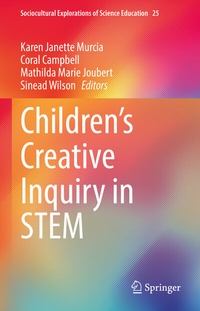
Children's Creative Inquiry in STEM
1st Edition
Published on 5. April 2022
XX, 364 pages
978-3-030-94724-8 (ISBN)
Description

This edited volume brings together international research that explores children's creativity in STEM inquiry. It takes the position that creativity is relevant in all aspects of life and is essential for adaptable and innovative thinking. The research informed content of the book, highlights both challenges and opportunities for growing children's creativity. The book focuses on fostering children's creativity and natural curiosity in the world around them through STEM inquiry. Through STEM inquiry, children are learning through a cross- disciplinary approach where they apply concepts from multiple fields as they are thinking creatively, problem solving and constructing solutions. Educators play a critical role in encouraging children's creativity by modelling creativity, providing creative projects for children and importantly, establishing rich culturally connected environments where children have the resources, conditions and opportunities for acting and thinking creatively.
The book provides a lens for looking at children's creativity in a range of different cultural settings. It offers insight and guidance to future research and will build educators' capacity for developing children's creative practices.
The book provides a lens for looking at children's creativity in a range of different cultural settings. It offers insight and guidance to future research and will build educators' capacity for developing children's creative practices.
Reviews / Votes
"This book presents a rich and detailed account of instructional and learning approaches for creative STEM inquiry. Most of the articles use qualitative research methodology and that is justified due to the vagueness of creativity definition within different cultural contexts, which again opens new and creative directions for future research. I highly recommend this book to STEM teacher educators and graduate students who may be interested in working in this evolving area." (Sandra Richy John, MAA Reviews, November 21, 2023)
More details
Other editions
Additional editions
Karen Janette Murcia | Coral Campbell | Mathilda Marie Joubert
Children's Creative Inquiry in STEM
Book
04/2022
Springer
€160.49
Shipment within 7-9 days
Persons
Karen Murcia (PhD) is an Associate Professor in the School of Education at Curtin University, Perth, Western Australia. Dr Murcia has an established track record of research related to STEM education that has a particular focus on scientific literacy, digital technologies in education and children's creativity. She has worked extensively in school-based research, with strong industry links and partnerships. She uses action research principles and design experiment methods to support teachers as classroom based researchers. She works primarily with qualitative methods and specialises in video ethnography and multimodal data analysis. Karen is a Chief Investigator with the ARC Centre of Excellence for the Digital Child and an Independent Director on the Board of Scitech Discovery Centre, Perth, Western Australia
Coral Campbell is an Associate Professor in the School of Education at Deakin University. She has contributed significantly to the fields of science, science teaching and science/STEM educational research over three careers. Coral's sustained focus on science/STEM education, teacher professional learning and students' learning in science is reflected in her research around developing greater understandings of how teachers and students learn and ways to enhance this learning.
Mathilda Joubert is Director of Excellence and Innovation at Sheridan College, Perth where she lectures in both the Education and Business Faculties. She is currently completing her PhD at the University of Western Australia, studying the assessment of children's creative thinking skills. Mathilda is a true cross-disciplinarian with bachelors, honours and/or masters degrees (in music, languages, arts education, cognitive neuropsychology and business) and experience teaching at primary, secondary and tertiary level. She serves on the Western Australian Executive of the Australian Council for Educational Leadership, is an accredited School Improvement Advisor for the Australian Council for Educational Research, a Director of Geelong Baptist College and a reviewer for the International Journal of Educational Research and the Thinking Skills and Creativity Journal.
Sinead Wilson is a Research Assistant and PhD student at Curtin University. In 2016, she graduated with a Masters of Education in through the University of Auckland and is passionate about educational projects and the research skills necessary to make them happen. Sinead has experience in working within a longitudinal research study called Growing Up in New Zealand where she worked as a research assistant for three years. From 2018- 2019 Sinead continued her work with Growing Up in New Zealand but from overseas in Mauritius, where she also volunteered her time at a local school. Sinead's main area of interest is within the domain of children's education and psychology, and her chosenfield for her doctorate is to investigate children's online experiences. Specifically, she will investigate how the online safety of children is managed in family, care and educational settings; and what constitutes positive interactions in online environments. This research will commence February 2020.
Coral Campbell is an Associate Professor in the School of Education at Deakin University. She has contributed significantly to the fields of science, science teaching and science/STEM educational research over three careers. Coral's sustained focus on science/STEM education, teacher professional learning and students' learning in science is reflected in her research around developing greater understandings of how teachers and students learn and ways to enhance this learning.
Mathilda Joubert is Director of Excellence and Innovation at Sheridan College, Perth where she lectures in both the Education and Business Faculties. She is currently completing her PhD at the University of Western Australia, studying the assessment of children's creative thinking skills. Mathilda is a true cross-disciplinarian with bachelors, honours and/or masters degrees (in music, languages, arts education, cognitive neuropsychology and business) and experience teaching at primary, secondary and tertiary level. She serves on the Western Australian Executive of the Australian Council for Educational Leadership, is an accredited School Improvement Advisor for the Australian Council for Educational Research, a Director of Geelong Baptist College and a reviewer for the International Journal of Educational Research and the Thinking Skills and Creativity Journal.
Sinead Wilson is a Research Assistant and PhD student at Curtin University. In 2016, she graduated with a Masters of Education in through the University of Auckland and is passionate about educational projects and the research skills necessary to make them happen. Sinead has experience in working within a longitudinal research study called Growing Up in New Zealand where she worked as a research assistant for three years. From 2018- 2019 Sinead continued her work with Growing Up in New Zealand but from overseas in Mauritius, where she also volunteered her time at a local school. Sinead's main area of interest is within the domain of children's education and psychology, and her chosenfield for her doctorate is to investigate children's online experiences. Specifically, she will investigate how the online safety of children is managed in family, care and educational settings; and what constitutes positive interactions in online environments. This research will commence February 2020.
Content
Introduction: Creativity and the creative product.- Part I: Creative Dispositions and Processes - Defining creativity, synergies between inquiry and creative approaches to STEM learning and teaching.- Chapter 1. Children's Creativity: A systematic Literature Review.- Chapter 2. Teachers' reflections on their changing roles and young childre's learning in creative, inquiry based STEM education.- Chapter 3. Growing children's questioning skills for creative inquiry in STEM.- Chapter 4. Creative learning contexts and fostering children's motivation to learn science.- Chapter 5. Child-focussed science inquiry: Can the right balance be found between curiosity, curriculum objectives and assessment requirements?.- Chapter 6. Working with STEM inquiry: Activities to encourage divergent thinking.- Part II: Characteristics of Creative STEM Learning Environments.- Chapter 7. STEM in Preschool: Working with educators to support child-initiated learning experiences.- Chapter 8. Using preschool children's natural curiosity as a leaver to STEM learning.- Chapter 9. Characteristics of learning environments and teachers' supports for children's creative STEM inquiry in Japan.- Chapter 10. Bush Kinders in Australia: A creative place for outdoor STEM learning.- Part III: Creative Approaches to Teaching STEM.- Chapter 11. Exploring STEM: Engineering design and young children's creativity.- Chapter 12. Dramatising inquiry learning: Reflections on how to use a historical story to actively and imaginatively engage children in resolving a STEM problem.- Chapter 13. Leonardo da Vinci's Apprentices or tinkering belles and boys at play.- Chapter 14. Introducing the nature of science in early childhood science education: A way to inspire children's curiosity, inquiry and play.- Part IV: Digital Creativity in Children's STEM Learning - Looking forward in the digital era.- Chapter 15. Integrating tangible technologies with young children's STREAM projects.- Chapter 16. The creative in computational thinking.- Chapter 17. Young children's playful engagement and learning with a fairy-tale themed augmented reality coding app.- Chapter 18. Preparing Greek pre-service kindergarten teachers to promote creativity: Opportunities using Scratch and Makey -Makey.
