

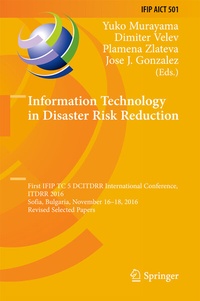
Information Technology in Disaster Risk Reduction
First IFIP TC 5 DCITDRR International Conference, ITDRR 2016, Sofia, Bulgaria, November 16-18, 2016, Revised Selected Papers
Published on 28. November 2017
XIII, 268 pages
978-3-319-68486-4 (ISBN)
Description

This volume constitutes the refereed post-conference proceedings of the First IFIP TC 5 DCDRR International Conference on Information Technology in Disaster Risk Reduction, ITDRR 2016, held in Sofia, Bulgaria, in November 2016.
The 20 revised full papers presented were carefully reviewed and selected from 52 submissions. The papers focus on various aspects and challenges of coping with disaster risk reduction. The main topics include areas such as big data, cloud computing, the Internet of Things, natural disasters, mobile computing, emergency management, disaster information processing, disaster risk assessment and management, and disaster management simulation.
The 20 revised full papers presented were carefully reviewed and selected from 52 submissions. The papers focus on various aspects and challenges of coping with disaster risk reduction. The main topics include areas such as big data, cloud computing, the Internet of Things, natural disasters, mobile computing, emergency management, disaster information processing, disaster risk assessment and management, and disaster management simulation.
More details
Series
Edition
1st ed. 2017
Language
English
Place of publication
Cham
Switzerland
Publishing group
Springer International Publishing
Target group
Professional and scholarly
Product notice
Reflowable
Illustrations
XIII, 268 p. 89 illus.
File size
19,17 MB
ISBN-13
978-3-319-68486-4 (9783319684864)
DOI
10.1007/978-3-319-68486-4
Schweitzer Classification
Other editions
Additional editions
Yuko Murayama | Dimiter Velev | Plamena Zlateva
Information Technology in Disaster Risk Reduction
First IFIP TC 5 DCITDRR International Conference, ITDRR 2016, Sofia, Bulgaria, November 16-18, 2016, Revised Selected Papers
Book
11/2017
Springer
€53.49
Shipment within 10-15 days
Content
- Intro
- Preface
- Organization
- Contents
- Understanding the Importance of Proper Incentives for Critical Infrastructures Management - How System Dynamics Can Help
- Abstract
- 1 Introduction
- 2 Understanding the Battlefield Landscape
- 3 System Dynamics and Evaluation of Proper Management Policies
- 3.1 The Template Model Preliminaries
- 3.2 The Template Model
- 4 Discussion
- 5 Conclusions
- References
- A Proposal on Patient Transport Decision Making in Multiple Hospitals in a Large-Scale Disaster
- Abstract
- 1 Introduction
- 2 Damage Situation of Iwate Prefectural Hospitals
- 3 Patient Transport from Damaged Hospitals to Supporting Hospitals
- 4 Patient Transport in March 2011
- 5 Proposed Method
- 6 Simulation Results and Comparison
- 7 Backup and Sharing of Patient Information
- 8 Conclusions
- Acknowledgments
- References
- Urban Disaster Simulation Incorporating Human Psychological Models in Evacuation Behaviors
- Abstract
- 1 Introduction
- 2 Related Work
- 3 Proposed Model
- 3.1 Normalcy Bias
- 3.2 Emotional Contagion Bias
- 3.3 Sympathy Behavior Bias
- 4 Simulation Experimental Setting
- 5 Simulation Results
- 5.1 Simulation Results for Normalcy Bias
- 5.2 Simulation Results for Emotional Contagion Bias
- 5.3 Simulation Results for Sympathy Behavior Bias
- 6 Conclusions
- References
- Stalking Resilience
- Abstract
- 1 Introduction
- 2 Advantages of a Maturity Model for Resilience
- 3 Overview of the Smart Mature Resilience Proposal
- 4 Resilience Literature Survey
- 4.1 There are Different Perspectives on the Concept of Resilience
- 4.2 A Shift in Resilience Tools from Theory to Practice
- 4.3 Political and Financial Support and Social Engagement
- 4.4 There is a Need to Link Resilience and Governance
- 4.5 Managing Risk in a Governance Context
- 5 The Enhanced Resilience Maturity Model
- 6 The Systemic Risk Assessment Questionnaire
- 7 Concluding Remarks
- Acknowledgement
- References
- Usability Evaluation of Information Technology in Disaster and Emergency Management
- Abstract
- 1 Introduction
- 2 Background and Related Work
- 2.1 Usability Engineering
- 2.2 Usability Evaluation
- 2.3 Usability Evaluation in Disaster and Emergency Management
- 3 Assessing Usability Evaluation Methods and Settings
- 3.1 Methods
- 3.2 Settings
- 4 Case Studies
- 4.1 Supporting Collaboration in MCIs with Tablet PCs
- 4.2 Supporting Triage and Hazard Identification with Smart Glasses
- 5 Conclusions
- References
- Formal Methods for Safe Design of Autonomous Systems Dedicated to Risk Management
- Abstract
- 1 Introduction
- 1.1 Potential Applications of Autonomous Systems
- 2 Reliability: Safety and Security
- 3 Formal Methods Overview
- 4 Autonomous Systems Illustrations
- 4.1 Transportation Example: Motorway
- 4.2 Autonomous System: Safety Drone Born
- 4.3 Other Works
- 5 Discussion About Present and Future
- 6 Conclusion
- References
- Using the Scorecard Approach to Measure Seismic Social Resilience in Nablus, Palestine
- Abstract
- 1 Introduction
- 2 Sources of Social Vulnerability in Palestine
- 3 Methodology for Social Vulnerability Assessment
- 3.1 Scorecard Approach
- 4 Case-Study Results and Discussion
- 4.1 Score System
- 4.2 Global and Detailed Results per Theme
- 4.3 Normalized Resilience Index
- 4.4 Statistical Dependence of Variables
- 5 Conclusions
- Acknowledgements
- References
- Better Access to Terminology for Crisis Communications
- Abstract
- 1 Introduction
- 2 Previous Studies and Paper Scope
- 3 Methodology and Examples of Terminologies
- 4 Current Use of Collections of Terms
- 5 Current Representations of Collections of Terms
- 6 A Novel Approach to Access Term Definitions
- 7 Conclusions and Future Works
- References
- Towards European Dimensions of City Resilience
- Abstract
- 1 Introduction
- 2 Existing City Elements in EU Policies
- 3 Methods
- 4 City Resilience Dimensions and Definition
- 4.1 Resilience Dimensions and Definitions
- 4.2 Model of Resilient Dimensions
- 5 Conclusions
- Acknowledgments
- References
- Climate Deterrence: Disasters and Security After COP 21
- Abstract
- 1 Introduction
- 2 Methodology
- 3 Results
- 4 Discussion
- 4.1 Climate Change and Security
- 4.2 Referent Object, Securitizing Actor and Functional Actor
- 4.3 Future Legitimization
- 4.4 The Role of Technology in Securitization
- 5 Conclusion
- References
- Urban Planning with the Combined Method of Perception-Driven Joint Learning Approach (PeDJoLA) and Geographic Information Systems (GIS) Model for Disaster Mitigation
- Abstract
- 1 Introduction
- 2 Complexity of Disaster Management
- 3 Capacity Development Model
- 4 Discussion
- 4.1 Perception of Risk and Capacity
- 4.2 Intervention Design
- 4.3 Role of Agents
- 4.4 Systems and Environment
- 4.5 Capacity Development Implementation
- 5 Conclusion
- References
- The Planning of Smart City to Mitigate the Impacts of Natural Disaster in North Sumatera
- Abstract
- 1 Introduction
- 2 Importance of Smart City Disaster Planning
- 3 Smart City Disaster Scenario
- 4 Discussion
- 5 Conclusion
- References
- Forecasting Natural Disasters of Tornados Using mHGN
- Abstract
- 1 Introduction
- 2 Natural Disaster Forecast
- 3 Multidimensional Hierarchical Graph Neuron (mHGN)
- 3.1 Experiment Results
- 3.2 Time-Series in Pattern Recognition
- 4 Multidimensional Graph Neuron for Tornado Forecasting
- 4.1 The Architecture of mHGN for Time-Series Tornado Data
- 4.2 Case Studies: Joplin's and Hackleburg-Phil Campbell's Tornados
- 5 Discussion
- 6 Conclusion
- References
- Enhancing Regional Digital Preparedness on Natural Hazards to Safeguard Business Resilience in the Asia-Pacific
- Abstract
- 1 High Vulnerabilities of Natural Hazards in the Asia-Pacific
- 2 Regional and Global Efforts on Promoting Business Continuity Since 2011 in the Asia-Pacific
- 3 Primary Targets for Introducing Business Continuity
- 4 Integrated Big Data Sets for Coordinating Digital Preparedness for Natural Hazards
- 5 Best Practices on Digital Preparedness in Taiwan Through Public-Private Partnership
- 6 Channels of Disaster Information Dissemination - 7-ELEVEN, Convenience Chain Stores
- 7 Open Data on the Common Alerting Protocol (CAP)
- 8 Conclusion to Move Forward - Enhancing Digital Preparedness on Natural Hazards for Sound and Smarter Investments
- References
- A Comprehensive Decision Support System for Enhanced Emergency Decision Management and Training
- Abstract
- 1 Introduction
- 2 Foundational Taxonomies for Emergency Management
- 3 The S-HELP DSS Overarching Architecture
- 3.1 Overview of the S-HELP System Components
- 4 Major Backbone System Components
- 4.1 Knowledge Management System (KMS)
- 4.2 Repository for Data Sets Component
- 4.3 Current Recognized Situation Component
- 4.4 Integration with Taxonomy
- 5 Testing of the S-HELP DSS
- 6 Conclusion
- Acknowledgments
- References
- The Generation of a Situation Model, in Real-Time, as a Support to Crisis Management
- Abstract
- 1 Introduction
- 2 Excessive Amount of Available Data to Be Processed in Real-Time
- 2.1 The Decision-Makers' Needs
- 2.2 The Time Pressure
- 2.3 Balance Between Swiftness and Quality
- 3 The Generation of a Situation Model in Real-Time
- 3.1 Particularities of Data Processing in Industry
- 3.2 Particularities of Data Processing During the Crisis Response
- 3.3 A Three-Level IT System as a Basis to Data Management During Crisis Situation
- 4 Particularities of Crisis Events' Data
- 4.1 Overall Descriptions of the Field Events to Be Observed
- 4.2 Issues Due to the Volume, Variety, Velocity and Veracity of the Data Coming from the Field
- 5 Approaches to Generating Situation Models from Raw Data
- 5.1 General Approaches Talking Down at Least One of the 4Vs' Issues
- 5.2 A New Approach Taking into Account All the vs of Big Data
- 6 Conclusion
- References
- Improving the Involvement of Digital Volunteers in Disaster Management
- Abstract
- 1 Introduction
- 2 Volunteered Geographic Information
- 2.1 Volunteered Geographic Information VGI Source
- 2.2 VGI Types
- 2.3 Typology of VGI
- 3 Motivation and Engagement of Digital Volunteers
- 4 Lessons Learned to Improve the Involvement of Volunteers
- 4.1 Characteristics of VGI
- 4.2 Communication Process
- 5 Conclusion
- Acknowledgments
- References
- Disaster Reduction Potential of IMPRESS Platform Tools
- Abstract
- 1 Introduction
- 2 System Overview
- 2.1 WARSYS Component
- 2.2 LOVEGO Component
- 2.3 SORLOC Component
- 2.4 PATEVO Component
- 2.5 Data Harmonization Component
- 2.6 Recommendation Component
- 2.7 INCIMAG Component
- 2.8 INCIMOB Component
- 3 Palermo Test Case and Achieved Results
- 4 Conclusions
- Acknowledgement
- References
- M&S Support for Crisis and Disaster Management Processes and Climate Change Implications
- Abstract
- 1 Introduction
- 2 Disasters Impact on People
- 3 Modeling and Simulation for NATO Crises Management and Disaster Response Support
- 4 Integrated (Distributed) CDMP & CCI Simulation Platform
- 5 Project Management of CDMP & CCI Simulation Platform
- 6 Trends in the Simulation Solutions for Disaster Risk Assessment
- 7 Knowledge and Expertise in Simulation Development Technologies
- 8 Remote Training and Distributed Exercises
- 9 Capability Analysis of Simulation Instruments for a Natural Disaster Risk Assessment
- 10 Criteria for Selection of Simulation Instruments and Solutions for Disaster Risk Assessment
- 11 NATO Computer Supported Capabilities Dealing with CDM & CCI
- 12 Conclusions
- References
- Assessment of Flood Vulnerability Using Fuzzy Logic and Geographical Information Systems
- Abstract
- 1 Introduction
- 2 Data and Methodology
- 2.1 Determining the River Catchment Area
- 2.2 Determining the Factors with Significant Influence of the Floods
- 3 Fuzzy Logic Overlay Analysis
- 3.1 Case Study: The River Luda Kamchia Basin
- 3.2 Flood Factors for River Luda Kamchia Basin
- 3.3 Results and Flood Vulnerability Map
- 4 Conclusions
- Acknowledgement
- References
- Author Index
