

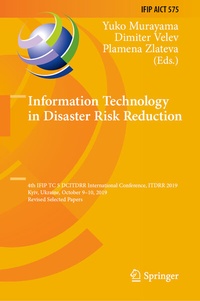
Information Technology in Disaster Risk Reduction
Description

This volume constitutes the refereed and revised post-conference proceedings of the 4th IFIP TC 5 DCITDRR International Conference on Information Technology in Disaster Risk Reduction, ITDRR 2019, in Kyiv, Ukraine, in October 2019.
The 17 full papers and 2 short papers presented were carefully reviewed and selected from 53 submissions. The papers focus on various aspects and challenges of coping with disaster risk reduction. The main topics include areas such as natural disasters, big data, cloud computing, Internet of Things, mobile computing, emergency management, disaster information processing, and disaster risk assessment and management.
More details
Other editions
Additional editions
Content
Issues in the Use of the Recovery Watcher for Situation Awareness in Disaster and Inclusive Communications.- Information Technology Reengineering of the Electricity Generation System in Post-Disaster Recovery.- Information Technologies for Assessing the Impact of Climate Change and Natural Disasters in Socio-Economic Systems.- Problems of Cultural Heritage Preservation in the Context of the Armed Conflict Growth.- Proposal of Evacuation Support System and Evaluation by Multi-agent Simulation in a Regional Disaster.- Environmental Monitoring and Population Protection from Environmental Factors.- Ecological Internet Resource as a tool for Information Control of the Harmful Effects of Environmental Pollution.- Building Resilient Community by Public Private Partnership - From Science to Action in Developing Countries.- Building Resilient Community Through Plant Back Better Initiative - Guiding Principles and Best Practices.- An Earth Coordinate System for Earthquake Forecasting using SLHGN.- ImpactMap: A Collaborative Environment to Support Impact Projection of Complex Decision.- Ad-Hoc Architecture of Systems for Disaster Risk Management.- Conceptual Model of Debris Flow Information System.- Towards an Indoor Navigation Application for Emergency Evacuations and Persons with Visual Impairments - Experiences from First Responders and End Users.- Cyber Crisis Management Roles - a Municipality Responsibility Case Study.- Mathematical Model of Management of the Integral Risk of Emergency Situation on the Example of Fires.- 3D Simulation to Validate Autonomous Intervention Systems Architecture for Disaster Management.- Classification of Social Media Messages Posted at the Time of Disaster.- Workshop Program on Disaster Prevention and Mitigation for Young Generation Utilizing Disaster Information Tweeting and Mapping System.
