

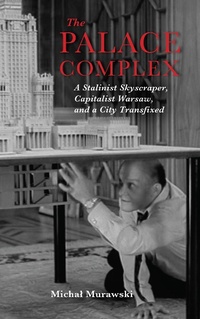
The Palace Complex
A Stalinist Skyscraper, Capitalist Warsaw, and a City Transfixed
Published on 22. March 2019
366 pages
978-0-253-03998-9 (ISBN)
Description

The Palace of Culture and Science is a massive Stalinist skyscraper that was "gifted" to Warsaw by the Soviet Union in 1955. Framing the Palace's visual, symbolic, and functional prominence in the everyday life of the Polish capital as a sort of obsession, locals joke that their city suffers from a "Palace of Culture complex." Despite attempts to privatize it, the Palace remains municipally owned, and continues to play host to a variety of public institutions and services. The Parade Square, which surrounds the building, has resisted attempts to convert it into a money-making commercial center. Author Michal Murawski traces the skyscraper's powerful impact on 21st century Warsaw; on its architectural and urban landscape; on its political, ideological, and cultural lives; and on the bodies and minds of its inhabitants. The Palace Complex explores the many factors that allow Warsaw's Palace to endure as a still-socialist building in a post-socialist city.
Reviews / Votes
The most brilliant book on a building in many years, making a case for Warsaw's once-loathed Palace of Culture and Science as the most enduring and successful legacy of Polish state socialism. -- Owen Hatherley * The New Statesman's "Books of the Year" list * The author of this remarkable work left Warsaw at six years old (in 1990) and has frequently revisited his birthplace. His book, the outcome of a Cambridge PhD, magnificently illustrated, often with the author's own photographs, traces the controversial history of its central building. -- Anthony Kemp-Welch * SLAVIC REVIEW * Warsaw has developed a very complex love-hate relationship with this astonishing building. In his Palace Complex Michal Murawski, a British leftist social anthropologist of Polish extraction, analyzes this relationship with great sophistication, playing on the double meaning of the word complex that signifies both something multifaceted and comprehensive and something indicative of a deep emotional entanglement that is only partially conscious. . . . [An] excellent book. -- Konstanty Gebert * AMERICAN ETHNOLOGIST * [Murawski] makes a novel argument that departs from anthropologists' frequent focus on architectural failures, positing instead that the skyscraper can be seen as a case of a resounding success. This provocative argument, going against the received (or perceived) wisdom that socialism produced only unlivable and ineffective environments, rests on the persistence of the Palace's public character, in contrast to much of its urban context, which since 1989 has undergone a thorough (re)privatization. . . . The Palace Complex is a clear, engaging, and, at times, quite entertaining read. -- Vladimir Kulic * Journal of the Society of Architectural Historians * Michal Murawski's book is an ambitious anthropological biography of Poland's tallest and most infamous building, the Palace of Culture and Science in Warsaw. . . . It is a truly fascinating story that challenges a tenacious stereotype, and Murawski tells it brilliantly, judiciously layering literatures from multiple disciplines, his own ethnographic work, and personal anecdotes. -- Patryk Babiracki * H-Net History * While the book has several theoretical interventions and themes (the gift dynamic, Althusser's work on ideology, debates on urban centres and periphery, to name a few), it is first and foremost a detailed narrative about the Palace and its extraordinariness. The author keeps introducing new exciting stories, details, characters and developments in the Palace's life (even in the Conclusion) and then some more come in the Epilogue, which focuses on the most recent relations of the Palace and the emphatically antipost- communist political regime of the 'Law and Justice' party. -- Anna Zhelnin * Anthropological Journal of European Cultures *More details
Language
English
Place of publication
Bloomington, IN
United States
Target group
Professional and scholarly
US School Grade: College Graduate Student and over
Illustrations
115 illustrations and 2 maps, all b&w
File size
123,74 MB
ISBN-13
978-0-253-03998-9 (9780253039989)
Copyright in bibliographic data and cover images is held by Nielsen Book Services Limited or by the publishers or by their respective licensors: all rights reserved.
Schweitzer Classification
Other editions
Additional editions
Book
03/2019
Indiana University Press
€79.50
Shipment within 10-20 days
Book
03/2019
Indiana University Press
€37.50
Shipment within 10-20 days
Person
Michal Murawski is Assistant Professor in Critical Area Studies at the School of Slavonic and East European Studies, University College London.
Content
Preface: Politicized Perambulations
Introduction: Palace Complex/Complex Palace
1. The Planners: Conceiving the Palace Complex
2. Public Spirit, or the Gift of Noncapitalism
3. Designing Architectural Power: Scale, Style and Location
4. Site-Specific: Varsovian Interpretations of the Palace
5. Varsovianization: The Palace Complex After 1989
6. "The Center of the Very Center"
7. The Extraordinary Palace
Conclusion: Complex Appropriations
Epilogue: The Still-Socialist Palace and the War Against Post-Communism
Appendix: Palaceological Survey: Summary of Results
Bibliography
Index
Introduction: Palace Complex/Complex Palace
1. The Planners: Conceiving the Palace Complex
2. Public Spirit, or the Gift of Noncapitalism
3. Designing Architectural Power: Scale, Style and Location
4. Site-Specific: Varsovian Interpretations of the Palace
5. Varsovianization: The Palace Complex After 1989
6. "The Center of the Very Center"
7. The Extraordinary Palace
Conclusion: Complex Appropriations
Epilogue: The Still-Socialist Palace and the War Against Post-Communism
Appendix: Palaceological Survey: Summary of Results
Bibliography
Index
