

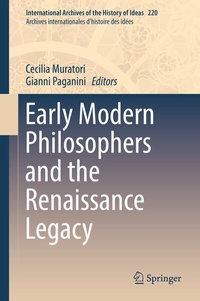
Early Modern Philosophers and the Renaissance Legacy
Description

When does Renaissance philosophy end, and Early Modern philosophy begin? Do Renaissance philosophers have something in common, which distinguishes them from Early Modern philosophers? And ultimately, what defines the modernity of the Early Modern period, and what role did the Renaissance play in shaping it? The answers to these questions are not just chronological. This book challenges traditional constructions of these periods, which partly reflect the prejudice that the Renaissance was a literary and artistic phenomenon, rather than a philosophical phase.
The essays in this book investigate how the legacy of Renaissance philosophers persisted in the following centuries through the direct encounters of subsequent generations with Renaissance philosophical texts. This volume treats Early Modern philosophers as joining their predecessors as 'conversation partners': the 'conversations' in this book feature, among others, Girolamo Cardano and Henry More, Thomas Hobbes and Lorenzo Valla, Bernardino Telesio and Francis Bacon, René Descartes and Tommaso Campanella, Giulio Cesare Vanini and the anonymous Theophrastus redivivus.Reviews / Votes
"Early Modern Philosophers and the Renaissance Legacy is one of several volumes published in this decade that reflect a revival of interest in Renaissance philosophy. . this volume makes a valuable contribution by broadening our view of what counts as philosophically significant and encouraging us to wander off the beaten paths to explore more varied interactions between Renaissance and seventeenth-century philosophers." (Helen Hattab, Journal of the History of Philosophy, Vol. 55 (4), October, 2017)More details
Other editions
Additional editions
Persons
Content
Introduction: Renaissance and Early Modern Philosophy: Mobile Frontiers and Established Outposts.- Section I: The Endurance of Tradition.- 1. What's Wrong with Doing History of Renaissance Philosophy? Rudolph Goclenius and the Canon of Early Modern Philosophy.- 2. Italian Renaissance Love Theory and the General Scholar in the Seventeenth Century.- 3. The Critique of Scholastic Language in Renaissance Humanism and Early Modern Philosophy.- 4. Henry More and Girolamo Cardano.- Section II: Natural Philosophy.- 5.From Attraction and Impulsus to Motion of Liberty. Rarefaction and Condensation, Nature and Violence in Cardano, Francis Bacon, Glisson and Hale.- 6. Telesio Among the Novatores: Telesio's Reception in the Seventeenth Century.- 7. Looking at an Earth-Like Moon and living on a Moon-Like Earth in Renaissance and Early Modern Thought. Section III: Changing Conceptions of the Human.- 8. Descartes, the Humanists and the Perfection of Man.- 9. The Return of Campanella:La Forge versus Cureau de la Chambre.- 10. From Animal Happiness to Human Unhappiness: Cardano, Vanini, Theophrastus redivivus (1659). Section IV: Moral and Political Theory.- 11. Ethics, Politics, and Friendship in Bacon's Essays (1625): Between Past and Future.- 12. Thomas Hobbes Against the Aristotelian Account of the Virtues and his Renaissance Source Lorenzo Valla.- 13. Debating "Greatness" from Machiavelli to Burton.- 14. John Upton from Political Liberty to Critical Liberty: The Moral and Political Implications of Ancient and Renaissance Studies in the Enlightenment.- 15. Epilogue: A Story in the History of Scholarship: The Rediscovery of Tommaso Campanella.
