

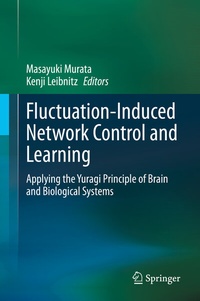
Fluctuation-Induced Network Control and Learning
Description

The book consists of two parts. Part 1 provides in four chapters an introduction to the biological background of the Yuragi concept as well as how these are applied to networking problems. Part 2 provides additional contributions that extend the original Yuragi concept to a Bayesian attractor model from human perceptual decision making. In the six chapters of the second part, applications to various fields in information network control and artificial intelligence are presented, ranging from virtual network reconfigurations, a software-defined Internet of Things, and low-power wide-area networks.
This book will benefit those working in the fields of information networks, distributed systems, and machine learning who seek new design mechanisms for controlling large-scale dynamically changing systems.More details
Other editions
Additional editions
Persons
Kenji Leibnitz received his M.Sc. and Ph.D.degrees in information science from the University of Würzburg, Germany, in 2003. In 2004, he joined the research group of Prof. Murata at Osaka University, where he became a specially appointed associate professor in 2006. In 2010, he moved to the National Institute of Information and Communications Technology (NICT) as a senior researcher, and since 2013 he has been a principal investigator at the Center for Information and Neural Networks (CiNet) of NICT and Osaka University. His research interests include modeling and performance analysis of communication networks, especially biologically and brain-inspired mechanisms for self-organization in future networks.
