

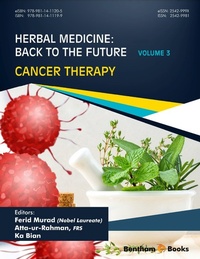
Cancer Therapy
Description

Herbal Medicine: Back to the Future compiles expert reviews on the application of herbal medicines (including Ayurveda, Chinese traditional medicines and alternative therapies) to treat different ailments. The book series demonstrates the use of sophisticated methods to understand traditional medicine, while providing readers a glimpse into the future of herbal medicine.
This volume presents reviews of traditional Chinese medicine and other plant based therapies useful for treating different cancers. The topics included in this volume are:
Herbal extracts from Carica papaya and Azadirachta
Natural antimutagens
Encapsulated polyphenols and other anticancer compounds derived from plants
Traditional Chinese medicine treatments for cancer related fatigue
Indirubins
Ayurvedic anticancer herbal medicines
Melanocyte regeneration through herbal medicine
This volume is essential reading for all researchers in the field of natural product chemistry and pharmacology. Medical professionals involved in oncology who seek to improve their knowledge about herbal medicine and alternative therapies will also benefit from the contents of the volume.
All prices
More details
Other editions
Additional editions
Content
- Cover
- Title
- Copyright
- End User License Agreement
- Contents
- Preface
- List of Contributors
- Herbal Extracts from Carica papaya and Azadirachta indica: What Role for ROS in Cancer Cell Lines?
- Luciana Dini1,2,*, Stefania Mariano3 and Elisa Panzarini3
- 1. CELLULAR SOURCES OF ROS
- 2. CONVERSION AND CLEARANCE OF ROS
- 3. FUNCTION OF ROS IN CANCER
- 3.1. Tumor Promoting Function of ROS
- 3.1.1. Effect on Tumorigenesis
- 3.1.2. Angiogenesis, Cell Invasion and Metastasis
- 3.2. Tumor Suppressive Function of ROS
- 3.2.1. Apoptosis
- 3.2.2. Autophagy
- 4. CANCER AND PHYTOTHERAPY
- 5. AZADIRACHTA INDICA AND CARICA PAPAYA EXTRACTS AS MODERN TOOL FOR CANCER TREATMENT WITH ANCIENT ROOTS
- 5.1. A. indica for Cancer Prevention and Treatment
- 5.1.1. Role of ROS in A. indica Treatment
- Normal Condition Oxidative Stress Condition
- 5.2. C papaya for Cancer Prevention and Treatment
- 5.2.1. Role of ROS in C. papaya Treatment
- Normal Condition Oxidative Stress Condition
- CONCLUSION
- CONSENT FOR PUBLICATION
- CONFLICT OF INTEREST
- ACKNOWLEDGMENT
- REFERENCES
- Natural Antimutagens. Chemopreventive Action of L-Ascorbic Acid and Green Tea Infusions on the Acute Toxicity and Mutagenicity of Reaction Mixtures Nitrite-Sulfonamide
- Ana Pontoriero and Marcela Rizzotto*
- INTRODUCTION
- Mutagens and Carcinogens
- Biological Tests
- Ames Test
- Allium Test
- NATURAL ANTIMUTAGENIC AGENTS
- Anthraquinones
- Aloe Species
- Rhamnus alaternus L.
- Carotenoids
- Artocarpus heterophyllus Lam (Jackfruit)
- Capsicum spp.
- Moringa Plants
- Coumarins
- Echeveria DC.
- Prunus mahaleb L.
- Flavonoids
- Artemisia absinthium L.
- Aspalathus linearis (rooibos)
- Belamcanda chinensis DC Goldblatt & Mabb
- Cyperus rotundus L.
- Phenolic Compounds
- Carum copticum L. (ajwain)
- Curcuma longa L. (Turmeric)
- Pistachia Vera
- Salvia nemorosa L.
- Veronica spp.
- Saponins
- Amaranthaceae Plants
- Amaranthus spinosus L.
- Tannins
- Phyllanthus amarus Schum. et Thonn.
- Pomegranate (Punica granatum)
- Terpenoids
- Morina Plants
- Zingiber zerumbet Smith
- Vitamins
- Actinidia Lindl (kiwifruit)
- CHEMOPREVENTIVE ACTION OF L-ASCORBIC ACID AND GREEN TEA INFUSIONS ON THE ACUTE TOXICITY AND MUTAGENICITY OF NITRITE-SULFONAMIDE REACTION MIXTURES
- Mutagens and Carcinogens
- Nitrites and Nitrosocompounds
- Exposure to N-nitrosocompounds (NOCs)
- Sulfa Drugs
- The Concept of Chemoprevention
- L-ascorbic Acid (AA)
- Green Tea
- BIOLOGICAL TESTS
- Ames Test
- Experimental
- NaStz-nitrite Mixture
- EFFECT OF L-ASCORBIC ACID (AA) ON THE MUTAGENICITY OF THE NASTZ-NITRITE MIX
- EFFECT OF GREEN TEA INFUSION (GT) ON THE MUTAGENICITY OF THE NASTZ-NITRITE MIX
- GLIBENCLAMIDE
- UV-VIS SPECTRA
- L-ascorbic Acid (AA)
- NaStz-nitrite System
- AA
- Green Tea
- NaStz-nitrite
- Glibenclamide
- CONCLUDING REMARKS
- CONSENT FOR PUBLICATION
- CONFLICT OF INTEREST
- ACKNOWLEDGEMENT
- REFERENCES
- Encapsulated Plant-Derived Polyphenols as Potential Cancer Treatment Agents
- Merve Deniz Kose and Oguz Bayraktar*
- INTRODUCTION
- Phenolic Acids
- Flavonoids
- Stilbenes
- Lignans
- PLANTS RICH IN POLYPHENOLS
- Content of the Polyphenols
- EXTRACTION METHODS OF POLYPHENOLS
- Conventional Methods
- Modern Extraction Techniques
- STABILITY OF POLYPHENOLS
- Bioavailability of Polyphenols
- Anti-Cancer Effect of Polyphenols
- Protective Role of Polyphenols on Cancer Studies
- ENCAPSULATION OF POLYPHENOLS
- Spray Drying
- Coacervation
- Liposomes
- Inclusion Encapsulation
- Co-Crystallization
- Freeze Drying
- Yeast Encapsulation
- Emulsions
- Nanoparticles in Cancer Therapy
- CONCLUDING REMARKS
- CONSENT FOR PUBLICATION
- CONFLICT OF INTEREST
- ACKNOWLEDGEMENT
- REFERENCES
- The Role of Traditional Chinese Herbal Medicines in Management of Patients with Cancer-related Fatigue
- Marcin Wlodarczyk1,*, Pawel Siwinski1, Aleksandra Tarasiuk2, Jakub Wlodarczyk2 and Aleksandra Sobolewska-Wlodarczyk2
- INTRODUCTION
- Prevalence of Cancer-related Fatigue
- Pathogenesis of Cancer-Related Fatigue
- Clinical Manifestations of Cancer-related Fatigue
- Treatment of Cancer-related Fatigue
- Chinese Herbal Medicines in Treatment of Cancer-related Fatigue
- Effectiveness and Safety of CHM in CRF
- Future Perspectives and Implications for Research
- CONCLUSIONS
- CONSENT FOR PUBLICATION
- CONFLICT OF INTEREST
- ACKNOWLEDGEMENT
- REFERENCES
- Indirubins as Multi-target Anti-Tumor Agents
- Yasamin Dabiri1, Guangqi Song2 and Xinlai Cheng1,*
- INTRODUCTION
- TOWARDS BIOAVAILABILITY: CHEMICAL MODIFICATION AND PHARMACEUTICAL FORMULATION
- Chemical Modification
- Pharmaceutical Formulation
- CELLULAR TARGETS OF INDIRUBIN AND DERIVATIVES
- Cyclin Dependent Kinases
- Glycogen Synthase Kinase 3
- Aryl Hydrocarbon Receptor
- STAT
- Vascular Endothelial Growth Factor Receptor
- Fibroblast Growth Factor Receptor
- Nuclear Factor-kB
- Casein Kinases
- Insulin-like Growth Factor 1 Receptor
- Transforming Growth Factor ß/Bone Morphogenetic Protein
- Cancer Stem Cell
- Indirubin-Mediated Cell Death Through Other Cellular Networks
- CLINICAL PERSPECTIVES
- CONCLUDING REMARKS
- CONSENT FOR PUBLICATION
- CONFLICT OF INTEREST
- ACKNOWLEDGEMENT
- REFERENCES
- Anticancer Agents: Plants Used in Ayurveda
- Uma Ranjan Lal, Dharmik Joshi and Sugato Banerjee*
- INTRODUCTION
- CANCER THERAPIES AND THEIR LIMITATIONS
- PRINCIPLES OF DRAVYA GUNA
- DEVELOPMENT OF ANTICANCER AGENTS FROM PLANT SOURCES
- PLANTS MENTIONED IN AYURVEDA WITH ANTI-CANCER POTENTIAL
- Abrus Precatorius
- Allium Sativum
- Aloe Vera
- Alstonia Scholaris
- Amoora Rohituka
- Anacardium Occidentale
- Andrographis Paniculata
- Annona Atemoya/Muricata
- Berberis Aristata
- Calotropis Gigantean
- Datura Metel
- Heliotropium Indicum
- Nigella Sativa
- Phyllanthus Niruri/Amarus
- Picrorrhiza Kurroa
- Piper Longum
- Podophyllum Hexandrum linn. (Podophyllin)
- Semecarpus Anacardium
- Tinospora Cordifolia
- Vinca Rosea
- Vitis Vinifera
- Withania Somnifera
- AYURVEDIC FORMULATIONS WITH ANTICANCER AND RADIO PROTECTIVE POTENTIAL
- CONCLUSION
- CONSENT FOR PUBLICATION
- CONFLICT OF INTEREST
- ACKNOWLEDGEMENT
- REFERENCES
- Plant Based Bioactive Compounds as an Alternative for Cancer Therapy
- Nikita Sharma1, R. Mankamna Kumari1, Nidhi Gupta2 and Surendra Nimesh1,*
- INTRODUCTION
- 1. POLYPHENOLS
- 1.1. Allicin
- 1.2. Curcumin
- 1.3. Resveratrol
- 1.4. Epigallocatechin Gallate
- 1.5. Rosmarinic Acid
- 2. ALKALOIDS
- Vinca alkaloids
- Camptothecin
- 3. SAPONINS AND TERPENOIDS
- 3.1. Diosgenin
- 3.2. Punicic Acid
- 3.3. Thymol
- Mechanism Associated with Cancer Chemoprevention and its Treatment
- Phytochemical Induced Apoptosis
- Epigenetics-DNA Methylation and Histone Modifications
- Cyclooxygenases-2 (COX-2)
- Angiogenesis Inhibition
- Other Mechanisms
- Limitations of Natural Compounds
- CONCLUSION
- CONSENT FOR PUBLICATION
- CONFLICT OF INTEREST
- ACKNOWLEDGMENTS
- REFERENCES
- Promoting Melanocyte Regeneration Using Different Plants and Their Constituents
- Sharique A. Ali*, Naima Parveen and Ayesha S. Ali
- INTRODUCTION
- SKIN PIGMENTATION AT A GLANCE
- Melanocyte Development
- Melanogenesis
- MelaninTransfer to Keratinocytes
- PIGMENTARY DISORDERS
- VITILIGO
- Epidemiology
- Types of Vitiligo
- 1. Non segmental vitiligo
- 2. Segmental Vitiligo
- 3. Undetermined or Unclassifiable Forms of Vitiligo
- Pathogenesis of Vitiligo
- Genetic Hypothesis
- Autoimmune Hypothesis
- Neural Hypothesis
- Autocytotoxic Hypothesis
- Growth Factor Defect Hypothesis
- Adhesion Defect Theory
- Convergence Theory
- CURRENT TREATMENT MODALITIES FOR VITILIGO
- (i). Physical Treatment
- a). Narrow Band UVB- NBUVB
- b). PUVA Therapy
- c). Monochromatic Excimer Light
- (ii). Pharmacological Treatment
- a). Topical Corticosteroid
- b). Immunomodulators
- (iii). Surgical Treatment
- Suction Blister Epidermal Grafting
- Split Thickness Grafting
- Epidermal Cell Suspension Grafting
- Non- cultured Epidermal Cell Suspension Grafting
- PROMOTING MELANOCYTE REGENERATION USING DIFFERENT PLANTS AND THEIR CONSTITUENTS
- Psoralea Corylifolia
- Nigella Sativa
- Withania Somnifera
- Piper Nigrum
- Ficus Carica
- Berberis Vulgaris
- Nelumbo Nucifera
- Polygoni Multiflorum
- Angelica Sinensis
- Ammi Majus
- CONCLUSION
- CONSENT FOR PUBLICATION
- CONFLICT OF INTEREST
- ACKNOWLEDGEMENT
- REFERENCES
- Subject Index
- Back Cover
