

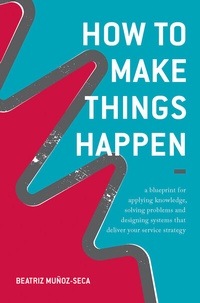
How to Make Things Happen
Description

This book offers models and frameworks to analyze your service delivery systems as a whole. It presents the framework to solve customer problems by delivering the right knowledge at the right time to the right place and take advantage of the efficiency that technology and algorithms offer.
Why do so many brilliant plans fail to deliver in practice? Why can't your employees just do what you want them to do? In most cases, because the operations eco-system in which those plans must be deployed fails to fully understand the problem that needs to be solved.
The fourth industrial revolution is seeing advances in Artificial Intelligence industrialize the service sector. But, despite the cost-cutting that these advances offer firms are still struggling to stay competitive. That is because they think that cost-cutting delivers increased efficiency whereas it is the other way around: increased efficiency cuts costs. And the heart of efficiency in delivering services is people andtheir knowledge.
As industrialization drives ever more standardized offerings and ever little human contact it is in those rare moments of human interaction where the greatest opportunity to add or destroy value lies. It is human brains and the knowledge they contain that are best suited to problem-solving and individualizing client solutions. The real competitive edge will become the ability to foresee and individualize problem-solving.
To do this, firms must start thinking of knowledge as inventory - who knows what, who needs to know what and where and when do they need to know it.
More details
Other editions
Additional editions
Person
Dr. Muñoz-Seca worked for over 15 years in national and multinational companies, in both the private and public sectors, in Mexico, the United States, and Spain. She joined IESE in 1990. She teaches Operations Strategy at IESE and at various business schools in Latin America.
She has been an advisor to the European Commission, and has participated in and led numerous international and national projects in her field. She also works as a part-time consultant in operations strategy, service design, and innovation.
