

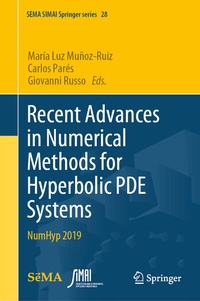
Recent Advances in Numerical Methods for Hyperbolic PDE Systems
Description

The present volume contains selected papers issued from the sixth edition of the International Conference "Numerical methods for hyperbolic problems" that took place in 2019 in Málaga (Spain). NumHyp conferences, which began in 2009, focus on recent developments and new directions in the field of numerical methods for hyperbolic partial differential equations (PDEs) and their applications. The 11 chapters of the book cover several state-of-the-art numerical techniques and applications, including the design of numerical methods with good properties (well-balanced, asymptotic-preserving, high-order accurate, domain invariant preserving, uncertainty quantification, etc.), applications to models issued from different fields (Euler equations of gas dynamics, Navier-Stokes equations, multilayer shallow-water systems, ideal magnetohydrodynamics or fluid models to simulate multiphase flow, sediment transport, turbulent deflagrations, etc.), and the development of new nonlinear dispersive shallow-water models.
The volume is addressed to PhD students and researchers in Applied Mathematics, Fluid Mechanics, or Engineering whose investigation focuses on or uses numerical methods for hyperbolic systems. It may also be a useful tool for practitioners who look for state-of-the-art methods for flow simulation.
More details
Other editions
Additional editions
Persons
Carlos Parés is a Professor of Applied Mathematics at the University of Málaga (Spain). He is a specialist in numerical methods for nonlinear hyperbolic systems of partial differential equations. He promoted the creation and development of the EDANYA group of research, which is currently an international reference in the simulation of geophysical flows. He was among the promoters of the series of conferences Numerical Methods for Hyperbolic Problems that started in 2009 in Castro-Urdiales (Spain).
María Luz Muñoz Ruiz is an Associate Professor in Applied Mathematics at the University of Málaga (Spain), from which she received an M.S. and Ph.D. degrees in Mathematics. She belongs to the Differential Equations, Numerical Analysis and Applications (EDANYA) research group, whose interests focus on the numerical resolution of nonconservative hyperbolic systems and its application to the simulation of geophysical flows.
Giovanni Russo is a fullprofessor of numerical analysis at the University of Catania. Works on numerical methods for evolutionary partial differential equations, and other topics in computation and applied mathemastics. Author of more than a hundred papers on international journals. Associate editor of SIMA, CMS, and other journals, responsible for various national and international research projects, chair of several international conferences and workshops. Has been PhD coordinator for more than sixteen years.
