

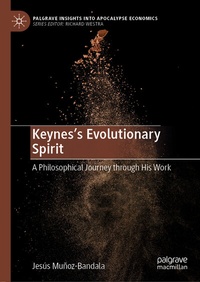
Keynes's Evolutionary Spirit
Description

This book chronicles the way Keynes's generous philosophy of practice evolved in consonance with the needs of his epoch. From a youngster reflecting on ethics and the classics, to becoming a leading voice in both wars in terms of political philosophy and international relations, to playing the role of innovator in both probability and economics, to taking a stance as an art appreciator, Keynes's life and multidisciplinary contributions to humankind were permeated by his philosophical milieu. However, only a flexible, dynamic, and broad philosophy could have reflected and led the economic and political events in the world of the first part of the 20th Century, which is what Keynes managed to accomplish, and that is what the book suggests. This book captures the gist of Keynes' evolutionary philosophy for our times.
The book adds an evolutionary perspective to the existing literature on Keynes. As a case in point, the theoretical foundations of both macroeconomics and laissez faire are dissected. But the book also tells the story of how Keynes's philosophy is adapted to a convulsed world, which is akin to ours, his legacy being gifted with multiple human considerations. The book offers an outline of Keynes's philosophical stance-also compared with those of other European thinkers-at a moment when new ethical, epistemological, economic, and political perspectives are required, especially after the crisis of 2020. The conclusion is that Keynes´s theoretical and practical insights were far ahead of his time.
Reviews / Votes
"Jesús Muñoz Bandala has written a remarkable work of scholarship. He takes us through Maynard Keynes's contributions from his earliest writings to his last, putting them within a novel structure of philosophical reconstruction in an evolutionary setting. The author relates his arguments and provides the evidence for them in later sections of the chapters and in appendixes to the chapters. The overall result is a challenging re-reading of Keynes himself and the relevance of this for the application of his fundamental contributions to the great issues that face the economics profession today."
- G. C. Harcourt , Honorary Professor, School of Economics, UNSW, SydneyMore details
Other editions
Additional editions
Person
Jesús Muñoz-Bandala holds a PhD in Economics from Lancaster University, UK, was a visiting researcher in Georgetown University, USA, and teaches and conducts research in Mexico City. He publishes on the legacy of Keynes, Marx, Nietzsche, and Friedman but also on economic philosophy, macroeconomics, international finance, and migration with a focus on humankind amelioration.
