

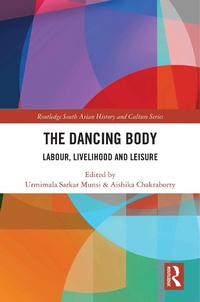
The Dancing Body
Labour, Livelihood and Leisure
1st Edition
Published on 30. August 2024
188 pages
978-1-040-11985-3 (ISBN)
Description

This book, with its focus on the dancing body, is the first of its kind within the larger context of dance in India.
The Dancing Body is a body that exists, survives, inhabits and performs in multiple space and time, by moving, laboring, migrating and straddling across geographic, cultural and emotional borders, writing different cultural meanings at different moments of time. In India, discourses around the body in dance have long been trapped within hagiographic histories in and around dancers and their dance. During the last few decades, however, significant scholarly inroads were made into the domain of dance by shaking up the stereotypes, assertions and labels, shaped and moulded by patriarchy, class, caste and power. This book brings together emerging discourses around dance and the body that have become central in the Indian nation-state. Contemporary discourses around identity politics, moral policing, politics of exclusion, and neo-liberal dispossessions vis a vis sexual labour, means of survival, pleasure and agency of dancers have helped frame the focus around labour, leisure and livelihood concerning the everyday existence of the body in dance.
This volume will be of great value to students, researchers and scholars in dance, gender studies, cultural studies, and performance studies, with a particular interest in Asian and South Asian Studies. The chapters in this book were originally published in a special issue of South Asian History and Culture.
The chapters in this book were originally published in a special issue of South Asian History and Culture.
The Dancing Body is a body that exists, survives, inhabits and performs in multiple space and time, by moving, laboring, migrating and straddling across geographic, cultural and emotional borders, writing different cultural meanings at different moments of time. In India, discourses around the body in dance have long been trapped within hagiographic histories in and around dancers and their dance. During the last few decades, however, significant scholarly inroads were made into the domain of dance by shaking up the stereotypes, assertions and labels, shaped and moulded by patriarchy, class, caste and power. This book brings together emerging discourses around dance and the body that have become central in the Indian nation-state. Contemporary discourses around identity politics, moral policing, politics of exclusion, and neo-liberal dispossessions vis a vis sexual labour, means of survival, pleasure and agency of dancers have helped frame the focus around labour, leisure and livelihood concerning the everyday existence of the body in dance.
This volume will be of great value to students, researchers and scholars in dance, gender studies, cultural studies, and performance studies, with a particular interest in Asian and South Asian Studies. The chapters in this book were originally published in a special issue of South Asian History and Culture.
The chapters in this book were originally published in a special issue of South Asian History and Culture.
More details
Series
Edition
1. Auflage
Language
English
Place of publication
London
United Kingdom
Publishing group
Taylor & Francis Ltd
Target group
College/higher education
ISBN-13
978-1-040-11985-3 (9781040119853)
Copyright in bibliographic data and cover images is held by Nielsen Book Services Limited or by the publishers or by their respective licensors: all rights reserved.
Schweitzer Classification
Other editions
Additional editions
Book
10/2025
1st Edition
Routledge
€63.20
Shipment within 10-20 days
Book
08/2024
1st Edition
Routledge
€193.40
Shipment within 10-20 days
Persons
Urmimala Sarkar Munsi is Professor and Dean of the School of Arts and Aesthetics in Jawaharlal Nehru University, India. Her research overlaps the intersection between dance, gender and lived experience; practice /theory interface; documenting performance; and the politics of identity and regional performances. Her recent publications are Uday Shankar and his Transcultural Experimentations: Dancing Modernity (2022), Alice Boner Across Arts and Geographies: Shaping the Dance Art of Uday Shankar (2021), Mapping Critical Dance Studies in India (2024), Marg Dance Readings (co- edited with Anita Cherian, 2023).
Aishika Chakraborty is Professor and Director of the School of Women's Studies, Jadavpur University, Kolkata, India. A gender historian, her current research thrives at the interface of class, patriarchy and performance of the labouring bodies in Indian contemporary and popular dance. She is the author of Widows of Colonial Bengal: Gender, Morality and Cultural Representation (2023) Kolkatar Nach: Samakalin Nagarnritya (2019) and Kolkatar Cabaret: Bangali, Younata ebang Miss Shefali (2020). She is currently working on a co-edited volume titled Gendered Bodies, Social Exclusions: Contemporary Issues in Women's Studies (Routledge).
Aishika Chakraborty is Professor and Director of the School of Women's Studies, Jadavpur University, Kolkata, India. A gender historian, her current research thrives at the interface of class, patriarchy and performance of the labouring bodies in Indian contemporary and popular dance. She is the author of Widows of Colonial Bengal: Gender, Morality and Cultural Representation (2023) Kolkatar Nach: Samakalin Nagarnritya (2019) and Kolkatar Cabaret: Bangali, Younata ebang Miss Shefali (2020). She is currently working on a co-edited volume titled Gendered Bodies, Social Exclusions: Contemporary Issues in Women's Studies (Routledge).
Content
Preface Introduction: The dancing body: labour, livelihood and leisure 1. Becoming a body 2. Artistic labour in dance and painting: revisiting the theory-practice debate via mimesis (Anukrti) and the abject body 3. Folk dance/vulgar dance: erotic lavani and the hereditary performance labour 4. Calcutta cabaret: dance of pleasure or perversion? 5. The erotic power of the dancer: labour of the erotic and the bodies of the sensory in the Arkestra of North India 6. The phantom of history: figurations of the dancing body and the 'Sitara Devi problem' of Indian cinema 7. Disco flamboyance, performative masculinities and dancer heroes of Bengali cinema 8. Choreographing the queer: Visual and textual stimuli in Mandeep Raikhy's dance-making process 9. The body and the contagion: a symbiosis of yoga, dance, health and spirituality 10. The award-wapsi controversy in India and the politics of dance
