

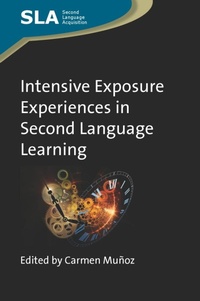
Intensive Exposure Experiences in Second Language Learning
Published on 28. September 2012
296 pages
978-1-84769-807-0 (ISBN)
Description

This volume brings together studies dealing with second language learning in contexts that provide intensive exposure to the target language. In doing so, it highlights the role of intensive exposure as a critical distinctive characteristic in the comparison of learning processes and outcomes from different learning contexts: naturalistic and foreign language instruction, stay abroad and at home, and extensive and intensive instruction programmes. The different chapters represent a wide range of learning contexts and types of learning, as well as different approaches that yield much needed evidence on the role of context of acquisition in second language learning.
Reviews / Votes
This is an impressive collection of studies on intensive exposure experiences in L2 learning. Findings from research in Canadian intensive programs, European schools and study abroad contexts illustrate the benefits of intensive L2 learning and provide compelling insights about interactions with learner factors including age, L1 background, L2 proficiency, academic ability, and language learning history. This is essential reading for L2 program developers, teachers and researchers. -- Nina Spada, University of Toronto, Canada This collection offers a rich exploration of the interplay among contexts for additional language learning, varying intensities of input and instruction, and mediating individual difference factors. The highly original research insights are gleaned from measured proficiency gains, corpus documentation of the linguistic environments, and qualitative learner perceptions of context affordances. A must-read! -- Lourdes Ortega, Georgetown University, USA This impressive volume brings together a rich collection of articles that offer penetrating discussions of the complex issues associated with intensive language learning. Its strengths lie in its focus on cross cultural research, contrasting methodologies, comparisons among different types of intensive learning programs, the age, L1 and social background of the learners and considerations of which types of program best promotes which type of gain. Particularly interesting is that time honored questions in SLA, the role of input, time-on task, form focused instruction among others, are considered as they relate to intensive language learning. -- Barbara Freed, Carnegie Mellon University, USA This book is intended for a broad audience, including teachers, language teacher educators, language education policymakers, applied linguists, L2 researchers, academics and postgraduate students (of L2 studies, psycholinguistics and bilingualism)... Despite the number of different contributors, the book is clearly well-edited, accessible, and consistent in its presentation. The authors appear to have achieved their goals with the book. -- Jon Clenton, Osaka University, Japan * the LINGUIST List, 24.584, 31st January 2013 * The book, which presents an interesting collection of texts, some from very renowned researchers in the field, will without any doubt serve as a useful resource for readers interested in issues related to intensive exposure to the target language and also more broadly to learning contexts. It could also serve as a textbook for a graduate seminar on the role of intensive exposure in second/foreign language acquisition as it provides readers with a solid general portrait of the effect of intensive exposure to the target language as a function of various factors in language development. -- Daphnee Simard, University of Quebec at Montreal, Canada * International Journal of Applied Linguistics, Vol. 23, No. 3, 2013 *More details
Series
Language
English
Place of publication
Bristol
United Kingdom
Publishing group
Channel View Publications Ltd
Target group
Professional and scholarly
ISBN-13
978-1-84769-807-0 (9781847698070)
Copyright in bibliographic data and cover images is held by Nielsen Book Services Limited or by the publishers or by their respective licensors: all rights reserved.
Schweitzer Classification
Other editions
Additional editions
Book
09/2012
Multilingual Matters
€48.50
Shipment within 10-20 days
Person
Carmen Munoz received her MA in Applied Linguistics from the University of Reading, UK and her PhD in English Linguistics from the University of Barcelona, Spain, where she is now a Professor of English Linguistics and Applied Linguistics. Her research interests include second and foreign language acquisition, as well as bilingual acquisition. Her recent publications have focused on the role of age and context in foreign language learning, young learners, and individual differences. She was the coordinator of the Barcelona Age Factor (BAF) Project.
Content
Carmen Munoz: Introduction
THEORETICAL UNDERPINNINGS OF INTENSIVE LEARNING
1. Raquel Serrano: Is Intensive Learning Effective? Reflecting on the Results from Cognitive Psychology and the SLA Literature
INTENSIVE INSTRUCTION
2. Patsy M. Lightbown: Intensive L2 Instruction in Canada: Why not Immersion?
3. Laura Collins and Joanna White: Closing the Gap: Intensity and Proficiency
4. Laura Collins, Joanna White, Pavel Trofimovich, Walcir Cardoso, and Marlise Horst: When Comprehensible Input isn't Comprehensive Input: A Multi-Dimensional Analysis of Instructional Input in Intensive EFL
5. Joanna White and Carolyn E. Turner: What Language is Promoted in Intensive Programs? Analyzing Language Generated from Oral Assessment Tasks
6. Alex Housen: Time and Amount of L2 Contact inside and outside the School - Insights from the European Schools
LEARNERS' PERCEPTIONS AND INTENSIVE EXPOSURE
7. Carmen Munoz: The Significance of Intensive Exposure as a Turning Point in Learners' Histories
8. Elsa Tragant: Change or Stability in Learners' Perceptions as a Result of Study Abroad
NATURALISTIC IMMERSION
9. Angels Llanes: The Impact of Study Abroad and Age on Second Language Accuracy Development
10. Carmen Perez-Vidal, Maria Juan-Garau, Joan C. Mora and Margalida Valls-Ferrer: Oral and Written Development in Formal Instruction and Study Abroad: Differential Effects of Learning Context
11. Romana Kopeckova: Differences in L2 Segmental Perception: The Effects of Age and L2 Learning Experience
THEORETICAL UNDERPINNINGS OF INTENSIVE LEARNING
1. Raquel Serrano: Is Intensive Learning Effective? Reflecting on the Results from Cognitive Psychology and the SLA Literature
INTENSIVE INSTRUCTION
2. Patsy M. Lightbown: Intensive L2 Instruction in Canada: Why not Immersion?
3. Laura Collins and Joanna White: Closing the Gap: Intensity and Proficiency
4. Laura Collins, Joanna White, Pavel Trofimovich, Walcir Cardoso, and Marlise Horst: When Comprehensible Input isn't Comprehensive Input: A Multi-Dimensional Analysis of Instructional Input in Intensive EFL
5. Joanna White and Carolyn E. Turner: What Language is Promoted in Intensive Programs? Analyzing Language Generated from Oral Assessment Tasks
6. Alex Housen: Time and Amount of L2 Contact inside and outside the School - Insights from the European Schools
LEARNERS' PERCEPTIONS AND INTENSIVE EXPOSURE
7. Carmen Munoz: The Significance of Intensive Exposure as a Turning Point in Learners' Histories
8. Elsa Tragant: Change or Stability in Learners' Perceptions as a Result of Study Abroad
NATURALISTIC IMMERSION
9. Angels Llanes: The Impact of Study Abroad and Age on Second Language Accuracy Development
10. Carmen Perez-Vidal, Maria Juan-Garau, Joan C. Mora and Margalida Valls-Ferrer: Oral and Written Development in Formal Instruction and Study Abroad: Differential Effects of Learning Context
11. Romana Kopeckova: Differences in L2 Segmental Perception: The Effects of Age and L2 Learning Experience
