

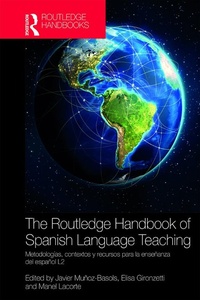
The Routledge Handbook of Spanish Language Teaching
metodologias, contextos y recursos para la ensenanza del espanol L2
1st Edition
Published on 17. October 2018
724 pages
978-1-317-29419-1 (ISBN)
Description

The Routledge Handbook of Spanish Language Teaching: metodologias, contextos y recursos para la ensenanza del espanol L2, provides a comprehensive, state-of-the-art account of the main methodologies, contexts and resources in Spanish Language Teaching (SLT), a field that has experienced significant growth world-wide in recent decades and has consolidated as an autonomous discipline within Applied Linguistics.
Written entirely in Spanish, the volume is the first handbook on Spanish Language Teaching to connect theories on language teaching with methodological and practical aspects from an international perspective. It brings together the most recent research and offers a broad, multifaceted view of the discipline.
Features include:
Forty-four chapters offering an interdisciplinary overview of SLT written by over sixty renowned experts from around the world;
Five broad sections that combine theoretical and practical components: Methodology; Language Skills; Formal and Grammatical Aspects; Sociocultural Aspects; and Tools and Resources;
In-depth reflections on the practical aspects of Hispanic Linguistics and Spanish Language Teaching to further engage with new theoretical ideas and to understand how to tackle classroom-related matters;
A consistent inner structure for each chapter with theoretical aspects, methodological guidelines, practical considerations, and valuable references for further reading;
An array of teaching techniques, reflection questions, language samples, design of activities, and methodological guidelines throughout the volume.
The Routledge Handbook of Spanish Language Teaching contributes to enriching the field by being an essential reference work and study material for specialists, researchers, language practitioners, and current and future educators. The book will be equally useful for people interested in curriculum design and graduate students willing to acquire a complete and up-to-date view of the field with immediate applicability to the teaching of the language.
Written entirely in Spanish, the volume is the first handbook on Spanish Language Teaching to connect theories on language teaching with methodological and practical aspects from an international perspective. It brings together the most recent research and offers a broad, multifaceted view of the discipline.
Features include:
Forty-four chapters offering an interdisciplinary overview of SLT written by over sixty renowned experts from around the world;
Five broad sections that combine theoretical and practical components: Methodology; Language Skills; Formal and Grammatical Aspects; Sociocultural Aspects; and Tools and Resources;
In-depth reflections on the practical aspects of Hispanic Linguistics and Spanish Language Teaching to further engage with new theoretical ideas and to understand how to tackle classroom-related matters;
A consistent inner structure for each chapter with theoretical aspects, methodological guidelines, practical considerations, and valuable references for further reading;
An array of teaching techniques, reflection questions, language samples, design of activities, and methodological guidelines throughout the volume.
The Routledge Handbook of Spanish Language Teaching contributes to enriching the field by being an essential reference work and study material for specialists, researchers, language practitioners, and current and future educators. The book will be equally useful for people interested in curriculum design and graduate students willing to acquire a complete and up-to-date view of the field with immediate applicability to the teaching of the language.
Reviews / Votes
"The Routledge Handbook of Spanish Language Teaching: metodologia, contextos y recursos para la ensenanza del Espanol L2 es el claro ejemplo de que los procesos de heterogeneidad y homogeneidad asociados a la globalizacion han irrumpido de lleno en el campo de la lingueistica aplicada a la ensenanza de la lengua espanola. Por un lado, se trata de un trabajo en el que destacados especialistas ubicados en diversos contextos geograficos y de ensenanza exponen los ultimos avances en los temas de mayor actualidad en la disciplina. Por otro lado, la homogeneidad se pone de manifiesto en la estructura de los capitulos (introduccion y palabras clave bilinguees, estado de la cuestion, consideraciones metodologicas, pautas, bibliografia citada y bibliografia recomendada). La calidad y el rigor teoricos se anticipan desde la introduccion (por ejemplo, en el interes por precisar las principales nomenclaturas de la investigacion y la ensenanza del espanol). El prurito por la aplicacion practica se plasma en cada capitulo, en la seccion de pautas, donde en ocasiones se incluyen ademas muestras de lengua para ilustrar aspectos pedagogicos concretos. La conjuncion de estos y otros muchos aciertos dan como resultado un todo armonico que nos pone a vibrar en una misma sintonia de empoderamiento y confianza en nuestra profesion y en el futuro de nuestra lengua."Martha Jurado, CEPE - Universidad Nacional Autonoma de Mexico (UNAM)
"This volume covers an extensive range of critical and current topics in teaching Spanish from both veteran and newer voices. Pressing issues of concern to both researchers and practitioners are represented, as well as useful reflections on how to bridge the two. The five principal sections of the book-cutting-edge methodologies, the development of language skills, features of various linguistic structures, a range of sociocultural topics, and a collection of high quality resources-offer readers a state of th
More details
Series
Edition
1. Auflage
Language
English
Place of publication
London
United Kingdom
Publishing group
Taylor & Francis Ltd
Target group
College/higher education
Professional and scholarly
File size
6,72 MB
ISBN-13
978-1-317-29419-1 (9781317294191)
Copyright in bibliographic data and cover images is held by Nielsen Book Services Limited or by the publishers or by their respective licensors: all rights reserved.
Schweitzer Classification
Other editions
Additional editions
Javier Munoz-Basols | Elisa Gironzetti | Manel Lacorte
The Routledge Handbook of Spanish Language Teaching
metodologias, contextos y recursos para la ensenanza del espanol L2
Book
06/2020
1st Edition
Routledge
€75.80
Shipment within 15-20 days
Javier Munoz-Basols | Elisa Gironzetti | Manel Lacorte
The Routledge Handbook of Spanish Language Teaching
metodologias, contextos y recursos para la ensenanza del espanol L2
Book
11/2018
1st Edition
Routledge
€364.52
Shipment within 10-20 days
Persons
Javier Munoz-Basols is Senior Instructor in Spanish and Co-ordinator of the Spanish language programme at the University of Oxford, UK
Elisa Gironzetti is Assistant Professor of Spanish Applied Linguistics and Coordinator and TA Supervisor for Spanish Language Courses at the University of Maryland, USA
Manel Lacorte is Associate Professor of Spanish Applied Linguistics and Director of the Spanish Language Program at the University of Maryland, USA
Elisa Gironzetti is Assistant Professor of Spanish Applied Linguistics and Coordinator and TA Supervisor for Spanish Language Courses at the University of Maryland, USA
Manel Lacorte is Associate Professor of Spanish Applied Linguistics and Director of the Spanish Language Program at the University of Maryland, USA
Content
Parte 1: Perspectivas metodologicas y curriculares 1. Metodos y enfoques para la ensenanza 2. Autonomia y motivacion 3. Estilos y estrategias de aprendizaje 4. Diseno, revision y evaluacion curricular 5. Planificacion de unidades didacticas 6. Analisis y diseno de materiales didacticos 7. Analisis y correccion de errores 8. Evaluacion 9. Adquisicion y ensenanza de segundas lenguas 10. Dimensiones criticas en la ensenanza del espanol Parte 2: Destrezas lingueisticas y comunicativas 11. Comprension lectora 12. Expresion escrita 13. Comprension auditiva 14. Expresion oral 15. Gramatica pedagogica 16. Vocabulario 17. Cultura e interculturalidad Parte 3: Aspectos lingueisticos y gramaticales 18. Lingueistica cognitiva 19. Fonologia y fonetica 20. Morfologia 21. Sintaxis 22. Semantica 23. Pragmatica 24. Sociolingueistica 25. Dialectologia 26. Lexicografia Parte 4: Contextos sociales y culturales 27. Bilingueismo y multilingueismo 28. Lenguas en contacto 29. Hablantes de herencia 30. Inmigracion y ensenanza a adultos 31. Aprendizaje-servicio y aprendizaje comunitario 32. Aprendizaje por contenidos e inmersion lingueistica 33. Programas de estudios en el extranjero 34. Espanol para las profesiones Parte 5: Herramientas didacticas y recursos profesionales 35. Contextos virtuales para el aprendizaje 36. Tecnologias educativas 37. Medios audiovisuales 38. Gamificacion 39. Corpus y bases de datos 40. Traduccion pedagogica 41. Literatura 42. Investigacion en accion 43. Profesores no nativos 44. Desarrollo profesional
