

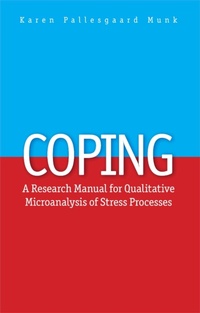
Coping
A Research Manual for Qualitative Microanalysis of Stress Processes
Published on 28. June 2019
158 pages
978-87-7219-000-6 (ISBN)
Description

The concept of 'coping' is fundamental in stress research, as an overall designation for everything people do to deal with stressful situations. In this book Karen Pallesgaard Munk further develops the theory of coping, using the American psychologist Richard S. Lazarus' analysis of emotions to research how individuals and groups experience stress. This new method, which Karen Pallesgaard Munk calls Qualitative Micro Analysis, begins with interviews that focus on both practical and emotional aspects of the life situation of the informant. Against this background, a systematic mapping of the informant's coping strategies and related narratives is made as a basis for change. In this book, instructions are given for how to conduct a coping interview, analyse the results and then communicate the data. The guidelines are applicable to both large research projects and smaller investigations on stress and well-being, for example by students of health.
More details
Other editions
Additional editions

Book
06/2019
Aarhus University Press
€44.84
Shipment within 10-20 days
Content
- Cover
- Title Page
- Colophon
- Contents
- Preface
- Introduction
- The Content of The Manual
- 1. Introduction to the Theoretical Basis of the Research Manual
- The Concept of Stress
- The Concept of Coping
- A Theory-Driven Research Method
- A Change of Perspective
- A Systemic Onset
- The Goal Hierarchy As A Leading Principle
- The Concept Of Goal - The Heart of The Theory and Method
- The Concept of Hierarchy
- The Goal Hierarchy and The Wellbeing of Human Beings
- The Role of The Goal Hierarchy in the Coping Process
- Emotions as a 'second language'
- The Three-Part Structure of The Coping Process
- The trigger
- Stage one:
- Stage two:
- Different Types of Coping
- Outcome of The Coping Process
- Summary
- 2. The Formative Elements of The Coping Course
- 1. The Objective Character of A Situation of Mental Strain
- Mental illnesses and the objective character of a situation
- Summary
- 2. The Subjective Character of A Situation of Mental Strain
- Summary
- 3. The Level of Perceived Reversibility of The Burden
- Summary
- 4. Emotional Reactions
- Summary
- 5. Resources Of Personality
- SummaryPersonal faculties
- 6. Environmental Resources
- Summary
- 3. Guidance on The Analysis of Coping Courses
- Step One: Identify the distressing event(s)
- Step Two: Find the personal meanings
- Step Three: Estimate the emotional implications
- Step Four: Map the coping strategies used by the informant
- Narrativity and Coping Strategies
- The Coping Strategies 'Prevention' and 'Restoration'
- The Coping Strategy 'Active Resignation'
- The Coping Strategy 'Extinction of Goal'
- The Coping Strategy 'Palliation'
- Absence of Coping: 'Passive Resignation'
- Step Five: Identify interventions
- Step Six: Record the outcomes of each sub-process
- Step Seven: Detect patterns across cases
- 4. The Coping Interview
- The Research Contract
- Attitudes to the interviewee
- The distribution of roles
- Practical arrangements
- Conclusion
- Coping Memories: Stored, Forgotten or Changed?
- Types of knowledge
- The phases of the memory process
- Forgetting
- A model for autobiographical memory
- Guidance from memory research for the interviewer
- The seductive storyteller
- Conclusion
- The Coping Interview as A Non-Linear Process
- Conclusion
- Interview Guide for The Coping Process
- Further comments on the interview
- The Pitfalls of The Research Interview
- 5. The Life-Historical Resource Interview
- The structure of a life-historical resource interview
- Analytic scheme for resources
- 6. Publication of The Results of The Microanalysis
- Schemes of Results Regarding Coping Courses
- Examples of Coping Narratives
- Conclusion
- Appendix
- The Method Used on A Real Case
- Notes
- References
