

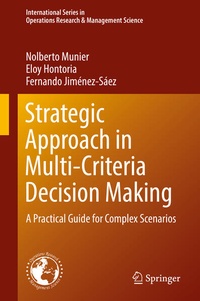
Strategic Approach in Multi-Criteria Decision Making
A Practical Guide for Complex Scenarios
1st Edition
Published on 29. January 2019
XV, 273 pages
978-3-030-02726-1 (ISBN)
Description

This book examines multiple criteria decision making (MCDM) and presents the Sequential Interactive Modelling for Urban Systems (SIMUS) as a method to be used for strategic decision making. It emphasizes the necessity to take into account aspects related to real world scenarios and incorporating possible real life aspects for modelling. The book also highlights the use of sensitivity analysis and presents a method for using criteria marginal values instead of weights, which permits the drawing of curves that depicts the variations of the objective function due to variations of these marginal values. In this way it also gives quantitative values of the objective function allowing stakeholders to perform a comprehensive risk analysis for a solution when it is affected by exogenous variables.
Strategic Approach in Multi-Criteria Decision Making: A Practical Guide for Complex Scenarios is divided into three parts. Part 1 is devoted to exploring the history and development of the discipline and the way it is currently used. It highlights drawbacks and problems that scholars have identified in different MCDM methods and techniques. Part 2 addresses best practices to assure quality MCDM process. Part 3 introduces the concept of Linear Programming and the proposed SIMUS method as techniques to deal with MCDM. It also includes case studies in order to help document and illustrate difficult concepts, especially related to demands from a scenario and also in their modelling. The decision making process can be a complex task, especially with multi-criteria problems. With large amounts of information, it can be an extremely difficult to make a rational decision, due to the number of intervening variables, their interrelationships, potential solutions that might exist, diverse objectives envisioned for a project, etc. The SIMUS method has been designed to offer a strategy to help organize, classify, and evaluate thisinformation effectively.
Strategic Approach in Multi-Criteria Decision Making: A Practical Guide for Complex Scenarios is divided into three parts. Part 1 is devoted to exploring the history and development of the discipline and the way it is currently used. It highlights drawbacks and problems that scholars have identified in different MCDM methods and techniques. Part 2 addresses best practices to assure quality MCDM process. Part 3 introduces the concept of Linear Programming and the proposed SIMUS method as techniques to deal with MCDM. It also includes case studies in order to help document and illustrate difficult concepts, especially related to demands from a scenario and also in their modelling. The decision making process can be a complex task, especially with multi-criteria problems. With large amounts of information, it can be an extremely difficult to make a rational decision, due to the number of intervening variables, their interrelationships, potential solutions that might exist, diverse objectives envisioned for a project, etc. The SIMUS method has been designed to offer a strategy to help organize, classify, and evaluate thisinformation effectively.
More details
Series
Language
English
Place of publication
Cham
Switzerland
Publishing group
Springer International Publishing
Target group
Professional and scholarly
Product notice
Reflowable
Illustrations
XV, 273 p. 109 illus., 67 illus. in color.
File size
8,48 MB
ISBN-13
978-3-030-02726-1 (9783030027261)
DOI
10.1007/978-3-030-02726-1
Schweitzer Classification
Other editions
New editions
Nolberto Munier
Strategic Approach in Multi-Criteria Decision Making
A Practical Guide for Complex Scenarios
E-Book
03/2024
2nd Edition
Springer
€149.79
Available for download
Additional editions
Nolberto Munier | Eloy Hontoria | Fernando Jiménez-Sáez
Strategic Approach in Multi-Criteria Decision Making
A Practical Guide for Complex Scenarios
Book
02/2019
1st Edition
Springer
€128.39
Article exhausted; check for reprint
Persons
Eloy Hontoria
Industrial Engineer- Polytechnic University of Valencia - Spain. Ph.D. degree in Economics and Business Administration (International Doctorate Mention). Extensive experience in Operations Management and Supply Chain at the Logistic Department in different local and multinational firms, being in charge of Logistics activities, as well as CEO of his own companies. Currently working at the Department of Business Economics at the Polytechnic University of Cartagena - Spain. His research interests refer to Operation Research, IT, Governance and Business Informatics.
Fernando Jiménez Sáez Ba. degree in Economics - Universidad Autónoma de Madrid (SPAIN) Ma. degree in Analysis and Management of Science and Technology - Universidad Carlos III de Madrid (SPAIN) Ma. degree in Economics of Technical Change - Maastricht University (THE NETHERLANDS) Ph.D. degree in Engineering Projects Management - Universitat Politècnica de València, (SPAIN) Tenured university professor in the Department of Engineering Projects of the Polytechnic University of Valencia. Researcher at INGENIO (CSIC-UPV) (Spanish Council of Scientific Research and Polytechnic University of Valencia). He has worked on numerous European, national and regional projects and contracts. Currently leading several projects and contracts with European and Latin American partners to study and diagnose the capabilities of Regional Innovation Systems.
Nolberto Munier Mechanical Engineer- National University of Córdoba - Argentina. Master degree in Project Management- Polytechnic University of Valencia- Spain. Ph.D. degree in Project Management - Polytechnic University of Valencia. Extensive experience in large projects in Argentina, Perú, Ecuador, México, USA and Canada. Author of 27 books on Operations Research, Project Management, Multi Criteria Decision-Making, and Risk Analysis, as well as more than 100 papers. Associate Researcher - INGENIO (CSIC-UPV) (Spanish Council of Scientific Research and Polytechnic University of Valencia). Currently a technical writer and reviewer of technical articles for several journals.
Fernando Jiménez Sáez Ba. degree in Economics - Universidad Autónoma de Madrid (SPAIN) Ma. degree in Analysis and Management of Science and Technology - Universidad Carlos III de Madrid (SPAIN) Ma. degree in Economics of Technical Change - Maastricht University (THE NETHERLANDS) Ph.D. degree in Engineering Projects Management - Universitat Politècnica de València, (SPAIN) Tenured university professor in the Department of Engineering Projects of the Polytechnic University of Valencia. Researcher at INGENIO (CSIC-UPV) (Spanish Council of Scientific Research and Polytechnic University of Valencia). He has worked on numerous European, national and regional projects and contracts. Currently leading several projects and contracts with European and Latin American partners to study and diagnose the capabilities of Regional Innovation Systems.
Nolberto Munier Mechanical Engineer- National University of Córdoba - Argentina. Master degree in Project Management- Polytechnic University of Valencia- Spain. Ph.D. degree in Project Management - Polytechnic University of Valencia. Extensive experience in large projects in Argentina, Perú, Ecuador, México, USA and Canada. Author of 27 books on Operations Research, Project Management, Multi Criteria Decision-Making, and Risk Analysis, as well as more than 100 papers. Associate Researcher - INGENIO (CSIC-UPV) (Spanish Council of Scientific Research and Polytechnic University of Valencia). Currently a technical writer and reviewer of technical articles for several journals.
Content
Chapter 1. Multicriteria decision making, evolution and characteristics.- Chapter 2. The initial decision matrix (IDM) and its fundamental role in modelling a scenario.- Chapter 3. How to shape multiple scenarios.- Chapter 4. The Decision-Maker, a vital component of the decision-making process.- Chapter 5. Design of a decision-making model reality-wise. How should it be done?- Chapter 6. Linear Programming fundamentals.- Chapter 7. The SIMUS method.- Chapter 8. Sensitivity analysis by SIMUS - The IOSA procedure.- Chapter 9. Group decision-making.- Chapter 10. SIMUS applied to quantify SWOT strategies.- Chapter 11. Analysis of lack of agreement between MCDM methods related to the solution of a problem - Proposing a methodology for comparing methods to a reference.- Chapter 12. Some complex and interesting cases solved by SIMUS.- Appendix
