

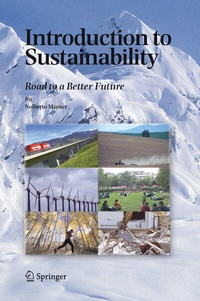
Introduction to Sustainability
Description

Reviews / Votes
From the reviews:
"It suggests methods and tools to achieve our aim of total sustainability. The book has been written in a very clear, readable and user friendly style. The distinguishing features of the book would be the numerous appropriate case studies appearing throughout the book and the internet references appearing at the end of the chapter. . The book contains many helpful tables. . this would be a useful introductory effort that will appeal to decision makers and workers in different spheres of environmental activities." (V. Lakshminarayanan, Journal of Ecobiology, Vol. 18 (2), 2006)
More details
Other editions
Additional editions
Person
Content
CHAPTER 2 – THE CULTURE OF WASTE (p. 43)
2.1 Introduction
Sustainability relates with Economics, Society, and Environment. However, one common fact that links them all is the generation of waste. This chapter is divided into two: The first part analyses the current generation of waste as well as its treatment. The second intends to establish policies for the future treatment of waste or, better yet, for ceasing the generation of waste. This first part begins by raising some capital questions:
What is waste?
Which are the components of waste?
Where is waste generated? and
How is waste treated?
The second part will deal with:
Why is waste produced? and
What is society doing to correct this problem?
2.2 First part: Current generation and treatment of waste
2.2.1 What is waste?
The dictionary defines ‘waste’ as something useless, unwanted, or defective and the word ‘by-product’ as something produced in an industrial or biological process in addition to the principal product. From the point of view of sustainability, the word ‘waste’ does not have that meaning as, though it may be unwanted, it is not something useless and is certainly not defective.
Even if in a manufacturing process a product or part of it does not conform to the manufacturer’s quality specs, it does not thereby become waste, but is, rather scrap material that is usually brought back to its original state and then processed again.
The Indigo Development Corporation (see Internet References at the end of this chapter) has a good definition of waste: they call waste a ‘dissipative use of natural resources’, as indeed it is, because if released into the air, soil or water there will actually be an unrecoverable dissipation of a natural resource.
Therefore, it is believed that the kind of ‘waste’ referred to here could be better called a by-product, and, as a consequence, having some economic value. The logging industry provides a very good example: A tree is sawed and transported to a sawmill, where it is de-barked the bark being the first by-product, which used then in the sawmill as fuel for a boiler or for producing ethanol (section 5.3.4.2).
The de-barked timber is then sawed into raw wood products, such as saw logs, veneer, building materials, pulpwood, etc., all of which could as easily be regarded as the main product. In the process sawdust is generated, which is another by-product normally utilized to produce particleboards, and also as biomass (section 5.3.4).
The branches of trees, cut into small pieces, are also used as mulch in gardens to retain humidity around plants. Raw wood products have many different uses, such as for boards and structural units in house construction, doors, windows, cabinets, furniture, etc. At the end of their life, these products are considered waste, and this is wrong since many beams, floors, windows can be reused for the same purpose, or taken advantage of the beauty of their grain to make useful and beautiful things.
