

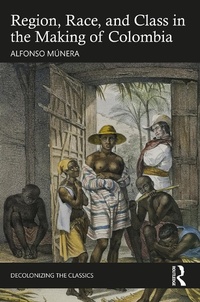
Region, Race, and Class in the Making of Colombia
1st Edition
Published on 18. August 2023
174 pages
978-1-000-92749-8 (ISBN)
Description

This pioneering translation of Alfonso Munera's seminal work El fracaso de la nacion presents a new interpretation and innovative perspective on canonical Colombian history and the failure of the Colombian nation to English-speaking readers.
Mainstream historiography depicts Colombian independence as the achievement of European-descendent elites only, downplaying the role and importance of regional subaltern classes. Munera's well-researched account challenges theoretical, political, and cultural interventions and shows that these subaltern groups were pivotal to achieving independence from Spain. It was their organizing and pressing for freedom from colonial domination that ultimately brought about independence in Cartagena and later to the whole country. Yet Munera demonstrates that these differing regional elites meant that a single, coherent unity across New Granada was not possible, a point that would ultimately doom subsequent nation-building efforts.
Offering a truly decolonizing perspective, one that has remained hidden from official accounts of Colombian independence, scholars and researchers in political science, history, sociology, and anthropology will welcome the opportunity to read this work for the first time in translation.
Mainstream historiography depicts Colombian independence as the achievement of European-descendent elites only, downplaying the role and importance of regional subaltern classes. Munera's well-researched account challenges theoretical, political, and cultural interventions and shows that these subaltern groups were pivotal to achieving independence from Spain. It was their organizing and pressing for freedom from colonial domination that ultimately brought about independence in Cartagena and later to the whole country. Yet Munera demonstrates that these differing regional elites meant that a single, coherent unity across New Granada was not possible, a point that would ultimately doom subsequent nation-building efforts.
Offering a truly decolonizing perspective, one that has remained hidden from official accounts of Colombian independence, scholars and researchers in political science, history, sociology, and anthropology will welcome the opportunity to read this work for the first time in translation.
Reviews / Votes
"In this myth-busting classic on the formation of the Colombian nation, Alfonso Munera brilliantly decenters traditional understandings of the archive by viewing it from the perspective of the country's Caribbean region. Far from being the straightforward realisation of an "imagined community", Munera argues that nation-building in Colombia was a deeply-fractured process in which the interests of the region's elites played a crucial role, alongside the vital but oft-neglected influence of the subaltern classes, the artisans and mulatos of Cartagena. This English translation now makes an influential text accessible to an even wider audience."Peter Wade, University of Manchester
"What a pleasure to see the long-overdue translation of this classic work of Latin American and Atlantic history. Alfonso Munera has been one of the leading voices in promoting the inclusion of Black agency and actors in the region's history. English-speaking audiences now have access to his pathbreaking research and to his lucid and compelling storytelling."
George Reid Andrews, Distinguished Professor of History, University of Pittsburgh
More details
Series
Edition
1. Auflage
Language
English
Place of publication
London
United Kingdom
Publishing group
Taylor & Francis Ltd
Target group
College/higher education
ISBN-13
978-1-000-92749-8 (9781000927498)
Copyright in bibliographic data and cover images is held by Nielsen Book Services Limited or by the publishers or by their respective licensors: all rights reserved.
Schweitzer Classification
Other editions
Additional editions
Alfonso Munera
Region, Race, and Class in the Making of Colombia
Book
12/2024
1st Edition
Routledge
€62.80
Shipment within 10-20 days
Alfonso Munera
Region, Race, and Class in the Making of Colombia
Book
08/2023
1st Edition
Routledge
€205.90
Shipment within 10-20 days
Person
Alfonso Munera is a historian, researcher, lecturer, and former ambassador. Born in Cartagena in 1953, Munera earned a law degree from the University of Cartagena in 1981 and an MA and PhD in Latin American studies and US history from the University of Connecticut in 1995. In 1981, he began teaching at the University of Cartagena, where he served as vice rector of research (2007-2010) and founded the International Institute for Caribbean Studies in 2005. Munera has been a visiting professor in Spain and the United States at institutions such as Pablo de Olavide University (1999), the University of Wisconsin (2003-2004), and the University of Seville (2006). Munera is one of Latin America's most recognized and respected historians and in 2010, was named as one of 12 renowned Afro-Colombians. His critique of the construction of the Colombian nation and the processes of independence, and his criticism of official history make him an outstanding researcher.
Content
Introduction 1. New Granada and the Problem of Central Authority 2. The Colombian Caribbean: Authority and Social Control in a Frontier Region 3. Cartagena de Indias: Progress and Crisis in a Former Trading Post of Enslaved People 4. Economic Implications of the Conflict between Cartagena and Santa Fe de Bogota 5. Cartagena's Struggle for Political Autonomy 6. Black and Mulatto Artisans and Independence of the Republic of Cartagena, 1810-1816 Conclusions Bibliography
