

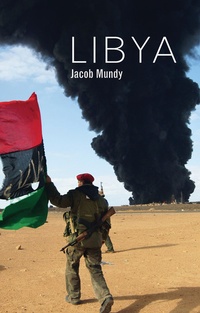
Libya
Description

More details
Other editions
Content
Figures
Introduction: the making and unmaking of modern Libya
Chapter 1. State of the Masses
Chapter 2. Uprising and intervention: Libya in revolt
Chapter 3. State of the Martyrs
Chapter 4. Hegemony or anarchy?
Chapter 5. Libya on the brink
Conclusion
Chronology
References
Introduction
For over half a decade, Libya has been ravaged by revolutionary violence, civil wars, and horrific acts of terrorism, all of which have further divided the polity, undermined the economy, fractured the state's sovereignty, and elicited repeated foreign interventions. These waves of political instability wracking the fragile mosaic of Libya's society were unleashed as the forty-two-year reign of Colonel Mu'ammar Al-Gaddafi came to its bitter and bloody end in 2011. Libya's anti-Gaddafi protestors, inspired by the successful revolutions in Tunisia and Egypt in early 2011, joined the Arab Spring in February, only to be dragged into an eight-month civil war that has irreparably fractured the nation. With military assistance from NATO and the Arab League, Libya's revolutionary militias, the thuwar, were finally able to depose the Gaddafi regime in the fall of 2011. Elections for a transitional government were soon held in the summer of 2012. Indeed, there was much hope and euphoria surrounding the possibilities facing a new Libya, a country with vast oil resources to finance its transition. Yet successive efforts to create a viable national authority only led to increasing social, economic, and political fragmentation across the country.
The primary question that drove the country back to civil war in 2014 was the extent to which Libya's new revolutionary forces should make any accommodation with the agents and institutions of the old regime. By the summer of 2014, Libya had two governments, both claiming electoral legitimacy and sovereignty over the country. Each was backed by unstable coalitions of militias representing a patchwork of ideologies and local interests. To make matters worse, a third government would emerge the following year. This one, however, would seek to extend the putative Caliphate of the Islamic State from the battlefields of Iraq and Syria to the scarred landscapes of Libya. In a desperate bid to hold Libya together, the North Atlantic powers backed the creation of a new interim national authority in late 2015 to lead the fight against the Islamic State and to stymie the flood of migrants and refugees leaving Libya's shores for Europe. Though there was some success with respect to the former, Libya's UN-backed Government of National Accord also complicated the already complex civil war that had erupted in 2014. By the end of 2017, questions continued to be raised as to whether or not Libya would become a failed state, if it were not already one.
The interesting thing about Libya, however, is the extent to which there often appears to be no relationship between political order in the country and the capacity of the central state that claims to rule it. Indeed, the Gaddafi regime was frequently accused of actively dismantling what few state structures Libya had either historically accumulated under Ottoman and Italian domination, or self-generated since independence in 1951. The historical weakness of the Libyan state was also one of the factors that allowed Gaddafi to seize control in the first place. The Gaddafi regime had easily come to power in a 1969 military coup that overthrew Libya's monarch, King Idris Al-Sanusi. Al-Sanusi had been a feeble and increasingly unpopular ruler, one installed by British and US administrators in a rush to give Libya independence after World War II. The Allied victory over the fascist armies of Italy and Germany on the battlefields of North Africa, a victory that was aided by Libyan partisans, had led to a tripartite French, British, and US administration over the former Italian colony, Libia Italiana. There were several reasons for the haste to give Libya independence in 1951. Most Libyans would never accept a return to Italian rule and the United Nations would never abide an indefinite Anglo-American trusteeship. The occupying North Atlantic forces, keen to maintain their forward Mediterranean deployment in the emerging Cold War, found a willing partner in the Sanusi. Thus Libya managed to achieve independence under the Sanusi monarchy despite the absence of a strong nationalist movement or any state institutions outside of the colonial administration. Insofar as there was a Libyan polity to speak of, it was one that had yet to be woven together through the modern processes and technologies of statebuilding. The imposition of the Sanusi monarchy also served to retard the development of alternative political movements based upon republicanism, Arab nationalism, and Islamist modernization, all of which were viewed as antagonistic to Anglo-American interests in the region.
Prior to the establishment of an Italian colony in Libya (1911-43) and the installation of the Sanusi monarchy in 1951, Libya's Ottoman rulers (1551-1911) had done little to create modern institutions there either. For centuries, Istanbul's presence had been limited to extracting what little wealth it could from the dying trans-Saharan trade networks that terminated along the impoverished coastal lands between Cairo and Tunis. The autonomy of local Ottoman deputies to pursue their own economic activities, notably on the high seas, became a prominent feature in historical narratives of the period. In the final decades of Ottoman rule, Istanbul's grip on Libya merely served to thwart Franco-British encroachment as well as Italy's aspirations to be seen as a great European power through imperial expansion. The violence of the Italian occupation in the 1920s, which featured extensive ethnic cleansing and acts of genocide against various segments of Libyan society, helped to facilitate the creation of a plantation colony, one that could absorb large numbers of European settlers. Many Libyans did not sit idly by, yet they would pay a steep price in blood for their resistance to Italian fascism.
It is difficult to imagine how a country that had experienced such political ravages and natural disadvantages could become one of the most developed nations in Africa and the Middle East within a few short decades. But this is the magic of oil, and it transformed Libya beyond all recognition from the 1960s onward.
Oil has always been a blessing and a curse for those who rule the countries that possess it. This was certainly the case for King Idris, who had been granted one of the world's poorest countries in 1951, surviving on base rents from Washington and London for the first decade of his rule. Though the world was awash with cheap oil in the 1950s and 1960s, the quality of Libya's crude and the country's proximity to Europe worked to position it favorably in the geopolitics of the age. Libya was a dependable ally of the North Atlantic world and on the "right" side of the Suez Canal, so its entry into the international oil market flooded the state's coffers with easy money. Libya's rapid - almost unprecedented - economic development in the 1960s helped to alleviate the country's chronic poverty. But oil also resulted in significant social dislocation for many Libyans while the revenues buttressed the authoritarian tendencies of the Sanusi regime. In the end, the monarchy became a victim of its own success, as the modernization of Libya had created new socio-economic divisions and expectations, as well as a new international political consciousness among key segments of the population. The Free Officers' coup of September 1, 1969, had drawn deep inspiration from events unfolding across the Middle East and North Africa, as well as the Third World and Non-Aligned movements that had emerged during the tumultuous decades of decolonization in the 1950s and 1960s. On the whole, the people of Libya appeared to embrace the 1969 coup with cautious optimism.
What the September 1 revolution initially represented and what it would become in the years that followed radically diverged. Gaddafi and his followers could have simply enacted a political system based on military-backed single-party rule led by a charismatic and iron-willed figure, a system following the Egyptian, Algerian, Iraqi, and Syrian models. Had this been the case, Libya's history - and the ultimate fate of the Gaddafi regime - might have been quite different. Instead, Gaddafi set the country upon its own unique path, one in which a new kind of political system, a "state of the masses" or Jamahiriyyah, would be erected. The state would be governed from the bottom up without parties or a civil society. This order putatively adapted the best practices of traditional Libyan Islamic society and applied them to modern governance.
At the same time, the fledgling Jamahiriyyah had to be defended. A framework of revolutionary committees, courts, guards, and informants would extirpate the enemies of the regime wherever they existed, at home or abroad. Over time, these revolutionary organs and the Jamahiriyyah system came to serve themselves and the regime behind them, terrorizing and dividing a citizenry whose livelihoods grew increasingly dependent upon a centrally planned economy. Arbitrary detentions, political imprisonment, disappearances, invasive surveillance, and executions all became commonplace during the darkest phases of the revolution in the late 1970s and early 1980s.
All of this socio-political "imagineering" in Gaddafi's Libya was also made possible by the magic of oil. The global price of oil reached unprecedented levels from the mid-1970s through the early 1980s. During this period, Libya continued to pursue infrastructural development at a breakneck speed while also greatly expanding the size of its military...
