

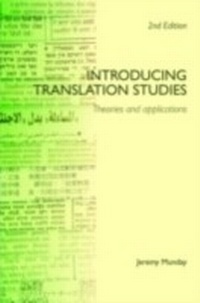
Introducing Translation Studies
Theories and Applications
2nd Edition
Published on 7. May 2009
XVI, 240 pages
978-0-203-86973-4 (ISBN)
Description

This introductory textbook provides an accessible overview of the key contributions to translation theory.
Jeremy Munday explores each theory chapter-by-chapter and tests the different approaches by applying them to texts. The texts discussed are taken from a broad range of languages - English, French, German, Spanish, Italian, Punjabi, Portuguese and English translations are provided. A wide variety of text types are analyzed, including a tourist brochure, a children's cookery book, a Harry Potter novel, the Bible, literary reviews and translators' prefaces, film translation, a technical text and a European Parliament speech. Each chapter includes the following features:
- a table introducing key concepts
- an introduction outlining the translation theory or theories
- illustrative texts with translations
- a chapter summary
- discussion points and exercises.
Including a general introduction, an extensive bibliography, and websites for further information, this is a practical, user-friendly textbook that gives a balanced and comprehensive insight into translation studies.
Jeremy Munday explores each theory chapter-by-chapter and tests the different approaches by applying them to texts. The texts discussed are taken from a broad range of languages - English, French, German, Spanish, Italian, Punjabi, Portuguese and English translations are provided. A wide variety of text types are analyzed, including a tourist brochure, a children's cookery book, a Harry Potter novel, the Bible, literary reviews and translators' prefaces, film translation, a technical text and a European Parliament speech. Each chapter includes the following features:
- a table introducing key concepts
- an introduction outlining the translation theory or theories
- illustrative texts with translations
- a chapter summary
- discussion points and exercises.
Including a general introduction, an extensive bibliography, and websites for further information, this is a practical, user-friendly textbook that gives a balanced and comprehensive insight into translation studies.
More details
Other editions
Additional editions
Book
06/2008
2nd Edition
Routledge
€100.47
Article exhausted; check for reprint
Book
06/2008
2nd Edition
Routledge
€47.22
Article exhausted; check for reprint
Person
Jeremy Munday is Senior Lecturer at the University of Leeds where he works in the Department of Spanish, Portuguese and Latin American Studies and the Centre for Translation Studies. He is a specialist in translation theory and his publications include The Routledge Companion to Translation Studies (Routledge, 2008), Style and Ideology in Translation: Latin American writing in English (Routledge, 2008) and Translation: An Advanced Resourcebook (Routledge 2004, with Basil Hatim).
Content
Introduction 1. The Discipline or Interdiscipline of Translation Studies 2. Translation Theory Before the Twentieth Century 3. Equivalence and Equivalent Effect 4. Studying the Translation Process: Translation Shifts, Contrastive Linguistics, and Cognitive Theories 5. Functional Theories of Translation 6. Discourse and Register Analysis Approaches 7. Systems Theories 8. Translation as Rewriting 9. Translation and Globalization 10. Translating the Foreign: The (In)Visibility of Translation 11. Philosophical Theories of Translation 12. Audiovisual Translation Studies. Conclusion: The Future of the Discipline. Appendix: Web Links. Bibliography. Index
