

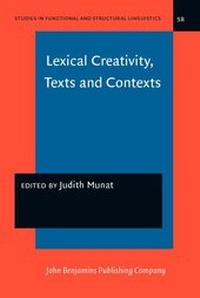
Lexical Creativity, Texts and Contexts
1st Edition
Published on 6. November 2007
XVI, 294 pages
978-90-272-9175-2 (ISBN)
Description

The coining of novel lexical items and the creative manipulation of existing words and expressions is heavily dependent on contextual factors, including the semantic, stylistic, textual and social environments in which they occur. The twelve specialists contributing to this collection aim to illuminate creativity in word formation with respect to functional discourse roles, but also examine 'critical creativity' determined by language policy, as well as diachronic phonetic variation in creatively-coined words.
The data, based either on large corpora or smaller hand-collected samples, is drawn from advertising, the daily press, electronic communication, literature, spoken interaction, cartoons, lexical ontologies and style guides.
The coining of novel lexical items and the creative manipulation of existing words and expressions is heavily dependent on contextual factors, including the semantic, stylistic, textual and social environments in which they occur. The twelve specialists contributing to this collection aim to illuminate creativity in word formation with respect to functional discourse roles, but also examine 'critical creativity' determined by language policy, as well as diachronic phonetic variation in creatively-coined words. The data, based either on large corpora or smaller hand-collected samples, is drawn from advertising, the daily press, electronic communication, literature, spoken interaction, cartoons, lexical ontologies and style guides. Each study analyses novel formations in relation to their contexts of use and inevitably leads to the crucial question of creativity vs. productivity. By focussing on creative lexical formations at the level of parole, these studies provide insights into morphological theory at the level of langue, and ultimately seek to explain lexical creativity as a function of language use.
The data, based either on large corpora or smaller hand-collected samples, is drawn from advertising, the daily press, electronic communication, literature, spoken interaction, cartoons, lexical ontologies and style guides.
The coining of novel lexical items and the creative manipulation of existing words and expressions is heavily dependent on contextual factors, including the semantic, stylistic, textual and social environments in which they occur. The twelve specialists contributing to this collection aim to illuminate creativity in word formation with respect to functional discourse roles, but also examine 'critical creativity' determined by language policy, as well as diachronic phonetic variation in creatively-coined words. The data, based either on large corpora or smaller hand-collected samples, is drawn from advertising, the daily press, electronic communication, literature, spoken interaction, cartoons, lexical ontologies and style guides. Each study analyses novel formations in relation to their contexts of use and inevitably leads to the crucial question of creativity vs. productivity. By focussing on creative lexical formations at the level of parole, these studies provide insights into morphological theory at the level of langue, and ultimately seek to explain lexical creativity as a function of language use.
More details
Other editions
Additional editions
Judith Munat
Lexical Creativity, Texts and Contexts
Book
11/2007
John Benjamins Publishing Co
€116.60
Shipment within 10-15 days
Person
Content
- Lexical Creativity, Texts and Contexts
- Editorial page
- Title page
- LCC data
- Table of contents
- List of tables
- List of figures
- List of contributors
- Editor's preface
- References
- Introduction
- Lexical creativity, textuality and problems of metalanguage
- 1. Introduction and terminology
- 1.1 Creativity vs. productivity in word-formation (WF) patterns
- 1.2 The metalanguage of text linguistics (TL): Textuality, context vs. co-text, genre, text-type, register
- 1.3 The categorisation and typology of texts
- 1.4 Devices, processes, domains and text-types (TTs)
- 2. Dynamic lexicology and neglected functions of WF
- 2.1 WF and dynamic lexicology in general
- 2.2 Functions of WF
- 3. Overview of the volume
- 4. Concluding remarks
- References
- Lexical creativity in discourse
- How to do (even more) things with nonce words (other than naming)
- 1. Preliminary remarks
- 1.1 The distinction between productivity and creativity - a cline
- 1.2 General functions of word-formation: Naming and beyond
- 1.3. Lexeme formation vs. nonce word-formation
- 2. Functions of NFs
- 2.1 Textual deixis - discourse functions of nonce formations
- 2.2 Hypostatisation
- 2.3 Attention-seeking/foregrounding
- 2.4 More specific metacommunicative functions
- 2.5 Special cases
- 3. Conclusion
- References
- The phonetics of 'un'
- 1. Introduction
- 2. Background
- 3. The storage and processing of affixed words
- 4. Methodology
- 5. Results
- 5.1 Affixes versus non-affixes
- 5.2 The phonetics of affixal un
- 6. Discussion and conclusion
- References
- Lexical creativity in texts
- Tracing lexical productivity and creativity in the British Media
- 1. Introduction
- 2. Data
- 3. Methodology and tools
- 4. Productivity
- 5. Creativity
- 6. Life-cycle
- 7. Rules of creativity
- 8. Case studies of some recently popular neologisms in the UK media
- 8.1 Neologism 1 - CHAV
- 8.2 Neologism 2 - HOODIE
- 8.3 Neologism 3 - NEET
- 8.4 Existing term with new meaning - TSAR
- 9. Conclusion
- References
- Lexical creativity in texts
- Cathy Wilcox meets the phrasal lexicon
- 1. Introduction
- 2. Potential locations for word play in PLIs
- 2.1 Idiosyncratic properties of PLIs
- 2.2 Creative artistic deformation of PLIs
- 3. Word play in a corpus of cartoons by Cathy Wilcox
- 3.1 Phonological deformation
- 3.2 Lexical substitutions
- 3.3 Lexical exchanges
- 3.4 Violating slot restrictions
- 3.5 Adding a modifier where none is conventionally permitted
- 3.6 Transforming a frozen PLI
- 3.7 PLI blends
- 3.8 Structural re-analysis
- 3.9 Literalising the sense of a metaphor within a PLI
- 3.10 Literalising the sense of a figurative PLI
- 3.11 Calques and other paraphrases
- 3.12 Pragmatic incongruity
- 3.13 Inferred PLIs
- 4. Conclusion
- 5. Artistry and artistic deformation
- References
- Lexical creativity in texts
- Blendalicious
- 1. Introduction
- 2. What are blends?
- 3. The structure of blends
- 4. The phonology of blends
- 5. Orthographic blends
- 6. Blends with more than two splinters
- 7. More on splinters
- 8. Splinters as bound morphemes
- 9. What kind of morphemes are these splinters?
- 10. Burgers
- 11. A note on the semantics of combining forms
- 12. Experimental data on the processing of novel blends
- 13. In which domains do blends tend to occur?
- 14. Summary and conclusions
- References
- Lexical creativity in texts
- Keeping up with the times
- 1. Introduction
- 2. LokinIn2Txtin: Devices and trends
- 2.1 Shortening devices in text messaging
- 2.2 Trends in text messaging: 'conservative' and 'advanced' texting
- 3. The world of Netspeak: hackers, crackers, bloggers, Usenetters, websters and other netizens
- 3.1 Word-formation devices in on-line communication
- 3.2 Idiomatic expressions (film at 11) and wordplay (dot's all folks)
- 4. Conclusion
- References
- Lexical creativity in texts
- Lexical creativity as a marker of style in science fiction and children's literature
- 1. Introduction
- 2. Productivity/creativity
- 3. Neologisms/nonce formations
- 4. Motivation and the pragmatics of WF
- 5. Novel formations in context
- 5.1 Science fiction
- 5.2 Children's literature
- 6. Functional motivations and ASDs
- 7. Closing considerations
- References
- Appendix A
- Appendix B
- Appendix C
- Creative concept formation
- Dynamic creation of analogically-motivated terms and categories in lexical ontologies
- 1. Introduction
- 2. Analogy as a mechanism of word creation
- 3. Analogy as a mechanism of term creation
- 3.1 Experimental support
- 3.2 Phonetic analogies revisited
- 4. Ad hoc categories as analogical by-products
- 5. Analogical retrieval in WordNet
- 6. Evaluation
- 7. Conclusions
- References
- Creative lexical categorisation in a narrative fiction
- 1. New words in fiction
- 2. Lexical categorisation
- 3. The Narrative: A fantasy novel
- 4. New meanings for words: Semasiological categorisation
- 5. The semantic change of dead
- 6. New lexical fields: Onomasiological categorisation
- 6.1 Construction of a category of invented words: Specialisation in magic
- 6.2 Recategorisation of common words to form a new category: Human motion verbs
- 6.3 Reorganisation of a conventional category: magicians and magi
- 7. Conclusions
- References
- Sociopolitical effects on creativity
- Occasional and systematic shifts in word-formation and idiom use in Latvian as a result of translation
- 1. Creative use, nonce use, wordplay
- 2. Latvian from isolation to "awakening"
- 3. Translation, globalisation and language
- 3.1 Democratisation
- 3.2 The early stages of creativity through advertising
- 3.3 Creativity in idiom transformations
- 3.4 Creativity in word formation
- 3.5 Compound phrases
- 4. Conclusion
- References
- Critical creativity
- 1. Introduction
- 2. Creativity as social practice
- 3. Politically correct terms as a case of critical creativity
- 4. Style guides
- 4.1 General reference books of bias-free usage
- 4.2 Guidelines for public written discourse
- 5. Creative word-formation patterns
- 5.1 Unification
- 5.2 Specification
- 5.3 Euphemism
- 6. Conclusions
- References
- Name index
- Subject index
- The series Studies In Functional And Structural Linguistics
