

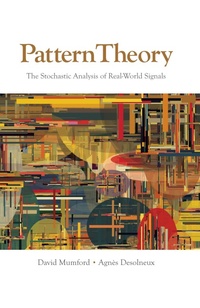
Pattern Theory
The Stochastic Analysis of Real-World Signals
1st Edition
Published on 9. August 2010
375 pages
978-1-4398-6556-9 (ISBN)
Description

Pattern theory is a distinctive approach to the analysis of all forms of real-world signals. At its core is the design of a large variety of probabilistic models whose samples reproduce the look and feel of the real signals, their patterns, and their variability. Bayesian statistical inference then allows you to apply these models in the analysis of new signals.
This book treats the mathematical tools, the models themselves, and the computational algorithms for applying statistics to analyze six representative classes of signals of increasing complexity. The book covers patterns in text, sound, and images. Discussions of images include recognizing characters, textures, nature scenes, and human faces. The text includes onlineaccess to thematerials (data, code, etc.) needed for the exercises.
This book treats the mathematical tools, the models themselves, and the computational algorithms for applying statistics to analyze six representative classes of signals of increasing complexity. The book covers patterns in text, sound, and images. Discussions of images include recognizing characters, textures, nature scenes, and human faces. The text includes onlineaccess to thematerials (data, code, etc.) needed for the exercises.
Reviews / Votes
required reading for any mathematician [involved] in the modeling complex and realistic signals-Marco Loog, Nieuw Archief voor Wiskunde, December 2011
The book comes with a large number of exercises and problems, some requiring computer programming. Thanks to these, it can be used as a textbook to support a quite original course that could be offered by a department of applied mathematics, computer science or electrical engineering. In fact, this excellent book targets and deserves a broad readership. It will provide precious and interesting material to anyone who would like to discover pattern theory and how it traverses across geometry, probability and signal processing.
-Laurent Younes, Mathematical Reviews, Issue 2011m
... a masterpiece. It is one of the best books I have ever read. ... What singles out this outstanding book is an extremely original subject development. ... This book is so exciting. It is a detective fiction. It is an inquiry into 'real-world signals.' In contrast to most detective stories, the beauty of the style is exceptional and meets the standards of the best writers. Art and beauty are present everywhere in this marvelous book. ... The overall organisation of the book is also marvelous. ... The authors are leaders in signal and image processing and this book is based on their extremely innovative research. Reading this book is like entering David Mumford's office and beginning a friendly and informal scientific discussion with him and Agnes. That is a good approximation to paradise.
-Yves Meyer, EMS Newsletter, September 2011
Pattern Theory covers six classic attempts at modeling signals from the human and natural world: natural language (written), music, character recognition, texture modeling, face recognition, and natural scenes. These applications, appealing to students and researchers alike, include fourteen 'crash courses' giving all the needed basics, exercises, and numerical simulations. ... a complete pedagogic tool at master or first-year graduate level. I endorse the publication of Pattern Theory, and will actually use it and recommend it to other researchers.
-Jean-Michel Morel, CMLA
This book is fascinating. It develops a statistic approach to finding the patterns in the signals generated by the world. The style is lucid. I'm reminded of Mumford's exposition of Theta functions and Abelian varieties in his Tata lectures. The exposition is thorough. The authors provide the necessary mathematical tools allowing scientists to pursue an exciting subject. I've been running a seminar at MIT entitled 'New Opportunities for the Interactions of Mathematics and Other Disciplines' because I'm convinced that mathematics will move in surprising new directions. Pattern Theory, a decade's effort, is a prime example.
-I.M. Singer, Institute Professor, MIT
More details
Edition
1. Auflage
Language
English
Place of publication
Florida
United States
Publishing group
Taylor & Francis Inc
Target group
Professional and scholarly
The book is ideal for people in the mathematical sub-field of Pattern Theory; instructors and students of the topic.
File size
15,37 MB
ISBN-13
978-1-4398-6556-9 (9781439865569)
Copyright in bibliographic data and cover images is held by Nielsen Book Services Limited or by the publishers or by their respective licensors: all rights reserved.
Schweitzer Classification
Other editions
Additional editions
Book
10/2024
1st Edition
Taylor & Francis
€61.00
Shipment within 10-20 days
Book
08/2010
1st Edition
A K Peters
€133.70
Shipment within 3-4 weeks
Persons
David Mumford is a professor emeritus of applied mathematics at Brown University. His contributions to mathematics fundamentally changed algebraic geometry, including his development of geometric invariant theory and his study of the moduli space of curves. In addition, Dr. Mumford's work in computer vision and pattern theory introduced new mathematical tools and models from analysis and differential geometry. He has been the recipient of many prestigious awards, including U.S. National Medal of Science (2010), the Wolf Foundation Prize in Mathematics (2008), the Steele Prize for Mathematical Exposition (2007), the Shaw Prize in Mathematical Sciences (2006), a MacArthur Foundation Fellowship (1987-1992), and the Fields Medal (1974).
Agnes Desolneux is a researcher at CNRS/Universite Paris Descartes. A former student of David Mumford's, she earned her Ph.D. in applied mathematics from CMLA, ENS Cachan. Dr. Desolneux's research interests include statistical image analysis, Gestalt theory, mathematical modeling of visual perception, and medical imaging.
Agnes Desolneux is a researcher at CNRS/Universite Paris Descartes. A former student of David Mumford's, she earned her Ph.D. in applied mathematics from CMLA, ENS Cachan. Dr. Desolneux's research interests include statistical image analysis, Gestalt theory, mathematical modeling of visual perception, and medical imaging.
Content
PrefaceNotationWhat Is Pattern Theory?English Text and Markov ChainsMusic and Piece wise Gaussian ModelsCharacter Recognition and Syntactic GroupingImage Texture, Segmentation and Gibbs ModelsFaces and Flexible TemplatesNatural Scenes and their Multiscale AnalysisBibliographyIndex
