

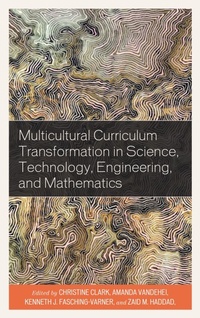
Multicultural Curriculum Transformation in Science, Technology, Engineering, and Mathematics
Lexington Books (Publisher)
1st Edition
Published on 27. July 2018
1 pages
978-1-9787-5751-6 (ISBN)
Description

This volume focuses on multicultural curriculum transformation in Science, Technology, Engineering, and Mathematics or STEM subject areas broadly, while also focusing on sub-content areas (e.g., earth science, digital technologies) in greater detail. The discussion of each sub-content area outlines critical considerations for multicultural curriculum transformation for the sub-content areas by grade level (early childhood and elementary school education, middle and/or junior high school education, and high school education) and then by organizing tool parameters: standards (both in a generalized fashion, and specific to Common Core State Standards, among other standards), educational context, relationships with and among students and their families, civic engagement, considerations pertaining to educational "ability" broadly considered (for example, for gifted and talented education, bilingual gifted and talented education, "regular" education, bilingual "regular" education, special education, bilingual special education), as well as relative to specific content and corresponding pedagogical considerations, including evaluation of student learning and teaching effectiveness. In this way, the volume provides a conceptual framework andconcrete examples for how to go about multiculturally-transforming curriculum in STEM curricula.
The volume is designed to speak with PK-12 teachers as colleagues in the multicultural curriculum transformation work at focus in each subject area and at varied grade levels. Readers are exposed to "things to think about," but also given curricular examples to work with or from in going about the actual, concrete work of curriculum change. It bridges the gaps between preparing PK-12 teachers to be able to 1) independently multiculturally adapt existing curriculum, and, 2) create new multicultural curriculum differentiated for their content areas and grade levels, while also, 3) providing ample examples of what such adapted and new differentiated curricula looks like. In so doing, this volume also bridges the gaps between the theory and practice of multicultural curriculum transformation in higher and PK-12 educational contexts.
The volume is designed to speak with PK-12 teachers as colleagues in the multicultural curriculum transformation work at focus in each subject area and at varied grade levels. Readers are exposed to "things to think about," but also given curricular examples to work with or from in going about the actual, concrete work of curriculum change. It bridges the gaps between preparing PK-12 teachers to be able to 1) independently multiculturally adapt existing curriculum, and, 2) create new multicultural curriculum differentiated for their content areas and grade levels, while also, 3) providing ample examples of what such adapted and new differentiated curricula looks like. In so doing, this volume also bridges the gaps between the theory and practice of multicultural curriculum transformation in higher and PK-12 educational contexts.
More details
Series
Edition
1. Auflage
Language
English
Place of publication
United States
Publishing group
Bloomsbury Publishing Plc
Target group
Professional and scholarly
Illustrations
25 b/w illustrations; 10 tables;
ISBN-13
978-1-9787-5751-6 (9781978757516)
Copyright in bibliographic data and cover images is held by Nielsen Book Services Limited or by the publishers or by their respective licensors: all rights reserved.
Schweitzer Classification
Other editions
Additional editions
Christine Clark | Amanda VandeHei-Carter | Kenneth J. Fasching-Varner
Multicultural Curriculum Transformation in Science, Technology, Engineering, and Mathematics
Book
07/2018
Lexington Books
€140.80
Shipment within 15-20 days
Persons
Christine Clark is professor and senior scholar for multicultural education and founding vice president for diversity and inclusion at the University of Nevada, Las Vegas.
Amanda VandeHei is assistant professor of literacy in the School of Education at Nevada State College.
Kenneth J. Fasching-Varner is the Shirley B. Barton Endowed associate professor of education and director of the Higher Education Administration Program at Louisiana State University.
Zaid M. Haddad is assistant professor of interdisciplinary studies & curriculum and instruction and a member of the Department of Interdisciplinary Learning and Teaching at the University of Texas, San Antonio.
Amanda VandeHei is assistant professor of literacy in the School of Education at Nevada State College.
Kenneth J. Fasching-Varner is the Shirley B. Barton Endowed associate professor of education and director of the Higher Education Administration Program at Louisiana State University.
Zaid M. Haddad is assistant professor of interdisciplinary studies & curriculum and instruction and a member of the Department of Interdisciplinary Learning and Teaching at the University of Texas, San Antonio.
Content
Preface
Acknowledgements
Introduction, Christine Clark, Amanda VandeHei, Kenneth J. Fasching-Varner, and Zaid M. Haddad
Mathematics
Chapter 1: Transforming Family "Math Night" with Latina/Latino Middle School Parents: Communicating about the Adoption of Common Core State Standards, Yolanda De La Cruz
Chapter 2: Using Iterative Visuals and Virtual Manipulatives to Support English Language Learners in Mathematics Education, Sarah A. Roberts
Chapter 3: Rethinking the Teaching and Learning of Latina/Latino Students to Promote a Multicultural Mathematics Education, Javier Díez-Palomar and Carlos A. LópezLeiva
Chapter 4: Students Who Speak English as a Second Language: Preparing Teachers for Changing Demographics-An Innovative and Collaborative Approach, Bettibel Kreye and Gresilda A. Tilley-Lubbs
Science
Chapter 5: Teaching Biology in the Age of the Next Generation Science Standards: Methodology for Teaching in High Needs Schools, Antoinette Linton
Chapter 6: LGBT-Inclusion Across the Life Science Curriculum, Mary HoelscherChapter 7: Earth Shaking Dragons and Orphan Tsunamis: Transforming Middle School Earth Science and STEM through Studying Ancient Science Inquiry and Multicultural Collaborations in Earthquakes, Tsunamis, and Disaster Preparedness, Marna Hauk and Adam Masaki JoyChapter 8: Classroom Meteorologists: Transforming Science Content in a Dual Language Second Grade Classroom, Sandra Lucia OsorioMathematics and Science
Chapter 9: Rethinking Art in Mathematics and Science, Jeff Sapp
Engineering
Chapter 10: Effective Engineering Models for Multicultural Curriculum Transformation in STEM: Engineering for All, Laura Luna, Twanelle Walker Majors, and Jennifer Meadows
Technology
Chapter 11: Multicultural Technology Education: The Need to Teach Digital Technologies to All Students, Janessa Schilmoeller, Lori Griswold, and Neal Strudler
Mathematics, Science, Engineering, and Technology
Chapter 12: Coming Out of the Lab Closet: Queering STEM Education for Student Success and Well-Being, Allison Mattheis, Jeremy B. Yoder, and Dixon Perey
Chapter 13: Considering Women's Ways of Knowing in STEM, Tracy Arnold, Eshani Gandhi, Schetema Nealy, and Brian TrinhCoda, Christine Clark, Amanda VandeHei, Kenneth J. Fasching-Varner, and Zaid M. Haddad
Resources
About the Editors and Authors
Index
Acknowledgements
Introduction, Christine Clark, Amanda VandeHei, Kenneth J. Fasching-Varner, and Zaid M. Haddad
Mathematics
Chapter 1: Transforming Family "Math Night" with Latina/Latino Middle School Parents: Communicating about the Adoption of Common Core State Standards, Yolanda De La Cruz
Chapter 2: Using Iterative Visuals and Virtual Manipulatives to Support English Language Learners in Mathematics Education, Sarah A. Roberts
Chapter 3: Rethinking the Teaching and Learning of Latina/Latino Students to Promote a Multicultural Mathematics Education, Javier Díez-Palomar and Carlos A. LópezLeiva
Chapter 4: Students Who Speak English as a Second Language: Preparing Teachers for Changing Demographics-An Innovative and Collaborative Approach, Bettibel Kreye and Gresilda A. Tilley-Lubbs
Science
Chapter 5: Teaching Biology in the Age of the Next Generation Science Standards: Methodology for Teaching in High Needs Schools, Antoinette Linton
Chapter 6: LGBT-Inclusion Across the Life Science Curriculum, Mary HoelscherChapter 7: Earth Shaking Dragons and Orphan Tsunamis: Transforming Middle School Earth Science and STEM through Studying Ancient Science Inquiry and Multicultural Collaborations in Earthquakes, Tsunamis, and Disaster Preparedness, Marna Hauk and Adam Masaki JoyChapter 8: Classroom Meteorologists: Transforming Science Content in a Dual Language Second Grade Classroom, Sandra Lucia OsorioMathematics and Science
Chapter 9: Rethinking Art in Mathematics and Science, Jeff Sapp
Engineering
Chapter 10: Effective Engineering Models for Multicultural Curriculum Transformation in STEM: Engineering for All, Laura Luna, Twanelle Walker Majors, and Jennifer Meadows
Technology
Chapter 11: Multicultural Technology Education: The Need to Teach Digital Technologies to All Students, Janessa Schilmoeller, Lori Griswold, and Neal Strudler
Mathematics, Science, Engineering, and Technology
Chapter 12: Coming Out of the Lab Closet: Queering STEM Education for Student Success and Well-Being, Allison Mattheis, Jeremy B. Yoder, and Dixon Perey
Chapter 13: Considering Women's Ways of Knowing in STEM, Tracy Arnold, Eshani Gandhi, Schetema Nealy, and Brian TrinhCoda, Christine Clark, Amanda VandeHei, Kenneth J. Fasching-Varner, and Zaid M. Haddad
Resources
About the Editors and Authors
Index
