

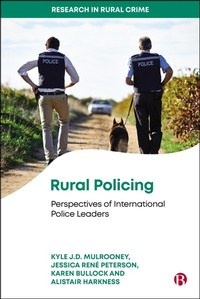
Rural Policing
Perspectives of International Police Leaders
1st Edition
Published on 15. January 2026
192 pages
978-1-5292-3497-8 (ISBN)
Description

Rural societies commonly face geographical isolation and a lack of resources, both of which impact policing practices in such communities. This collection addresses a gap in the literature on rural police leadership with a truly international perspective.
Data gathered through interviews with senior police officers illustrates their leadership challenges, including those around the prevention and reduction of crime, engagement and policing of diverse communities and the growing role of technology. The authors of this volume draw out the key themes of these practitioner voices, highlighting both best practice in police leadership and future directions for criminal justice practice, policy and research.
Data gathered through interviews with senior police officers illustrates their leadership challenges, including those around the prevention and reduction of crime, engagement and policing of diverse communities and the growing role of technology. The authors of this volume draw out the key themes of these practitioner voices, highlighting both best practice in police leadership and future directions for criminal justice practice, policy and research.
Reviews / Votes
'Voices from hands-on practitioners are privileged in this exceptional volume, highlighting the complex dynamics, immense challenges and personal rewards of policing in rural areas. A fascinating book not to be missed.' Rob White, University of Tasmania 'This unique text shares oft-unheard insights into rural policing "on the ground", globally; experiences, challenges and strategies. A key resource for criminologists, practitioners and communities.' Bridget Harris, Monash UniversityMore details
Series
Edition
First Edition
Language
English
Place of publication
Bristol
United Kingdom
Target group
Professional and scholarly
Product notice
Reflowable
Illustrations
4 s/w Tabellen
Not illustrated
File size
0,86 MB
ISBN-13
978-1-5292-3497-8 (9781529234978)
Copyright in bibliographic data and cover images is held by Nielsen Book Services Limited or by the publishers or by their respective licensors: all rights reserved.
Schweitzer Classification
Other editions
Additional editions
Kyle J.D. Mulrooney | Jessica Rene Peterson | Karen Bullock
Rural Policing
Perspectives of International Police Leaders
Book
approx. 01/2026
1st Edition
Bristol University Press
€121.50
Not yet published
Persons
Kyle J.D. Mulrooney is Associate Professor in Criminology and Senior Research Fellow in AI Innovation and Industry Engagement at the University of New England, Australia. A leading scholar in rural criminology, he is Co-Director of the Centre for Rural Criminology and past President of the International Society for the Study of Rural Crime. His research and consultancy work focus on practical, evidence-based crime prevention and law enforcement strategies tailored to remote and regional communities. He holds a PhD in Cultural and Global Criminology (University of Kent/Universitaet Hamburg), an MA in the Sociology of Law (International Institute for the Sociology of Law), a BA (Hons) in Criminology and Justice Studies (University of Ontario) and a Graduate Certificate in AI Innovation.
Jessica Rene Peterson is Associate Professor in Criminology and Criminal justice at Southern Oregon University, United States. She is also an adjunct lecturer and research associate at the University of New England, Australia. She is the current Chair of the American Society of Criminology Division of Rural Crime and Co-Editor of the International Journal of Rural Criminology. Her primary research interests include policing, discretionary decision-making, and rural crime and justice.
Karen Bullock is a professor and independent researcher in the United Kingdom. She has degrees from the London School of Economics, University College London and the University of Surrey. She primarily conducts research in the fields of policing and crime reduction and her teaching reflects these areas of expertise. She has conducted numerous studies on subjects as diverse as police officer understanding of human rights and the police use of social media and has published in the order of 50 peer reviewed articles and two monographs.
Alistair Harkness is Associate Professor in Criminology, Head of the Department of Social and Philosophical Inquiry and Co-Director of the Centre for Rural Criminology at the University of New England, Australia. He is the current treasurer of the International Society for the Study of Rural Crime, and is Co-Editor of the International Journal of Rural Criminology. His primary research interests are in rural acquisitive crime, crime prevention, policing responses and community partnerships, and the politics of criminal justice.
Jessica Rene Peterson is Associate Professor in Criminology and Criminal justice at Southern Oregon University, United States. She is also an adjunct lecturer and research associate at the University of New England, Australia. She is the current Chair of the American Society of Criminology Division of Rural Crime and Co-Editor of the International Journal of Rural Criminology. Her primary research interests include policing, discretionary decision-making, and rural crime and justice.
Karen Bullock is a professor and independent researcher in the United Kingdom. She has degrees from the London School of Economics, University College London and the University of Surrey. She primarily conducts research in the fields of policing and crime reduction and her teaching reflects these areas of expertise. She has conducted numerous studies on subjects as diverse as police officer understanding of human rights and the police use of social media and has published in the order of 50 peer reviewed articles and two monographs.
Alistair Harkness is Associate Professor in Criminology, Head of the Department of Social and Philosophical Inquiry and Co-Director of the Centre for Rural Criminology at the University of New England, Australia. He is the current treasurer of the International Society for the Study of Rural Crime, and is Co-Editor of the International Journal of Rural Criminology. His primary research interests are in rural acquisitive crime, crime prevention, policing responses and community partnerships, and the politics of criminal justice.
Content
PART A
1. Practitioner Voice
2. Extant Literature
PART B
3. Australia
4. Brazil
5. Canada
6. England
7. New Zealand
8. South Africa
9. Sweden
10. Tuvalu
11. United States of America
12. Wales
PART C
13. Comparison and contrast
14. Challenges and change
1. Practitioner Voice
2. Extant Literature
PART B
3. Australia
4. Brazil
5. Canada
6. England
7. New Zealand
8. South Africa
9. Sweden
10. Tuvalu
11. United States of America
12. Wales
PART C
13. Comparison and contrast
14. Challenges and change
