

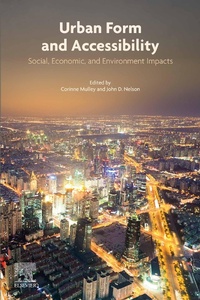
Urban Form and Accessibility
Social, Economic, and Environment Impacts
Published on 2. December 2020
448 pages
978-0-12-819823-0 (ISBN)
Description

The growth of global urbanization places great strains on energy, transportation, housing and public spaces needs. As such, transport and land use are inextricably linked. Urban Form and Accessibility: Social, Economic, and Environment Impacts consolidates key insights from multidisciplinary perspectives on the relationship between urban form and transportation planning. Synthesizing the latest cutting-edge research, the book translates academic evidence into practice. Starting with an overview of the key concepts relevant to each discipline, the book covers critical elements such as governance, travel behavior, and technological disruption, showing how to move towards a more sustainable society for all city inhabitants.
- Draws on evidence-based success stories from countries around the globe
- Gathers global leading thinkers to provide the state-of-the-art on the topic
- Examines social, economic, and environmental impacts within each chapter
- Each chapter's content will have the same structure for easier discoverability
More details
Other editions
Additional editions
Corinne Mulley | John D. Nelson
Urban Form and Accessibility
Social, Economic, and Environment Impacts
Book
11/2020
Elsevier
€116.50
Shipment within 15-20 days
Content
1. Introduction 2. Cities, their form, and accessibility3. Sustainable transport planning and residential segregation at the city scale4. Governance, mobility and the urban form5. Emerging mobility technologies and transitions of urban space allocation in a Nordic governance context6. Urban form and travel behaviour: The interplay with residential self-selection and residential dissonance7. Making place in the car-dependent city8. Active accessibility and transit-oriented development: connecting two sides of the same coin9. Urban form and walkable environments10. The potential for telecommuting to offer sustainable and resilient accessibility11. School location, urban structure and accessibility12. Built environment and health13. Transport, access and health14. Public transport equity outcomes through the lens of urban form15. Urban expansion and mobility on the periphery in the global South16. Who gains in a distance-based public transport fare scheme? Accessibility, urban form and equity implications in Santiago de Chile17. Urban form and public transport design18. Innovative financial mechanisms for transport infrastructure in time of crisis: The case of London Crossrail19. Dispersion of agglomeration through high-speed rail in China20. City logistics and the urban environment21. Land use models and modelling
