

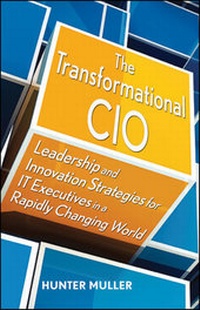
The Transformational CIO
Description

More details
Other editions
Additional editions
Person
Content
INTRODUCTION
The best way to predict the future is to create it.
-Peter Drucker
Don't Be Afraid to Change Your Game
In my younger days, I was a highly competitive athlete. My primary sport was slalom skiing, and I was good enough to win two state championships when I was in high school. At various times in my life I have competed in football, wrestling, baseball, tennis, golf, and sailing. I guess you can say that competitive sports have played a significant role in my life. They have shaped me into the person I am today.
As an athlete, you learn early that every competitive experience exposes you to a different set of challenges. You learn to assess the situation rapidly, figure out how it is different, and adapt to it. In other words, you are continually changing your game.
Your ability to change, to adjust, to transform yourself becomes your greatest competitive advantage as an athlete. A former sportswriter told me that I fit the mold of the "intrepid athlete" because no matter what the circumstances, I'll always find a way to adjust my strategy and gain the edge over the competition.
You can only push these sports analogies so far when you're talking about business, but I think this one is valid, especially if you are a chief information officer or IT leader.
If you're going to succeed in a transformational role, you must be ready to change yourself. Sometimes the change will be a matter of fine-tuning, sometimes it will require much more. Part of your job is determining how much you have to change to achieve your goal-and then making that change as completely and as thoroughly as possible.
When I interviewed Pat Toole, the CIO of IBM, I was struck by the depth and the sincerity of the company's commitment to change. Like many of his colleagues at IBM, Pat survived the company's near-death experience in the 1990s. He doesn't have to imagine the existential danger posed by standing still-he feels it in his gut.
A full century after its birth, IBM remains a compelling story of corporate success. Even though it has racked up seven straight years of double-digit earnings per share growth, IBM is still grinding through a mind-boggling process of trimming billions of dollars from its operating costs.
Accompanying its all-encompassing campaign to reduce costs is an equally impressive strategy to drive innovative practices into every nook and cranny of the company-which isn't easy when you consider the size and scope of IBM's worldwide operations.
Pat sits near the center of this epic transformation, and yet he seems quite calm. He knows the magnitude of the challenge, and he understands the risks. His job isn't protecting the status quo-his job is tearing it down and replacing it with something better.
Pat uses the word "restlessness" to describe the culture at IBM. When you're restless, you can't sit still. You seek change. You welcome what's new and different; you embrace the future.
I'm not sure that I would want to have Pat's job, but I certainly respect his determination. When I look at Pat, I see a transformational CIO.
What You Need to Know Now about Business Transformation Strategy
Business transformation is really another way of saying "business responding appropriately to changes in the market." The reason that business transformation is terribly important right now, however, is simple: In today's unpredictable economy, markets are changing very quickly-but most businesses are still changing very slowly.
Moreover, the changes rippling across the global economy are not producing uniform effects. Some markets are changing faster and more profoundly than others. It's almost as if the laws of economics were applied haphazardly, generating different results in different markets. Faced with this kind of uncertainty, many companies choose to wait it out. But this sort of approach merely guarantees an even slower response to changing market conditions.
For many companies, the inability to respond appropriately to sudden changes in their markets will prove fatal. I won't speculate about which companies are spiraling downward into the dustbin of history, but I'll wager you a fine dinner that they are the companies that are ill-prepared for change.
The winners, on the other hand, will be the companies that prepare for change and nurture a corporate culture that embraces continuous business transformation. These winners will develop processes and frameworks that enable and support continuous business transformation, they will reward the people who come up with the innovations that fuel and energize continuous transformation, and they will go to market first (or second) with the products and services generated through their business transformation processes.
The New Yin and Yang of IT
Innovative use of technology is a prime requisite for success in today's markets. It's not the only requisite, but it's difficult to imagine an organization succeeding without it.
From the CIO's perspective, however, it seems impossible to consider innovation without considering costs. In the CIO's mind, innovation is inextricably linked with applications development. By the common calculus of IT budgeting, resources for apps development are created by extracting fixed costs from IT operations (i.e., "keeping the lights on").
But that means the CIO always has to justify new spending by showing how much money it will save. That kind of approach made sense 18 months ago, but as the competition heats up again, it doesn't seem like a formula for growth. As an old boss used to say, you can never save your way to greatness.
I submit that a new equation needs to be written. Instead of trying to balance innovation and cost cutting, the new formula balances innovation and value creation. After all, what really matters to the business, creating value or cutting costs? You already know the answer.
For the next couple of years, at least, the role of the CIO will be to navigate a practical course away from the old paradigm, which forced every IT expense to be counterbalanced by an anticipated savings, and move toward a new paradigm in which IT investments are justified by how much value they will create.
The "old" yin-yang was innovation and cost savings; the "new" yin-yang is innovation and business value. Welcome to the latest cycle in the continually unfolding IT saga.
Personally, I believe that the severe economic challenges of the past few years have created a new breed of transformational CIOs who are highly innovative, extremely cost-conscious, and acutely aware of the need to create value. In today's tumultuous business environment, this dual responsibility does not seem odd-it seems normal.
Is Everyone Really a Transformational Leader?
Last year, I hosted a high-level, invitation-only conference for about 120 CIOs and senior technology executives at major companies in the Chicago area. The conference's title was "The CIO as Transformational Leader" and its general purpose was preparing CIOs for the multiple challenges of rapidly changing global markets.
Predictably, one of the keynote presenters asked the assembled executives for a show of hands to indicate how many considered themselves to be a "transformational leader."
Practically everyone in the room raised a hand. I remember thinking, "Wow, that's great. Everyone here is already a transformational leader." Then I thought, "Wait a second. If everyone in this room is already a transformational leader, what's the point of this event?"
Before I could think too deeply about this, the presenter moved on to his next slide, and my concerns were quickly forgotten-until a few days later, when I had the good fortune to be chatting on the phone with Philip Fasano, the CIO of Kaiser Permanente. When the subject turned to business transformation, Philip made a remark that brought me back to that moment in Chicago when everyone raised their hands. Here is what Philip said:
Just because you're the CIO doesn't automatically make you a transformational CIO.
Philip's remark really got me thinking hard about what it means to be a transformational CIO. I wondered what you had to achieve to qualify as "transformational." Most of this book is devoted to answering that question.
You will read more about Philip and his amazing accomplishments at Kaiser Permanente in the chapters that follow. You will also read about the achievements of CIOs and senior executives at IBM, Microsoft, Siemens, Dell, Shell Oil, Citigroup, Hilton, Cisco, General Motors, General Electric, Walt Disney Parks and Resorts, CVS Caremark, Kimberly-Clark, Salesforce.com, Flextronics, Boston Scientific, Pitney Bowes, Red Hat, Cognizant, Stryker, Terex, Wipro, Frontier Communications, EMCOR, Verisk Analytics, QBE the Americas, and the United States Tennis Association.
By my own estimation, all of the CIOs interviewed for this book qualify as transformational. All of them have successfully guided large-scale, company-wide projects resulting in significant changes to the operating processes of their companies. In many instances, these transformational projects also set the stage for deep and fundamental shifts in company...
