

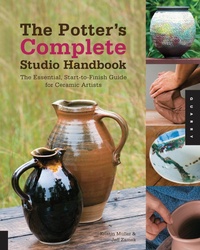
The Potter's Complete Studio Handbook: Volume 2
The Essential, Start-to-Finish Guide for Ceramic Artists
Published on 1. October 2011
320 pages
978-1-61058-160-8 (ISBN)
Description

Pottery making and wheel throwing is a timeless craft, perfect for beginner crafters and artisans who don't mind getting their hands dirty. The Potter's Complete Studio Handbook is the perfect guide for all levels to enjoy and master the art of pottery. The book is a compilation of the best features from The Potter's Studio Handbook and The Potter's Studio Clay and Glaze Handbook, bringing the best of hand-building and wheel-throwing techniques together with comprehensive instruction for clays and glazes.
Inside, you'll find:
-expert tips and tricks for selecting and preparing your clay, constructing slab projects, throwing and centering clay on the wheel, firing your project to perfection
-16 beautiful and functional projects with step-by-step photos using wheel-throwing, hand-building, and slipcasting techniques that can be done at home
-more than 40 formulas for unique clays and glazes with instructions on how to use them plus troubleshooting tips from the experts
-behind-the-scenes access to production and mining facilities . . . and much more!
Inside, you'll find:
-expert tips and tricks for selecting and preparing your clay, constructing slab projects, throwing and centering clay on the wheel, firing your project to perfection
-16 beautiful and functional projects with step-by-step photos using wheel-throwing, hand-building, and slipcasting techniques that can be done at home
-more than 40 formulas for unique clays and glazes with instructions on how to use them plus troubleshooting tips from the experts
-behind-the-scenes access to production and mining facilities . . . and much more!
More details
Series
Language
English
Place of publication
Beverly
United States
Publishing group
Quarto Publishing Group USA Inc
Illustrations
600
File size
42,17 MB
ISBN-13
978-1-61058-160-8 (9781610581608)
Copyright in bibliographic data and cover images is held by Nielsen Book Services Limited or by the publishers or by their respective licensors: all rights reserved.
Schweitzer Classification
Other editions
Additional editions
Kristin Muller | Jeff Zamek
The Potter's Complete Studio Handbook
An Essential Guide to Choosing, Working, and Designing with Clay and Glaze in the Ceramic Studio
Book
10/2011
Quarry Books
€41.03
Article exhausted; check different version
Persons
Kristin Muller has been a ceramic artist for 20 years and an arts administrator for 10. Currently the education director for Brookfield Craft Center in Brookfield, Connecticut, she has been teaching ceramics there for more than thirteen years. She holds a bachelor of science in studio arts with a concentration in ceramics from Southern Connecticut State University. Kristin has attended countless seminars and workshops with leading potters and clay artists and is currently an MFA candidate at Hood College. She has a studio and wood-fired Anagama kiln in eastern Pennsylvania, and she exhibits her work nationally and internationally. www.kristinmuller.net
As a ceramics instructor and consultant, Jeff Zamek has lectured and led workshops for more than 30 years, and has developed clay body and glaze formulas for ceramics supply companies throughout the United States. As a freelance writer, he has contributed articles to most major ceramics magazines, including Pottery Making Illustrated, Ceramics Monthly, and Ceramic Industry. Zamek is the author of What Every Potter Should Know and Safety in the Ceramics Studio, both published by Krause. He lives in Southampton, MA. http://www.jeffzamek.com
As a ceramics instructor and consultant, Jeff Zamek has lectured and led workshops for more than 30 years, and has developed clay body and glaze formulas for ceramics supply companies throughout the United States. As a freelance writer, he has contributed articles to most major ceramics magazines, including Pottery Making Illustrated, Ceramics Monthly, and Ceramic Industry. Zamek is the author of What Every Potter Should Know and Safety in the Ceramics Studio, both published by Krause. He lives in Southampton, MA. http://www.jeffzamek.com
Content
- Intro
- Title Page
- Contents
- Foreword by Brother Iain Highet
- Introduction
- Part One: studio requirements and properties of clay
- Chapter One: your studio
- Workspace Considerations
- Physical Requirements for Setting up a Studio
- Planning the Placement of Tools and Equipment
- Chapter Two: tools and equipment
- Essential Equipment
- Tools for Hand Building
- Tools for Wheel Work
- Chapter Three: clay
- Types of Clay
- Choosing a Clay Supplier
- States of Clay
- Conversion of Clay Through Fire
- Ceramic Temperatures
- The Origin of Clay
- Dynamic Clay
- Acquiring Clay: Buy Premixed or Mix Your Own?
- Mixing Your Own Clay
- Buying Premixed Clay
- Choosing a Ceramics Supplier
- Clay Body Formulas
- Testing Clay Body Formulas
- Troubleshooting Clay Imperfections
- Chapter Four: preliminary clay techniques
- Managing Clay Consistency
- Wedging
- Shrinkage and Drying
- Keeping the Studio Clean
- Reclaiming and Recycling Clay
- Chapter Five: hand building
- Pinch Pots
- Stamping Clay
- Slab Construction
- Cutting and Joining Slabs
- Slump and Hump Molds
- Coil Building
- Chapter Six: throwing on the potter's wheel
- Setting Up the Wheel and Stool
- Potter's Wheel Dynamics
- Developing Skills Through Repetition
- Pottery Forms
- Basic Wheel Techniques
- Troubleshooting Common Throwing Problems
- Chapter Seven: decorative and finishing techniques
- Choosing Glazes
- Mixing Glazes
- Safety Precautions
- Gathering Supplies
- Preparing Ware for Glazing
- Chapter Eight: glaze chemistry
- Desirable Glaze
- Testing Glaze
- Glazes for Foods and Beverages
- Adjusting and Testing Glazes
- Ask the Right Questions
- Particle Size
- Kiln Size and Atmosphere
- Kiln Firing Cycle
- Raw Material Substitutions
- Metallic Coloring Oxide/Carbonates
- Glaze Water and Soluble Materials
- Adjusting Clay Content
- Creating Test Tiles
- Preparing the Glaze Mixture
- Dipping Test Tiles
- Useful Glaze Tests
- Glaze Calculation Software
- Chapter Nine: troubleshooting glazes
- Glaze Blisters
- Crazing
- Correcting Crazing
- Shivering
- Correcting Shivering
- S-Crack Issues
- Five Steps to Prevent S-Cracks
- Incorrect Coning Technique
- Chapter Ten: ceramic kilns and firing work
- Types of Kiln Firing
- Pyrometric Cones
- Chapter Eleven: how to fire an electric kiln
- Choosing and Preparing Your Electric Kiln
- Bisque Firing
- Loading Green Ware for Bisque Firing
- Loading Glaze Ware for Glaze Firing
- Keeping a Kiln Log and a Glaze Journal
- Cooling the Kiln
- Unloading the Kiln
- Inside the Kiln
- Changing Clay Color
- Speckling Effect
- Special Glaze Effects
- Ceramics Showcase: Special Glaze Effects
- Part Two: a step-by-step guide to hand-building and pottery wheel projects
- Chapter Twelve: hand-building projects
- Slab Plates
- Whimsical Teapot
- Coiled and Paddled Jar
- Chapter Thirteen: beginning wheel projects
- Faceted Utensil Holder
- Bottles and Vases
- Pitchers
- Batter Bowl with Handle
- Set of Mugs
- Throwing Bowl Forms
- Shaping a Constant Curve and Using a Throwing Rib
- Principles of Trimming
- Trimming Multiple Forms
- Guide to Trimming Clay
- Guide to Trimming Multiple Forms
- Chapter Fourteen: intermediate wheel projects
- Plates and Platters
- Trimming a Plate
- Chip and Dip Dish
- Casserole with Lid and Handles
- Teapot with Lid, Spout, and Handle
- Two-Part Vase
- Chapter Fifteen: clay and glaze formulas
- Thrown Cylinder
- Thrown Jar
- Square-Sided Thrown Raku Covered Jar
- Wheel-Thrown Altered Oval
- Wheel-Thrown Unglazed Bowl
- Slab Construction Oval Platter
- Wheel-Thrown/Hand-Built Sculptural Disk
- Wheel-Thrown Bottle
- Wheel-Thrown Disk
- Wheel-Thrown Bowl
- Wheel-Thrown Oval Cylinder
- Wheel-Thrown Covered Jar
- Wheel-Thrown Bowl
- Wheel-Thrown Goblet
- Wheel-Thrown Covered Jar
- Wheel-Thrown Bottle
- Wheel-Thrown Raku-Fired Vase
- Press-Molded Bowl
- Wheel-Thrown Bowl
- Wheel-Thrown Sculptural Rattle
- Wheel-Thrown Jar
- Wheel-Thrown Cup
- Chapter Sixteen: going into the ceramics business
- Plan Your Business
- Plan Your Production Time
- Plan Your Purchases and Pricing
- Marketing Your Pottery
- Creating Functional Sets to Sell
- Sources of Inspiration
- Conclusion
- Resources
- Glossary
- Index
- About the Authors
- Copyright
