

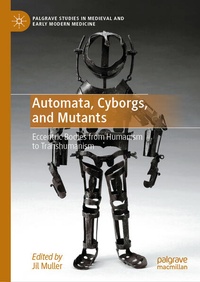
Automata, Cyborgs, and Mutants
Description

What does it mean to be human in an age of rapid technological advancement? Are we on the brink of transcending our biological limitations, or are we losing touch with the essence of what it means to be human? Emerging technologies challenge our understanding of identity, ethics, and existence.
Bringing together leading voices from history, philosophy, science, and ethics, this volume delves into the intricate intersections of transhumanism and posthumanism, offering a thought-provoking exploration of historical and philosophical debates from the Renaissance to the present. It examines how transhumanist thought envisions the enhancement of human capabilities through science and technology, while posthumanism questions the very boundaries that define what it means to be human. A must-read for scholars, students, and anyone intrigued by the future of humanity, this volume
is an essential guide to the debates shaping our technological era.
More details
Other editions
Additional editions
Person
Jil Muller is Assistant Professor at Paderborn University, Germany, where she is Deputy Head of the Center for the History of Women Philosophers and Scientists. Her research focuses on early modern philosophy, the history of medicine, moral theories, and women in early modern philosophy.
Content
1.Introduction; Jil Muller.- 2. Between Thinking Tools and Extended Minds: Is There Any Room for Natural Organs of Knowledge and Action?; Guido Giglioni.- Part I. Automata in the History of Medicine.- 3. Crossing the Boundaries of Life: Reanimation in Later Medieval Central Europe; Hannah Elmer.- 4. Mechanical and Hydraulic Elements in Sixteenth-century Medicine; Michael Stolberg.- 5. From Contemplation to Composition: Translating Physiology in the Early Modern Period; Thomas A. Murphy.- Part II. Automata in Early Modern Philosophy.- 6. Flesh, Soul, and Steel: Aporias of Materialist Embodiment; Charles Wolfe.- 7. Descartes on Clocks and Automata; Jil Muller.- 8. Automaton in the Chinese Room: Descartes's Causal Theory of Representation; William Eaton.- 9. The Epistemic Category of Vegetative: A Historical Tracking Indicator for Understanding the Evolution of Western Medicine towards Transhumanism; Sarah Carvallo.- Part III. Spiritual Automata, Intelligence, and Immortality.- 10. A Transhuman Ontology: Spinoza and the Good Change; Emanuele Costa.- 11. Gilles Deleuze's Dream of a Non-human Future of Mankind; Audrey Borowski.- 12. Transhumanist Immortality and the Heideggerian Phenomenology: The Death of Biological Automata and Existing Beings; Jessica Lombard.- Part IV. Automata in Arts, Architecture, and Constructions.- 13. Neither Comic Nor Corpse: Revisiting Braccelli's Bizarie di Varie Figure; Nicole Howard.- 14. Blurring Boundaries: Eighteenth-century Garden Entertainment and the Role of the Beholders in Jacques Vaucanson's Automatic Performances; Albert Kozik.- Part V. Transhumanism, Fiction, and Cyborg.- 15. Robots and the History of the Mind-body Problem; Richard Blum.- 16. Transcending the Human: The Disavowal of Anthropocentrism in Posthuman Philosophical Thought; Ramah Khazam.- 17. From Automaton to Cyborg: In Search of the Autonomy of the Living; Emanuele Clarizio.- 18. The Mutant and the Cyborg: Between Science and Fiction, The Posthuman and the Transhuman; Thierry Hoquet.
