

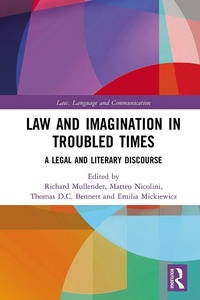
Law and Imagination in Troubled Times
A Legal and Literary Discourse
1st Edition
Published on 12. May 2020
282 pages
978-1-000-06683-8 (ISBN)
Description

This collection focuses on how troubled times impact upon the law, the body politic, and the complex interrelationship among them. It centres on how they engage in a dialogue with the imagination and literature, thus triggering an emergent (but thus far underdeveloped) field concerning the 'legal imagination.'
Legal change necessitates a close examination of the historical, cultural, social, and economic variables that promote and affect such change. This requires us to attend to the variety of non-legal variables that percolate throughout the legal system. The collection probes 'the transatlantic constitution' and focuses attention on imagination in a common law context that seems to foster imagination as a cultural capability.
The book is divided into four parts. The first part begins with a set of insights into the historical development of legal education in England and concludes with a reflection on the historical transition of England from an absolute monarchy to a republic. The second part of the volume examines the role that imagination plays in the functioning of the courts. The third part focuses on patterns of thought in legal scholarship and detects how legal imagination contributes to the process of producing new legal categories and terminology. The fourth part focuses on patterns of thought in legal scholarship, and looks to the impact of the imagination on legal thinking in the future.
The work provides stimulating reading for those working in the areas of legal philosophy, legal history and law and humanities and law and language.
Legal change necessitates a close examination of the historical, cultural, social, and economic variables that promote and affect such change. This requires us to attend to the variety of non-legal variables that percolate throughout the legal system. The collection probes 'the transatlantic constitution' and focuses attention on imagination in a common law context that seems to foster imagination as a cultural capability.
The book is divided into four parts. The first part begins with a set of insights into the historical development of legal education in England and concludes with a reflection on the historical transition of England from an absolute monarchy to a republic. The second part of the volume examines the role that imagination plays in the functioning of the courts. The third part focuses on patterns of thought in legal scholarship and detects how legal imagination contributes to the process of producing new legal categories and terminology. The fourth part focuses on patterns of thought in legal scholarship, and looks to the impact of the imagination on legal thinking in the future.
The work provides stimulating reading for those working in the areas of legal philosophy, legal history and law and humanities and law and language.
More details
Series
Edition
1. Auflage
Language
English
Place of publication
London
United Kingdom
Publishing group
Taylor & Francis Ltd
Target group
College/higher education
Product notice
Reflowable
ISBN-13
978-1-000-06683-8 (9781000066838)
Copyright in bibliographic data and cover images is held by Nielsen Book Services Limited or by the publishers or by their respective licensors: all rights reserved.
Schweitzer Classification
Other editions
Additional editions
Richard Mullender | Matteo Nicolini | Thomas D.C. Bennett
Law and Imagination in Troubled Times
A Legal and Literary Discourse
Book
02/2022
1st Edition
Routledge
€65.60
Shipment within 15-20 days
Richard Mullender | Matteo Nicolini | Thomas D.C. Bennett
Law and Imagination in Troubled Times
A Legal and Literary Discourse
Book
06/2020
1st Edition
Routledge
€179.51
Shipment within 15-20 days
Law and Imagination in Troubled Times
A Legal and Literary Discourse
Book
06/2020
Taylor & Francis
Unfortunately, price unknown
Available (delivery time upon request)
Persons
Richard Mullender is Professor in Law and Legal Theory in Newcastle University Law School (the UK).
Matteo Nicolini is Associate Professor of Public Comparative Law at the Department of Law of the University of Verona (Italy).
Thomas D.C. Bennett is a Lecturer in Law at City, University of London (the UK).
Emilia Mickiewicz is Lecturer in Law at Newcastle University Law School and the SLS jurisprudence stream convenor (the UK).
Matteo Nicolini is Associate Professor of Public Comparative Law at the Department of Law of the University of Verona (Italy).
Thomas D.C. Bennett is a Lecturer in Law at City, University of London (the UK).
Emilia Mickiewicz is Lecturer in Law at Newcastle University Law School and the SLS jurisprudence stream convenor (the UK).
Content
Chapter 1;
Legal Imagination in Trouble Times: An Introduction;
Part One - Imagination, Law, and History: Framing the Future;
Chapter 2;
The Progress of Legal Education in England;
Chapter 3;
The Dragon in the Cave: Fleta as a Legal Imagining of Early English Common Law;
Chapter 4;
The Apotheosis of King Charles I;
Part Two - The Courts and the Legal Imagination;
Chapter 5;
Pathologies of Imagination and Legitimacy of Judicial Decision Making;
Chapter 6;
Law and Belief: The Reality of Judicial Interpretation;
Chapter 7;
Legal Imagination or an Extra-Legal Hoax: On Storytelling, Friends of the Court and Crossing Legal Boundaries in the US Supreme Court;
Part Three - Thought, Stylistics and Discourse;
Chapter 8;
The French Revolution and the Programmatic Imagination: Hilary Mantel on Law, Politics, and Misery;
Chapter 9;
Internal Coherence and the Possibility of Judicial Integrity;
Chapter 10;
Legal Humanism: 'Stylistic Imagination' and the Making of Legal Traditions;
Part Four - The Future of the Legal Imagination
Chapter 11;
Depicting the End of the American Frontier: Some Thoughts on Larry McMurtry's Lonesome Dove Series;
Chapter 12;
Coleridge's Dystopia and the Optics of Law;
Chapter 13;
Against the Failure of the Legal Imagination. Literary Narratives, Brexit and the Sort of the Anglo-British Constitution;
Legal Imagination in Trouble Times: An Introduction;
Part One - Imagination, Law, and History: Framing the Future;
Chapter 2;
The Progress of Legal Education in England;
Chapter 3;
The Dragon in the Cave: Fleta as a Legal Imagining of Early English Common Law;
Chapter 4;
The Apotheosis of King Charles I;
Part Two - The Courts and the Legal Imagination;
Chapter 5;
Pathologies of Imagination and Legitimacy of Judicial Decision Making;
Chapter 6;
Law and Belief: The Reality of Judicial Interpretation;
Chapter 7;
Legal Imagination or an Extra-Legal Hoax: On Storytelling, Friends of the Court and Crossing Legal Boundaries in the US Supreme Court;
Part Three - Thought, Stylistics and Discourse;
Chapter 8;
The French Revolution and the Programmatic Imagination: Hilary Mantel on Law, Politics, and Misery;
Chapter 9;
Internal Coherence and the Possibility of Judicial Integrity;
Chapter 10;
Legal Humanism: 'Stylistic Imagination' and the Making of Legal Traditions;
Part Four - The Future of the Legal Imagination
Chapter 11;
Depicting the End of the American Frontier: Some Thoughts on Larry McMurtry's Lonesome Dove Series;
Chapter 12;
Coleridge's Dystopia and the Optics of Law;
Chapter 13;
Against the Failure of the Legal Imagination. Literary Narratives, Brexit and the Sort of the Anglo-British Constitution;
